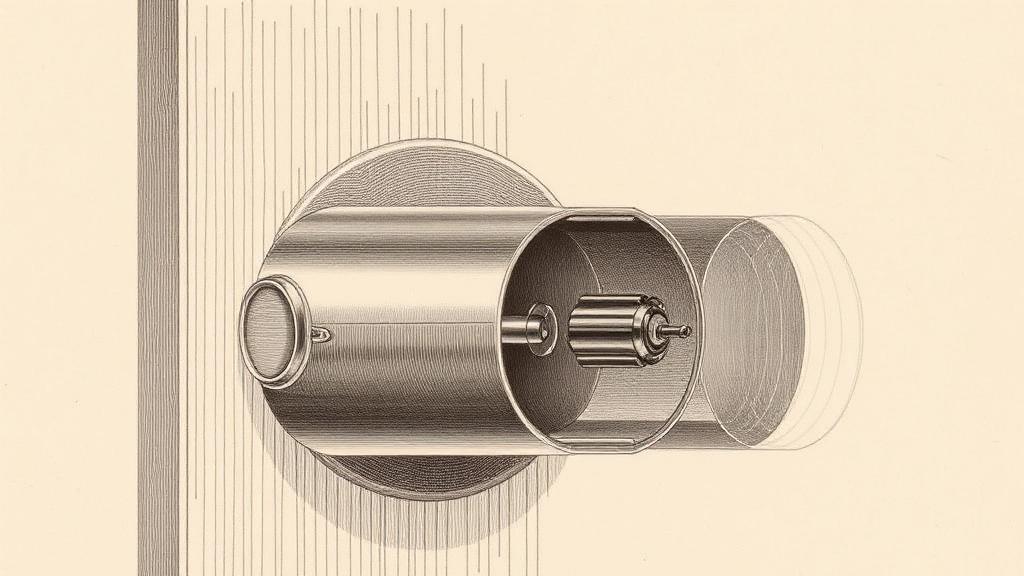
The hands-free deadbolt, or what ultra-wideband did to the front door
In January 2025, at the Consumer Electronics Show in Las Vegas, Schlage set a deadbolt on a door frame and demonstrated what it did. You walked toward it with your hands full; at three feet, without touching anything, the lock disengaged. The chip doing the work was an ultra-wideband radio the size of a grain of rice — the same one Apple had been shipping in every iPhone since the iPhone 11 in September 2019. Nobody had put it in a front door before.
Ultra-wideband is a radio standard the FCC authorized for unlicensed use in the United States in February 2002, covering frequencies from 3.1 to 10.6 GHz. Where Bluetooth can estimate whether a device is near or far, and NFC works only at contact range, UWB measures the time a radio pulse takes to travel between two devices and return — a technique called two-way ranging — to an accuracy of centimeters. It reports not just distance but angle and direction. It is, in effect, a tape measure that works through walls and pockets.
Apple’s U1 chip arrived in the iPhone 11 in September 2019. For two years its main consumer application was AirTags, the item-finding tags launched in April 2021 that used UWB to point a directional arrow toward whatever you’d misplaced. The residential front door would wait.
Apple HomeKey launched with iOS 15 in September 2021 as an NFC credential system: tap your iPhone or Apple Watch against the lock reader, the Secure Enclave presents a signed token, the lock opens. The credential can’t be copied and can be revoked from the Wallet app. Hyatt was the first hotel chain to adopt it, in December 2021; Schlage’s Encode Plus followed in early 2022 as the first NFC HomeKey residential lock. The tap was still required.
iOS 18, released September 16, 2024, added UWB proximity unlock to HomeKey. The difference: instead of waiting for a tap, the lock could now track your approach and act on intent. Schlage’s Sense Pro, announced at CES in January 2025, runs a system the company calls Converge: its UWB radio measures your speed, trajectory, and angle of approach and fires the unlatch at the threshold — before your hand reaches the handle. A trajectory that curves away gets ignored. The lock shipped June 29, 2026, eighteen months after CES, after enough observers had questioned whether UWB HomeKey would ever arrive in a consumer product to make the appearance notable.
The Secure Enclave credential still protects the mechanism. What changed is the gesture. For every lock in six thousand years — Egyptian wood pegs, Roman wards, Barron’s steel tumblers, Yale’s precision cylinders, Schlage’s own earlier deadbolts — you had to present something: insert, lift, turn, tap. The Sense Pro is the first residential lock that asks nothing.
The key has been in your pocket since 2019. Only the door took this long to notice.
Sources
- Ultra-wideband — Wikipedia — FCC authorization (February 2002), frequency range (3.1–10.6 GHz), two-way ranging technique, Apple U1 chip introduction in iPhone 11 (September 2019).
- Use digital keys in Wallet on iPhone — Apple Support — HomeKey credential architecture, Secure Enclave storage, NFC and UWB unlock modes, iOS 15 launch.
- New Schlage Smart Lock Supports Apple’s iOS 18 Hands-Free Unlocking With UWB — MacRumors, January 2025 — CES 2025 announcement, iOS 18 UWB HomeKey feature, Converge algorithm details.
- Schlage Sense Pro Smart Lock Arrives With Apple Home Key UWB — iDropNews — June 29, 2026 ship date, $399.99 price, Converge technology, 18-month gap from announcement to launch.