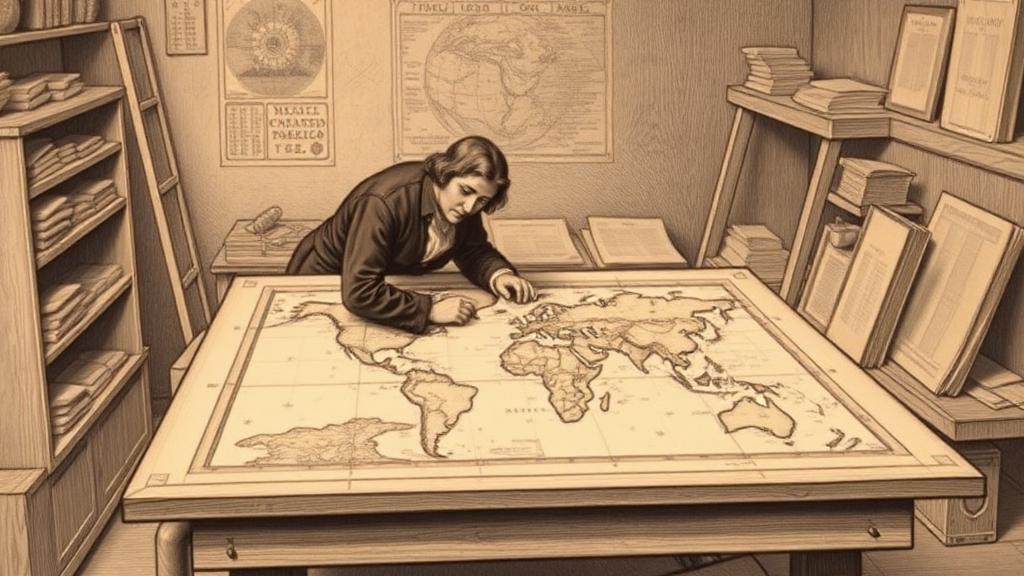
The map that named America
In the spring of 1507, in a printshop in Saint-Dié-des-Vosges — a modest Lorraine town in the foothills of the Vosges — a German cartographer named Martin Waldseemüller assembled twelve freshly inked sheets into a world eight feet wide. When he stepped back and looked, he saw something no map had yet shown: two immense continents in the western ocean, bounded on both sides by open water, entirely separate from Asia. Printed across the lower landmass, in careful Roman type, was a single word that had never appeared on any map before: AMERICA.
Behind the map was the Gymnasium Vosagense, a small humanist collective of scholars and printers sponsored by Duke René II of Lorraine. Waldseemüller was its cartographer; Matthias Ringmann, an Alsatian classicist in his mid-twenties, supplied the Latin and almost certainly wrote the companion text, a slim volume called Cosmographiae Introductio published alongside the map in April 1507. That book explained the naming: the new continent would honor Amerigo Vespucci, the Florentine navigator whose 1501–1502 voyage down the Brazilian coast had persuaded him — and through him, the scholars in Saint-Dié — that this was not Asia but a fourth landmass entirely.
The name was Latin feminine, constructed to match Europa, Asia, and Africa (Wikipedia). Ringmann, trained in classical languages where Waldseemüller was not, likely coined the exact formulation. The woodcut map ran to roughly 1,000 copies and, when its twelve sections were assembled, measured 4½ by 8 feet — the largest printed world map of its era. Among its more startling features was a broad ocean to the west of the Americas, depicted with apparent confidence at least six years before Balboa crossed the Darién isthmus and confirmed it with his own eyes in 1513.
Then Waldseemüller changed his mind. His 1513 Ptolemy atlas dropped the name entirely, relabeling the continent “Terra Incognita” and adding a note about Columbus’s prior discovery. His 1516 Carta Marina omitted “America” altogether. Spain had refused the name for years, insisting Columbus deserved the credit, and perhaps Waldseemüller felt the pressure (Smithsonian Magazine). He died around 1520 without leaving an explanation. The sole surviving copy of the original map slept in the tower garret of Wolfegg Castle in Württemberg until July 17, 1901, when a Jesuit historian named Father Joseph Fischer found it tucked inside a beechwood binding, bearing the 1515 bookplate of astronomer Johannes Schöner.
The 1507 copies, already distributed across European scholarly networks, were beyond recall. Cartographers kept copying the name — first onto South America, then, by 1538, onto both continents, when Gerhard Mercator settled the matter by printing “America” across the full Western Hemisphere. What Waldseemüller’s map had fixed, in woodcut and ink, was the idea of the Western Hemisphere as a distinct, bounded, nameable thing — a concept that every subsequent map, atlas, and globe would inherit. The Library of Congress purchased the Wolfegg copy in 2003 for ten million dollars.
The continent had its name. The next problem was how to show its coastline without bending the truth too far — and that would take another sixty years to solve.
Sources
- Waldseemüller map — Wikipedia — map dimensions, print run, 12-sheet woodcut, naming convention, 1513 Terra Incognita reversal.
- The Waldseemüller Map: Charting the New World — Smithsonian Magazine — Ringmann’s authorship of Cosmographiae Introductio, Wolfegg Castle discovery by Father Fischer, Library of Congress acquisition.