Walyalup Bridge: Australia's first extradosed bridge
Jan Middleton was teaching a colleague to drive in 1956 when the car hit a patch of wet oil on the Fremantle Traffic Bridge, skidded, and dropped ten metres into the Swan River. All three occupants hauled themselves out with nothing worse than bruised bones. Seventy years later, Middleton — now ninety-two — was among the first walkers to cross the bridge that replaced it.
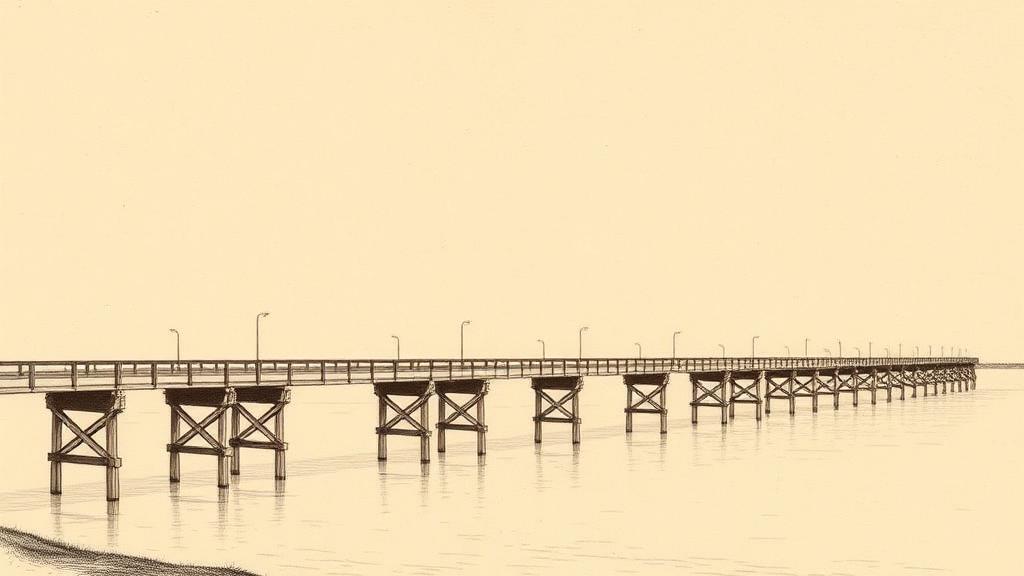
The bridge she remembered opened on December 15, 1939. Its defining feature was not its span or its design but its material: timber. The government had priced two versions — £A 75,000 in timber, £A 650,000 in concrete — and chose accordingly, reasoning that expansion of Fremantle Harbour further east would render the crossing obsolete within a generation. The temporary bridge outlasted the harbour expansion, three generations of engineers, and most of the people who built it, eventually carrying 30,000 vehicles a day across 24 timber piers sunk into the Swan River. By 2016, the structure was eighty-seven years into a lifespan that was never supposed to exceed twenty.
It closed on February 1, 2026. By then, the Walyalup Bridge — Walyalup being the Whadjuk Noongar name for the country around Fremantle, from walyo, the word for the woylie, a small marsupial once common in the scrubland here — was already being assembled alongside it. The proximity was deliberate: by engineering the construction sequence so that demolition and new construction overlapped, the team reduced the river-crossing closure from an estimated eighteen months to nine, delivering the bridge four months ahead of the original schedule.
What they built is Australia’s first extradosed bridge. The form is a structural hybrid: the main deck — a stiff prestressed concrete box girder — carries sixty to seventy percent of live load in bending, the way a conventional cantilever span does. Short towers, rising only seven to thirteen percent of the main span’s height, carry the remainder through external cables. The result looks almost demure compared to a full cable-stayed bridge; the towers are low enough that the river’s skyline reads as open water, not a forest of steel. The form had never been built in Australia, so Arup embedded European specialists — engineers with direct experience building extradosed bridges elsewhere — to collaborate with the local team on design and detailed engineering. The concrete segments were precast offsite and lifted into place on the Swan River.
The numbers on the river tell their own story. The old bridge: 24 piers. The new bridge: 2 piers, a 117-metre main span, 9 metres of clearance for boats. Kayakers and sailboats that once threaded carefully between timber columns now have a river that feels, for the first time in nearly ninety years, navigably open.
On November 1, 2026, more than 15,000 people walked across before a vehicle touched the deck.
The engineers in 1939 built a temporary bridge. It stood for eighty-seven years. The bridge that replaced it carries a name that was here long before either of them.
Sources
- Walyalup Bridge — Wikipedia — engineering specifications, construction timeline, Noongar etymology of the name, cost history, opening date.
- Swan River Crossings Fremantle Traffic Bridge — Arup — extradosed bridge design principles, European specialist involvement, precast segmental construction, overlap construction sequencing that halved closure time.
- Fremantle Traffic Bridge — Wikipedia — history of the 1939 timber bridge, timber-vs-concrete cost decision, 24-pier count, 30,000 daily vehicles by 2016, closure date.
- Walyalup Bridge: Jan Middleton — ABC News — Jan Middleton’s 1956 crash on the old bridge and her crossing the new one at 92; opening day attendance figures.