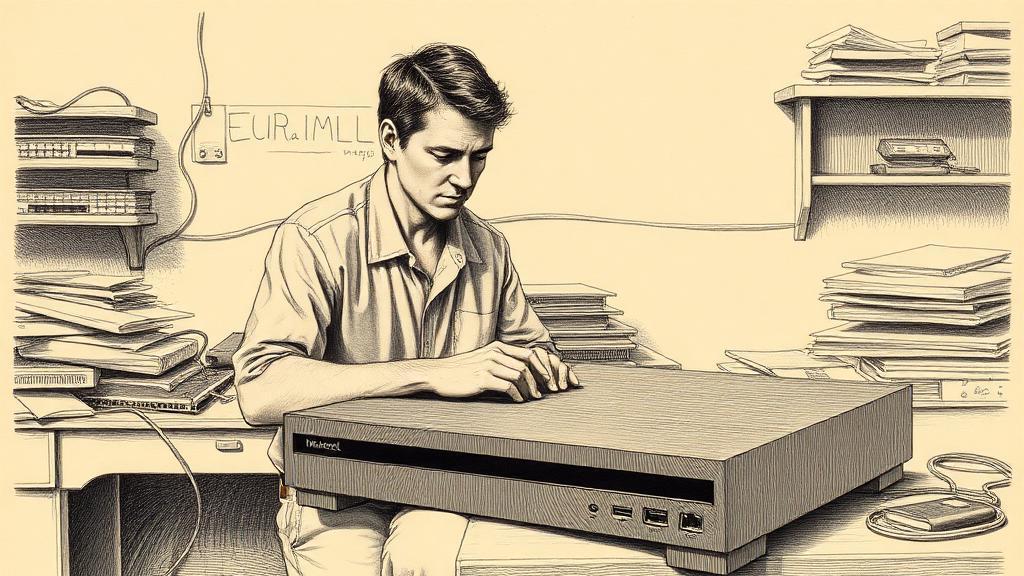
The original Xbox, or how Microsoft lost four billion dollars and still won
Bill Gates walked onto the Consumer Electronics Show stage in Las Vegas on January 3, 2001, with Dwayne “The Rock” Johnson at his side, to introduce an eight-and-a-half-pound matte-black box. The crowd applauded. Johnson flexed. Microsoft was getting into the console business.
The project had its roots three years earlier, inside Microsoft’s DirectX division. In 1998, four engineers — Seamus Blackley, Kevin Bachus, Ted Hase, and Otto Berkes — watched Sony announce the PlayStation 2 and felt the particular unease of watching a competitor move into your territory (Wikipedia). Sony was pitching the PS2 not as a game machine but as the living-room entertainment hub — a category Microsoft had long considered its own. The engineers drafted a proposal, walked it up the org chart, and eventually got it in front of Bill Gates, who approved the budget.
What Blackley’s team built was, in every essential way, a PC in a console case. The processor was an Intel Pentium III running at 733 MHz; the graphics came from a custom Nvidia chip derived from the GeForce 3 (Video Game Console Library). Two features set it apart from every console before: an eight-gigabyte hard drive, standard on every unit — no memory card required, no save-game limits imposed by a 256-kilobyte cartridge — and a 100-megabit Ethernet port, built in, not optional. You could rip a CD to the drive and play your own music through any game. Microsoft was already building the service that would use the other port.
The Xbox launched on November 15, 2001, at $299, alongside Halo: Combat Evolved — a first-person shooter from Bungie that Microsoft had acquired in 2000 and converted into a console exclusive. Bungie had been developing Halo for the Mac; Steve Jobs had demoed it at Macworld in 1999. Microsoft bought the studio and redirected the project entirely. Halo moved eight million copies and gave the Xbox a reason to exist beyond its spec sheet.
By any conventional measure, the original Xbox was a financial disaster. The PlayStation 2 outsold it roughly four to one, moving more than 106 million units worldwide to Xbox’s 24 million — Japan barely bought Xboxes at all (Wikipedia). Microsoft lost approximately four billion dollars on the platform.
And yet. On November 15, 2002 — exactly one year after launch — Microsoft switched on Xbox Live, the first online gaming service built into a console from the hardware design up. Within two months, 250,000 subscribers were playing on matchmade servers with voice chat and persistent friends lists. None of it required a separately purchased network adapter, or a modem port hidden on the back panel, or a per-game online scheme stitched together by individual developers. The Ethernet jack that Blackley had insisted on — the one that looked like overengineering in 2001 — turned out to be the point.
The four billion dollars bought Microsoft a permanent seat at the console table. That seat has not been vacated since.
Sources
- Xbox (console) — Wikipedia — development history, key personnel (Blackley, Bachus, Berkes, Hase), CES 2001 unveiling, launch date and price, PlayStation 2 vs Xbox sales figures, four-billion-dollar loss estimate.
- Original Xbox (2001) — Video Game Console Library — hardware specifications, built-in HDD and Ethernet innovations, Xbox Live launch and subscriber growth figures.