Ytterbium at sea
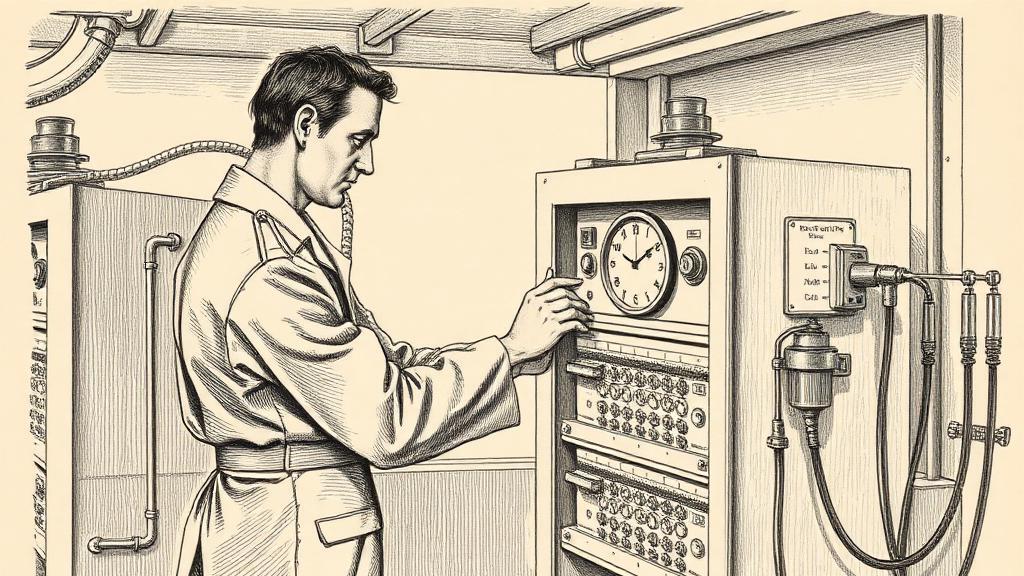
In July 2024, in the swells off the coast of South Australia, a rack of equipment in the hold of ADV Sycamore was doing something no ship had ever hosted before. A laser was cooling a beam of ytterbium-171 atoms to near absolute zero, slowing them until they could be interrogated at the frequency of a specific transition between two atomic energy levels — a line 10 millihertz wide, oscillating 518 trillion times every second. It was, in every technical sense, an optical atomic clock. It was also the first one ever to operate at sea.
The machine came from the Institute for Photonics and Advanced Sensing at the University of Adelaide, where Professor André Luiten and his team had spent years compressing what normally fills a laboratory’s worth of vibration-isolated optical tables into a single rack that could survive a working ship. “We have pushed everything to its limits,” Luiten said. The Defence Science and Technology Group provided part of the funding. The question they were testing was whether the clock would still be a clock once it left the lab.
After several continuous days at sea, it was. The device maintained the same stability it had shown on solid ground — no drift, no degradation — despite the pitch, roll, temperature shifts, and mechanical noise that come with being underway. The results appeared in Optica in April 2026, described as the first demonstration of a laser-cooled optical atomic clock operating in a maritime environment.
The IPAS clock isn’t the most precise timekeeper ever built — the laboratory standards at NIST and the Physikalisch-Technische Bundesanstalt beat it by several orders of magnitude. But those machines weigh hundreds of kilograms, require temperature-controlled rooms, and sit on isolation platforms that would be useless under three-metre swells. The ADV Sycamore trial wasn’t about setting records. It was about crossing the border between laboratory physics and the physical world.
John Harrison spent 34 years trying to cross the same border with springs and levers. His H4, completed in 1759, was the first clock precise enough to determine longitude at sea — a silver pocket watch that lost only 5.1 seconds over 81 days between Portsmouth and Kingston, Jamaica. Harrison would not have recognised the IPAS device as a clock. He would have recognised immediately what it was for.
The use cases are not speculative. A ship navigating without GPS — because signals are jammed, compromised, or simply unavailable in contested waters — needs an independent time reference to compute its position. A portable optical clock that holds close-to-lab precision at sea provides one. The same technology could keep distributed radio telescopes synchronised across continents, maintain coherent communications for submerged submarines, and eventually move from naval vessels into the civilian shipping and aviation infrastructure that GPS dependencies have made quietly fragile.
Harrison’s H4 is in a display case at the Royal Observatory in Greenwich. The problem it solved has not stayed in the case with it.
Sources
- Next-generation atomic clock successfully tested at sea — University of Adelaide — sea trial details, ADV Sycamore, Professor Luiten, and Defence Science and Technology Group funding.
- Next-generation atomic clock successfully tested at sea — Phys.org — independent coverage; publication in Optica (DOI: 10.1364/OPTICA.584095), first maritime demonstration claim.
- Portable laser-cooled ytterbium beam clock — arxiv 2603.25261 — technical paper; Yb-171 1S₀→3P₀ transition at 10 mHz linewidth, stability of 1.9×10⁻¹⁵ at 200 s.