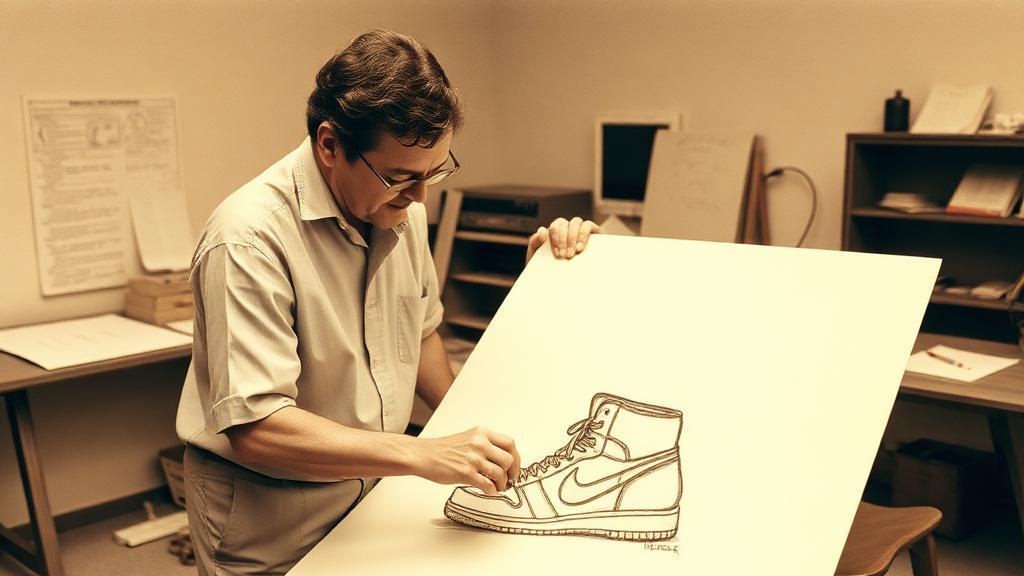
The Air Jordan I: the $5,000 fine Nike paid gladly
Before the Air Jordan existed as a retail product, it existed as a violation. In October 1984, Michael Jordan wore a black-and-red prototype called the Air Ship into an NBA preseason game, and the league noticed — not because of how Jordan played in them, but because of the color.
Jordan had not wanted to be at Nike. He preferred Adidas and had told his agent, David Falk, to make that happen. When Adidas declined — the company was mid-transition after Adi Dassler’s death earlier that year — Falk tried Converse. They offered $100,000 annually and a place on the roster alongside Magic Johnson and Larry Bird (Wikipedia). Jordan visited, listened, and left unimpressed. Signing with Nike required a different lever: Falk called Jordan’s mother, Delores, and asked her to talk her son into visiting Beaverton.
Nike’s offer was $2.5 million plus royalties — triple any NBA player’s going rate at the time. Jordan signed in October 1984. He was twenty-one years old.
Nike’s creative director, Peter Moore, had designed the shoe before the contract was finalized. He drew from the Adidas Forum — Jordan’s own preferred shoe — borrowing its cross-ankle strap, then chose the Chicago Bulls’ red, black, and white for the colorway. Jordan resisted; he wanted Carolina blue. Moore held firm. His stated goal was to break the color barrier in footwear: before the Air Jordan, roughly 99% of basketball shoes came in white (Peter Moore Created). The result was a leather high-top that looked, on a 1984 NBA court, like a minor provocation.
The NBA treated it as one. On February 25, 1985, the league cited the “51% rule”: shoes must be at least half white and match teammates’ footwear. Jordan’s colorway came in at 23% white. The fine was $5,000 per game (Wikipedia). Nike paid every one, then built an advertising campaign around the letters. The ad copy read: “On September 15th, Nike created a revolutionary new basketball shoe. On October 18th, the NBA threw them out of the game.” There is a detail worth noting: Jordan was almost certainly wearing the Air Ship during actual games — not the Air Jordan I itself. The proper Banned colorway of the AJ1 appeared in public exactly once before retail, at the 1985 NBA Dunk Contest. Jordan won.
The Air Jordan I went on retail sale April 1, 1985, at $65 — about twice the going rate for a basketball shoe. Nike had projected $3 million in sales over three years. In the first six weeks, they shipped 1.5 million pairs; by year’s end the line had earned $126 million (Temple University). More durable than the revenue was the structure underneath it: a shoe named after one athlete, styled to his team’s colors, sold entirely on his personality rather than any product claim. Every athlete-as-brand contract since — from Kobe Bryant to LeBron James — runs on the template that Falk and Nike assembled in Beaverton in 1984.
The NBA stopped enforcing the uniform rule before the season was out. By then, the fine had done more for the shoe than any advertisement could have managed on its own.
Sources
- Air Jordan — Wikipedia — Nike contract terms, the Converse offer, NBA rule details, fine amount, Air Ship vs. Air Jordan I distinction, first-year sales figures.
- 40 Years from Lift-off — Peter Moore Created — Moore’s design process, the Adidas Forum influence, the color strategy, Jordan’s preference for Carolina blue.
- How Michael Jordan revolutionized the sneaker industry — Temple University — First-year sales context and the cultural shift to athlete-as-brand marketing.