Hello, Macintosh: the computer that spoke for itself
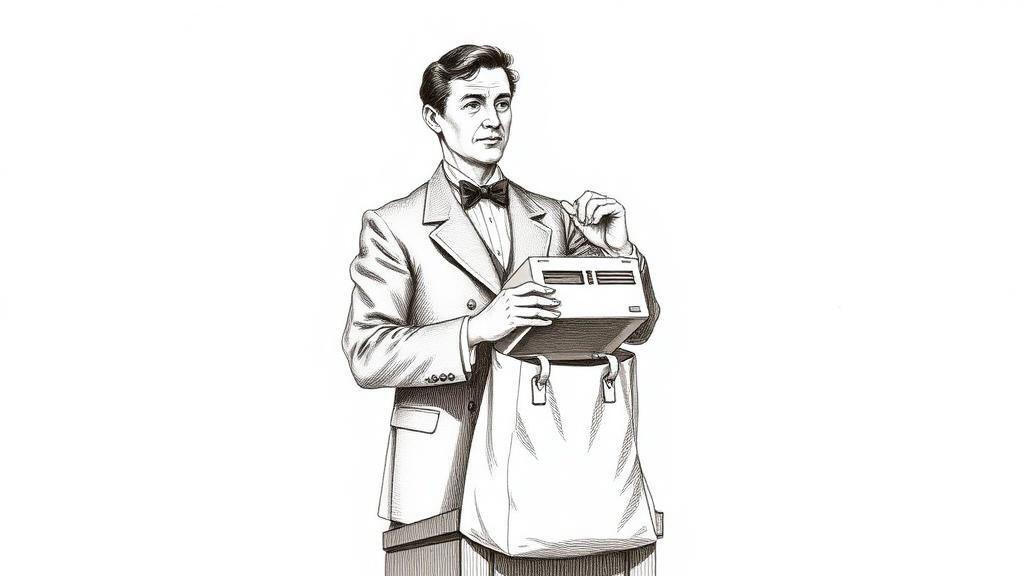
Steve Jobs stood at the Flint Center for the Performing Arts at De Anza College, Cupertino, on January 24, 1984, wearing a double-breasted suit and a bow tie, and reached into a canvas bag on a table. What came out was a beige box roughly the size of a bread loaf, with a carrying handle molded into the top and a 9-inch screen on its face. He slid a floppy disk into the slot, stepped back, and let the machine do the talking.
The screen filled with a cascade of graphics. Then, in a raspy synthesized voice, the box spoke: “Hello. I’m Macintosh.” The audience — roughly 2,500 of them — erupted. The speech had been written by Andy Hertzfeld, one of the Mac’s principal software engineers, as a surprise: the machine would introduce itself rather than wait to be introduced.
The project had begun in September 1979 with Jef Raskin, Apple’s employee #31 — a former UCSD professor who joined the company in January 1978 to write its BASIC manual and pivoted, within months, to designing computers instead. His proposal to management was radical for the time: a sealed, low-cost appliance for ordinary people, with a graphical interface instead of a command line. He named it after his favorite eating apple, the McIntosh, and recruited Burrell Smith, Bill Atkinson, and Joanna Hoffman. Then Steve Jobs, freshly bounced from the higher-profile Lisa project, arrived and took over. Raskin resigned by mid-1981. The irony is not subtle: he had opposed both the mouse and the Motorola 68000 processor — the two design choices that actually made the Macintosh work.
What shipped on January 24 ran on that 68000 at 7.8 MHz, with 128 kilobytes of RAM, a 512 × 342 monochrome display, and a 400-kilobyte 3.5-inch floppy. It cost $2,495 — roughly $7,700 today — and came bundled with MacWrite and MacPaint to show off what a graphical interface could actually do. Two days before the launch, a 60-second commercial directed by Ridley Scott had run once during Super Bowl XVIII: a woman in orange shorts hurling a sledgehammer at a screen projecting an authoritarian figure through a grey dystopia. The ad never named Apple. It didn’t need to.
Inside the finished case, Jobs had insisted on one last detail: the molded-in signatures of all 47 members of the development team. The reasoning was plain — artists sign their work. The team’s feelings about their director were complicated (the hours were brutal, the standards shifted daily, and Jobs had a habit of calling the same code “brilliant” one week and dismissing it the next), but they signed anyway.
The Mac brought the graphical user interface to the mass market — not as an invention; the GUI had been pioneered at Xerox PARC in the early 1970s — but as a product that a dentist or a college student could actually buy. Desktop publishing followed almost immediately: PageMaker shipped in July 1985, and within two years the Mac had become the production tool of choice for magazines, newspapers, and anyone else who needed to lay out text next to pictures without employing a typesetter.
The machine that introduced itself in 1984 was making a quiet argument: that a computer should address the person in front of it, not the other way around. More than forty years on, every screen in your pocket is still making that same case.
Sources
- Macintosh 128K — Wikipedia — launch date, price, technical specifications, the Super Bowl ad, team signatures.
- The Father of the Macintosh — Folklore.org — Jef Raskin’s founding of the project, his opposition to the mouse and 68000, Andy Hertzfeld’s role writing the opening speech.
- 1984 — Computer History Museum — historical context, Macintosh as the first successful mass-market GUI computer, significance for personal computing.