Aliro 1.0: the open standard that ended the key wars
The Aqara U400 smart lock shipped in 2025 with a capability that felt like the future — step toward your door with an iPhone in your pocket and it opened itself, no gesture, no tap. Do the same thing with a Samsung Galaxy and you reached for the PIN pad instead. Not because the hardware was different. Because the credential standard running inside the lock was Apple’s proprietary HomeKey, and HomeKey only talked to Apple devices.
On February 26, 2026, the Connectivity Standards Alliance released Aliro 1.0 (CSA official announcement). The CSA had already proved it could corral competitors into a shared standard: Matter, released in 2022, united rival smart home ecosystems around a common device protocol. Aliro extended that approach to access control. The project was announced in November 2023 alongside a founding partnership with ASSA ABLOY; by the time the 1.0 specification landed, more than 220 member companies had contributed — Apple, Google, Samsung, Allegion, HID Global, Kwikset, Nordic Semiconductor, Nuki, and a range of chip vendors and building security firms.
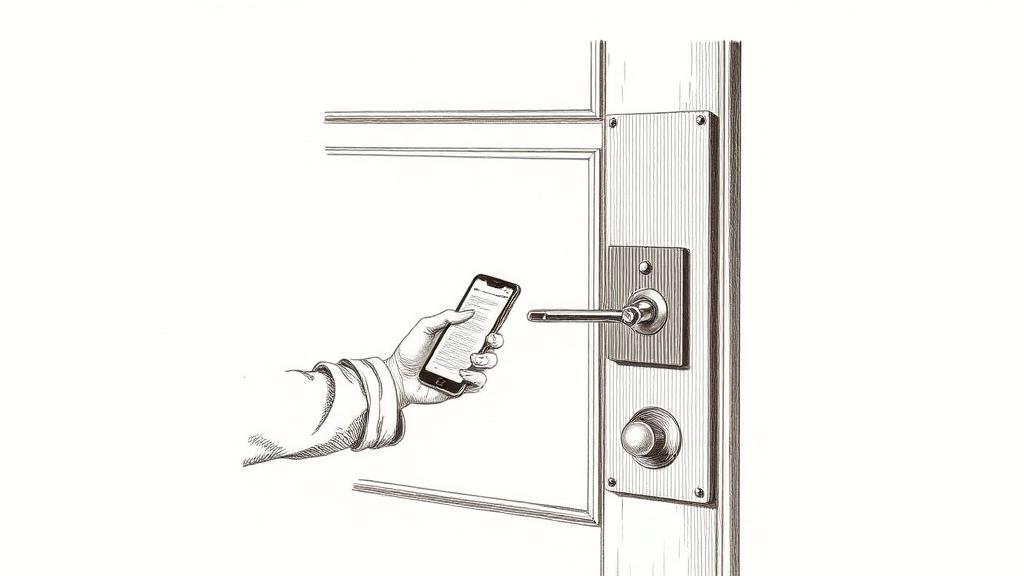
Aliro is a credential and communication standard — not an app, not a hardware platform. A lock manufacturer builds to the Aliro specification once. The resulting credential lives in whichever wallet the owner uses: Apple Wallet, Google Wallet, Samsung Wallet. The same credential opens the door via tap (NFC), a deliberate approach with phone in hand (Bluetooth LE), or hands-free as you walk up (Bluetooth LE plus Ultra-Wideband). The credential uses asymmetric cryptography: the lock stores only the public certificate and never sees the private key (MacRumors).
Beneath the standards-body language, Aliro is something specific: Apple HomeKey, opened up. Apple’s credential system had set the bar for elegance — tap or walk up, door opens — but manufacturers wanting those features had to negotiate directly with Apple, and the result was a market that sorted customers by phone brand. Aliro is what happens when the rest of the industry stops negotiating and starts standardizing. CSA president Tobin Richardson called it plainly: “Aliro is solving the fragmentation that has held back digital key adoption, replacing it with a single interoperability standard built through Alliance Member collaboration” (CSA press release).
The scope extends well past residential front doors. Hotels, office buildings, universities, hospitals, and gym locker rooms are all within Aliro’s design brief. A single credential in a digital wallet can, in principle, open every door its holder is authorized to pass through — apartment lobby, office elevator bank, server room — regardless of who manufactured the hardware (Apple Insider).
The Egyptian wooden lock made the question physical: the right key lifted the right pins. Aliro makes the question cryptographic: the right certificate satisfies the right public key. Six thousand years later, the lock still doesn’t care who you are. It only cares whether you can prove it.
Sources
- Introducing Aliro 1.0 — CSA — official announcement, February 26, 2026; founding member list, technical specifications (NFC/BLE/UWB, asymmetric cryptography), Tobin Richardson’s statement on fragmentation.
- Aliro 1.0 press release — PR Newswire — 220+ member count, founding companies (Apple, Google, Samsung, ASSA ABLOY, Infineon), executive quotes.
- Aliro 1.0 released — MacRumors — credential mechanism details, wallet integration (Apple/Google/Samsung), expected first certified products.
- Apple Home Key comes to everyone — Apple Insider — Aqara U400 Apple-only limitation, how Apple HomeKey’s proprietary model led to Aliro, scope expansion (offices, hospitals, gyms).