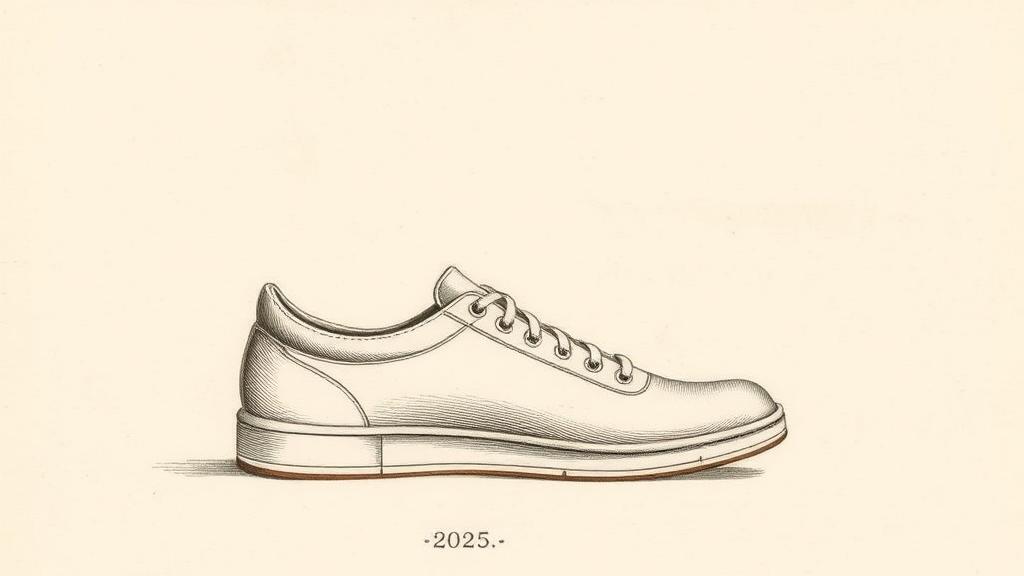
The shoe that owed the atmosphere nothing
On February 5, 2025, five shoe stores on four continents each took delivery of exactly one hundred pairs of a plain white slip-on with no laces. The M0.0NSHOT Zero retailed for $200. It was certified by a New Zealand environmental body called Toitū Envirocare to carry a carbon footprint of 0.0 kilograms of CO2 equivalent. The average sneaker emits 14 kilograms — roughly thirty pounds of greenhouse gas, built into something you put on your feet and walk away in.
Allbirds had spent three years getting to zero. The project began in 2022, when co-founder Tim Brown started asking what it would actually take to eliminate emissions rather than offset them. Carbon offsets — buying credits linked to some distant tree plantation — are accounting. Brown wanted engineering. A prototype appeared at the Global Fashion Summit in Copenhagen in June 2023 as a gray, unnamed thing. Then came eighteen months of work to close the gap between “feasible in prototype” and “something a store can sell.”
The answer required a specific farm. Lake Hawea Station occupies 6,505 hectares in New Zealand’s Queenstown Lakes District, where roughly ten thousand purebred Merino sheep graze on land managed through regenerative practices: native forest protection, supplementary planting, pest control. In April 2021 it became the first farm in New Zealand certified carbon-zero by Toitū Envirocare — not by offsetting, but by sequestering more carbon in its native forests than it emits in all operations. A company called CarbonCrop monitors the sequestration using satellite imagery and machine learning across more than a million data points. The wool those sheep produce is climate-positive before it leaves the paddock.
That wool becomes the M0.0NSHOT’s upper. The midsole is Allbirds’ own sugarcane foam, carbon-negative since the company first introduced it. The eyelets are bioplastic derived from captured methane — a greenhouse gas converted into hardware. The packaging is sugarcane-based. As for laces: the designers removed them. Not as a style decision, but because the synthetic cord and plastic tips were the last component the team could not clean up sufficiently to hold the certification. The absence of laces is the most visible mark of the constraint.
The launch came with a recipe book. Allbirds published the full methodology on the same day it released the shoe — materials specifications, farm partnerships, the carbon accounting framework — specifically so that competitors could replicate it. Sustainability director Hana Kajimura framed it as the point: this was not a niche to protect, but a threshold to prove was crossable. Tim Brown was direct: “We really want you to take our work and apply it to your own products.” Nike, Adidas, and the rest of the industry received a working playbook on launch day.
Whether that generosity was idealistic or strategically rational is a reasonable argument. Either way, the M0.0NSHOT had settled one question: zero-carbon footwear is not a speculative ambition. It is a materials problem with a known solution, worked out at a farm in the Queenstown Lakes, a sugarcane field, and a methane capture facility. Every shoe designed after February 5, 2025 has a number to beat.
Sources
- Inside Allbirds’ net-zero shoe claim — Trellis — Development background, materials breakdown, open-source launch, Tim Brown and Hana Kajimura quotes, Lake Hawea Station partnership, Toitū Envirocare certification details.
- Allbirds creates zero-carbon shoe — Retail Dive — Copenhagen prototype debut (June 2023), development timeline, pricing rationale.