Chenab Rail Bridge, or how to build a record where roads don't exist
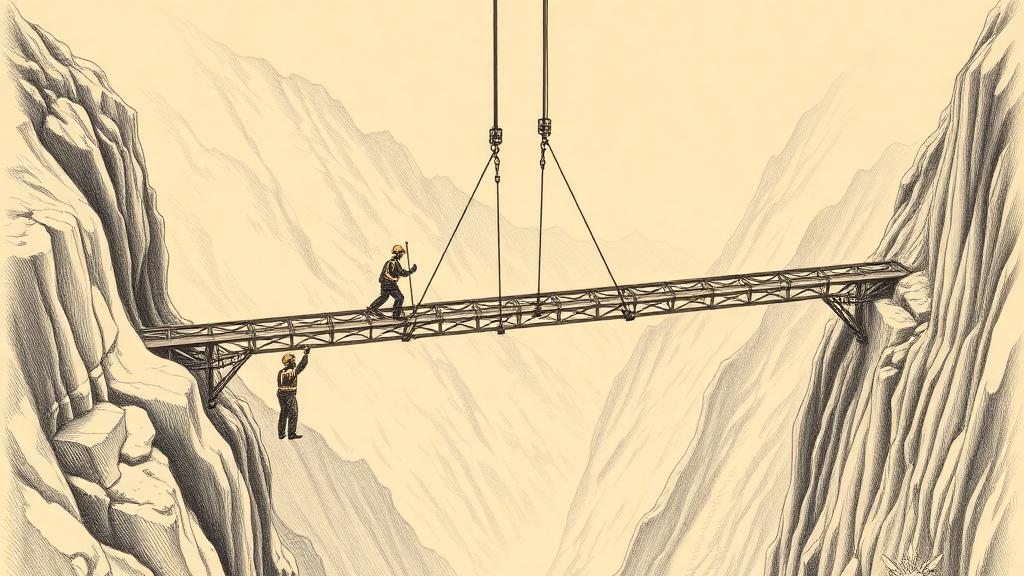
The two halves of an arch met in midair on April 5, 2021, 359 meters above the Chenab River in the Reasi gorge of Jammu and Kashmir. Workers on opposite banks had been building out simultaneously for months — cable cranes holding steel trusses against Himalayan winds while welders walked the slowly extending ribs toward each other. When the crown bolt went home, India had the tallest railway bridge in the world. Its deck sits 29 meters higher than the top of the Eiffel Tower, which had been the world’s most famous tall iron thing for the better part of a century and presumably had opinions about the comparison.
The Chenab Rail Bridge stands between Bakkal and Kauri stations in Reasi district — the most hostile single stretch of the Udhampur–Srinagar–Baramulla Rail Link, a project India had been attempting since 2003. The problem was the gorge: nearly 400 meters deep, its fractured limestone walls sitting in Seismic Zone V (India’s highest earthquake-risk classification), with no paved road anywhere near the site. The first survey teams reached the gorge by mule.
The specifications that eventually emerged were unusual even by record-breaking standards. The main arch spans 467 meters across the gorge — India’s largest steel arch — while the full structure runs 1,315 meters end to end using 28,660 tonnes of steel and 66,000 cubic meters of concrete. WSP Finland and Leonhardt, Andrä und Partner of Germany handled the arch design; IISc Bengaluru did the foundation analysis; IIT Delhi and IIT Roorkee split the seismic work. The design life is 120 years.
Some of those specifications cross into territory that most bridge engineers never encounter. The structure is rated to survive a magnitude-8.0 earthquake, winds of 266 km/h, and blasts equivalent to 40 tonnes of TNT — that last criterion added because the bridge sits not far from the Line of Control with Pakistan. The steel plates in the most exposed sections are 63 millimeters thick.
L. Prakash, the chief engineer, came from Mysore, where he had spent his career in the gentler terrain of the Western Ghats. The Reasi gorge was something else. Before a single concrete pier could be poured, his team built 23 kilometers of access roads — 11 on each bank — so that trucks could reach the site at all. Construction was suspended from 2008 to 2010 after safety reviews found the original alignment inadequate. When work resumed, the project established an on-site NABL-accredited testing laboratory — the first such facility on any Indian Railways project — to monitor every concrete pour and every weld in real time.
On June 6, 2025, Prime Minister Narendra Modi inaugurated the bridge, and the first Vande Bharat Express crossed from Katra to Srinagar. Until that morning, no continuous rail line had reached the Kashmir Valley. Anyone traveling by train had to transfer to a road for the final leg across the mountains — a gap the USBRL project had been working to close for more than twenty years.
The mules that carried the first surveyors into the gorge are long retired. The arch they made possible will be carrying trains until at least 2145.
Sources
- Wikipedia: Chenab Rail Bridge — dimensions, timeline, design team, seismic classification, and opening details
- Railway Technology: Chenab Bridge — engineering specifications, construction innovations, and material quantities
- Gulf News: From mules to machines — construction access challenges and chief engineer L. Prakash’s account of the site conditions