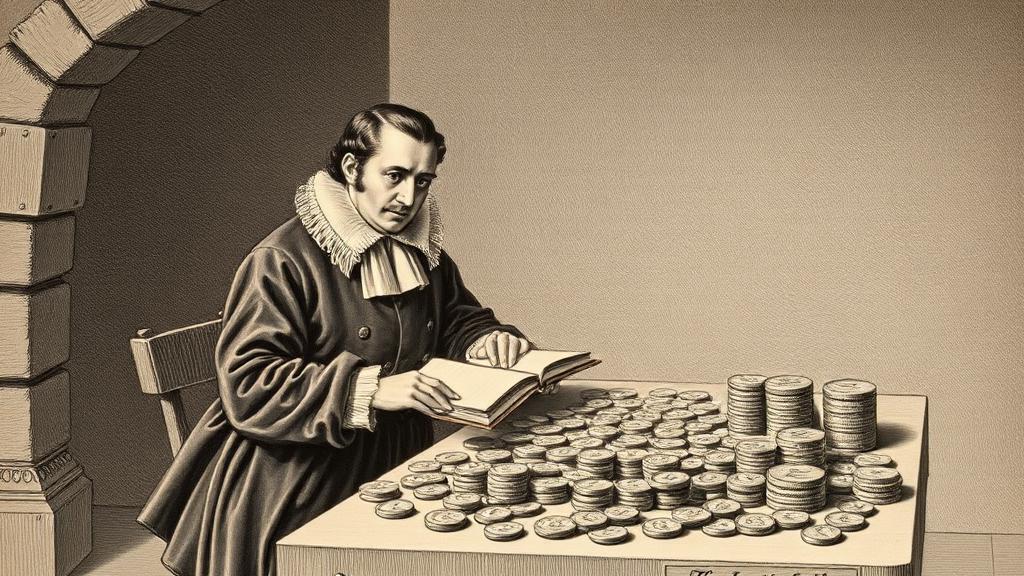
The Amsterdam Wisselbank, or where money learned to live in a ledger
On a January morning in 1609, a merchant on the Herengracht could arrive at his counting table carrying coin from nearly eight hundred distinct denominations — Spanish reals, Rhenish thalers, Flemish grosses, worn English crowns — struck across forty-eight different mints in the Dutch provinces alone, each metal slightly different, each fineness set by a separate standard, each edge possibly filed since it last changed hands. Before he paid his broker, someone had to weigh the pile. Commerce across the greatest trading harbor in the world had become a lengthy argument over metal.
On 31 January 1609, the Amsterdam city council opened the Wisselbank — the Exchange Bank — in the old city hall on Dam Square. (When the new city hall was built in 1655, the bank moved in too; that building is the Royal Palace today.) The mandate was narrow and direct: end the currency chaos. Merchants had been clipping, filing, and sweating coins for decades. A good Dutch guilder had effectively ceased to exist because no one could agree on which one counted.
The Wisselbank’s solution was to stop pretending that money was metal. A merchant brought his pile to the bank; assayers measured the actual silver content of each coin; the bank credited him with an account balance — “bank money” — denominated in a standardized guilder of known weight. The physical coins went into the vault. The account entry stayed with the merchant. When he needed to pay someone, he authorized a transfer between ledger entries. No coin moved. By the 1640s, deposits had grown from roughly one million florins in the first decade to eight million, and bank money traded at a consistent three-to-five percent premium over physical coin — because merchants valued the abstraction more than the metal it represented.
Adam Smith, writing in The Wealth of Nations in 1776, devoted several pages to the Wisselbank. Bank money, he observed, was “secure from fire, robbery, and other accidents” and “can be paid away by a simple transfer, without the trouble of counting.” What Smith did not know — and could not, since it emerged only when the French arrived and opened the books in 1795 — was that the bank had been secretly lending its reserves to the Dutch East India Company for decades, in direct violation of its founding principle of full reserve backing. By 1790 the premium evaporated, confidence collapsed, and the bank declared insolvency. The reserve system it claimed to uphold had been quietly abandoned from within.
The model outlived the institution. The Bank of England, founded in 1694, had already borrowed the Wisselbank’s central insight, and every central bank built since has inherited the same move: the separation of the unit of account from the unit of circulation. Before 1609, money meant physical metal you could weigh and bite. After 1609, it could mean a trusted number held in a register and moved by a pen stroke. Every wire transfer, every “funds available” notice, every clearing system that settles obligations without touching a coin is the ledger on Dam Square, very much scaled up.
The silver in the Wisselbank’s vault is gone. The number it was converted into never quite stopped running.
Sources
- Bank of Amsterdam — Wikipedia — founding date, structure, the bank money premium, the secret VOC loans, decline, and connection to modern central banking.
- The Bank of Amsterdam — Beursgeschiedenis.nl — founding context, VOC account, book-entry innovation, and legacy as an international reference currency.
- How the Bank of Amsterdam Changed Money — Tontine Coffee-House — Adam Smith’s Wealth of Nations quote, the 100% reserve principle, and deposit growth figures.