Pont Neuf: the bridge that gave Paris its river back
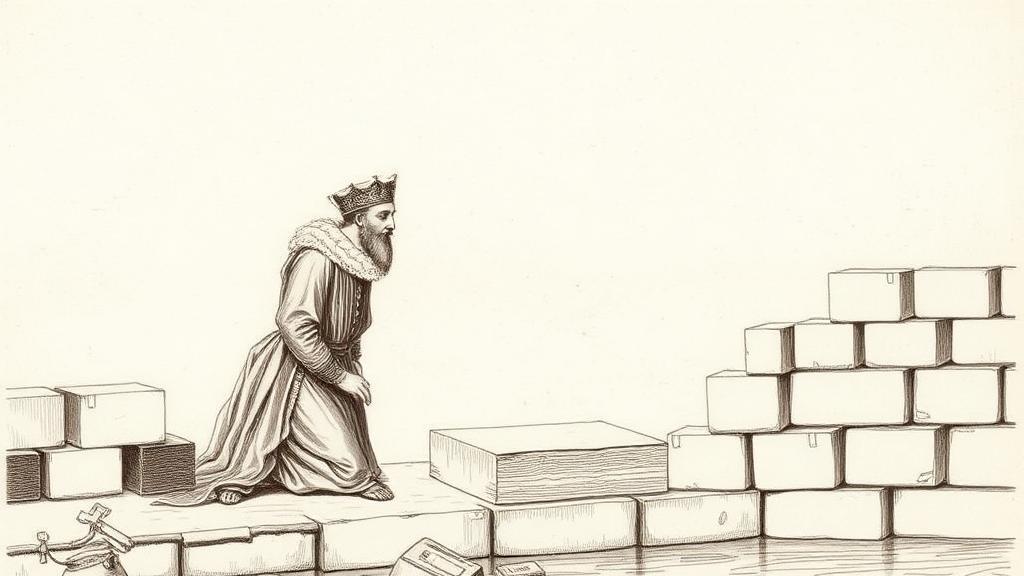
On 31 May 1578, Henri III of France waded into a construction site at the western tip of the Île de la Cité and placed the ceremonial first stone of a bridge across the Seine. Within ten years, he was dead, Paris was in open rebellion, and the twelve half-finished arches sat in the river collecting silt. The bridge was not finished. It was, for a while, barely started.
The project had been conceived under Henri II in 1550 and funded fitfully since 1577. Its designers — Baptiste Androuet du Cerceau and Guillaume Marchand — called for a double span of stone arches: seven connecting the island to the Right Bank, five to the Left, carrying a roadway 232 meters long and 22 meters wide. Henri IV, who had converted to Catholicism to win the throne and was engaged in the delicate work of making himself agreeable to a city that had lately been at war with him, resumed construction in 1599 and opened the bridge to traffic in 1604. He rode across it at the official inauguration in 1607, twenty-nine years after his predecessor’s stone-laying ceremony.
What struck contemporary Parisians about the completed bridge was what it lacked. Every bridge in medieval Paris supported houses — shopfronts and apartments crammed out to the parapets, whole neighborhoods suspended over the water. Henri IV ordered none of it. He wanted unobstructed views from the bridge toward the Louvre, so his commissioners left the deck clear and added raised pedestrian sidewalks on either side — the first in Paris, protecting walkers from mud and horses. The extra width required twelve semicircular bays, one projecting out over each pier, cantilevered above the river. Vendors claimed every one almost immediately.
By 1619 the commerce had grown vigorous enough that city merchants petitioned for a royal ban on trade conducted on the Pont Neuf — booksellers and tooth-pullers and dog-shearers were undercutting established shops on both banks. A contemporary proverb held that you could not cross without encountering “a monk, a white horse, and a girl,” meaning every stratum of Paris briefly occupied the same stone. Watching from the parapets were 381 grotesque mascarons — stone faces, each carved differently, representing satyrs and forest divinities from Greco-Roman mythology, attributed to the sculptor Germain Pilon. Not two are alike. The faces are still there.
The Pont Neuf’s lasting contribution was its premise. Stripping the houses off the bridge was an urban-planning decision as much as an engineering one, and it became the template for European bridge design for the next two centuries: a public promenade open to the sky and the river, rather than a roofed street pinched between facades. Henri IV’s equestrian statue, added to the bridge’s island midpoint in 1614, was melted down during the Revolution in 1792 and recast from public donations in 1818. The bridge itself survived everything — revolution, Haussmann’s clearances, two world wars — and was restored for its 400th anniversary in 2007.
The bridge Henri III named “new” in 1578 has been the oldest standing span across the Seine for three centuries. The name turned out to be a better monument than the original stone.
Sources
- Pont Neuf — Wikipedia — construction timeline, architects, dimensions, the mascarons, Henri IV statue history.
- Pont Neuf — Encyclopaedia Britannica — engineering design, first pedestrian sidewalks in Paris, Henri IV’s role in resuming construction.
- Pont Neuf: the little secrets — French Moments — the vendor culture, the 1619 royal ban on bridge commerce, the proverb about crossing the bridge.