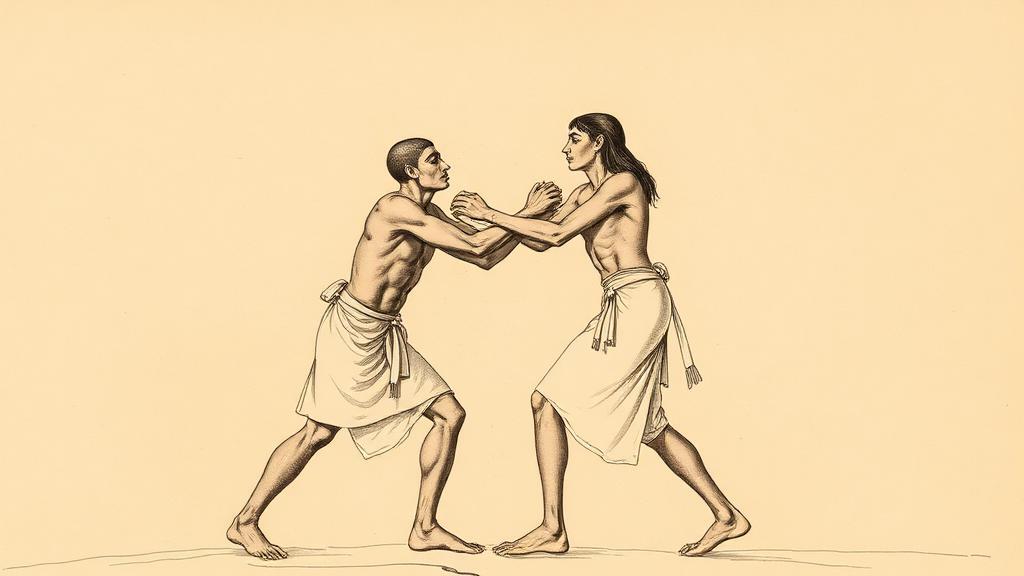
Beni Hasan's wall of wrestlers: Egypt's oldest sports record
On the eastern wall of a rock-cut tomb at Beni Hasan, roughly 245 kilometres south of Cairo, someone in the twenty-first century BCE painted row after row of wrestlers. The figures move in flat, two-toned Middle Kingdom profile, but the techniques they demonstrate are anything but stylized — here a man hooks his opponent’s ankle; here another drives an arm under a shoulder for a throw that any modern grappler would recognize in an instant. The wall records more than 200 distinct wrestling positions, carved into limestone like a training manual no one could spill wine on.
The tomb belongs to Baqet III, Great Chief of the Oryx nome — the sixteenth administrative district of Upper Egypt — who served under Pharaoh Mentuhotep II during the 11th Dynasty, around 2000 BCE. His nome sat on the east bank of the Nile, and the necropolis cut into the limestone cliffs above it eventually received 39 rock-cut tombs. The finest belong to Baqet III, his son Khety, and the later governors Amenemhat and Khnumhotep II — four generations of provincial lords who apparently shared the view that athletic prowess was worth taking into the afterlife.
The scenes at Beni Hasan cover more than wrestling. Three of the tombs show tahtib, the Egyptian stick-fighting discipline that trained warriors for close combat and survives today as the country’s oldest continuously practised martial form. Other panels document archery, swimming, boat racing, and what appear to be early ball games. Taken together they form the most comprehensive visual record of organized athletic competition to survive from the ancient world — not housed in a stadium or a public square, but carved into governors’ tombs by artists who treated sport with the same gravity they gave to harvests and battles.
In 1891, a seventeen-year-old named Howard Carter arrived at Beni Hasan with the Egyptologist Percy Newberry and set to work painting watercolours of the walls. Colour photography did not yet exist, so Carter’s copies — he was reportedly so absorbed that he spent several nights sleeping inside the tomb rather than break off — became the primary visual record for Newberry’s Beni Hasan, published in four volumes between 1893 and 1900. Thirty-one years later, Carter would open another Egyptian tomb and find it rather more intact. The wrestling figures he copied as a teenager are now among the most reproduced images in the history of sport.
The first Olympic Games at Olympia would not be held until 776 BCE — more than twelve centuries after Baqet III’s painters laid down those wrestling sequences. What Beni Hasan documents is not a precursor to the Greeks; it is evidence of a separate tradition, already systematic enough to have produced not just champions but technique — a vocabulary of moves so precise that someone judged it worth incising into stone forever.
The vocabulary is still current. Every wrestler who learns a hip throw or an ankle pick is working from the same grammar those walls recorded four thousand years ago.
Sources
- Beni Hasan — Wikipedia — Middle Kingdom dating, tomb list, Dynasty XI–XII context, Percy Newberry documentation.
- Baqet III — Wikipedia — Baqet III’s title, role under Pharaoh Mentuhotep II, and tomb BH15 wrestling scene details.
- Before Tutankhamun: Howard Carter’s Watercolours — V&A Blog — Carter’s 1891 arrival at Beni Hasan, watercolour-copying work with Newberry, nights spent in the tomb.
- Tahtib — Wikipedia — stick-fighting depictions in three Beni Hasan tombs; identification as the oldest continuously practised martial form in Egypt.