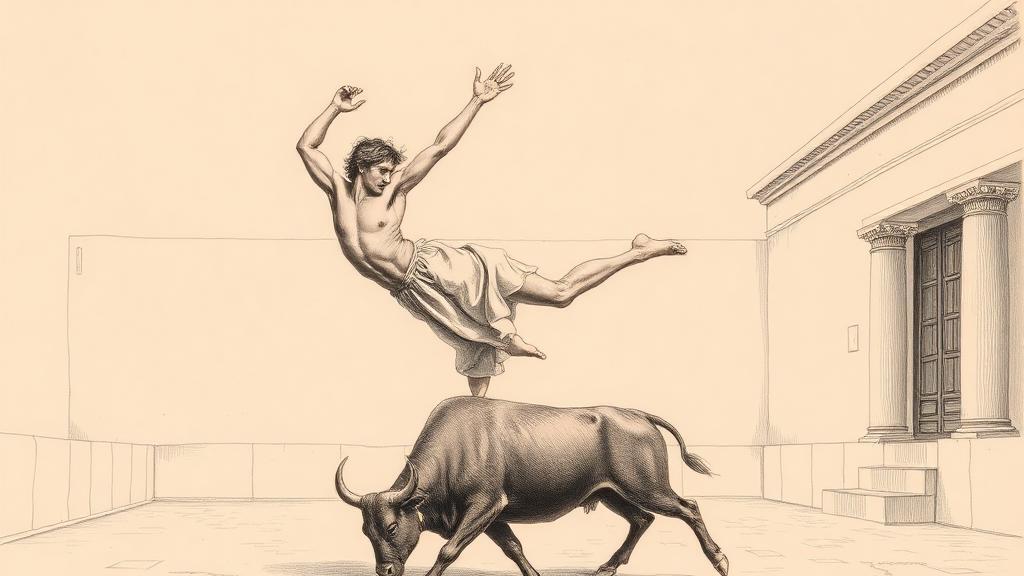
The bull-leaper of Knossos
A young man, rendered red-skinned in the convention of Minoan fresco painters, hangs upside-down above a charging bull at the Palace of Knossos, somewhere around 1500 BCE. His hands are free. His feet are in the air. In the split second before this painted moment, he grabbed the animal’s horns, let the bull’s own upward momentum hurl him skyward, and bent into a backward somersault over its spine. Two women — rendered pale, as is the Minoan custom for female figures — stand at either end of the bull, apparently positioned to catch him when he lands. The whole sequence fits on a panel 78 centimeters tall and just over a meter wide.
That panel, reassembled from fragments and now in the Heraklion Archaeological Museum in Crete, is the oldest surviving image of what we would recognize as an organized athletic event in the European world.
Arthur Evans broke ground at Knossos on March 23, 1900, and over the following years uncovered one of the Bronze Age’s great palace complexes. The bull-leaping fresco came up in seven scattered fragments. Evans and his team, working with a father-and-son pair of Swiss painters — both, by a coincidence that seems almost designed to confuse posterity, named Émile Gilliéron — reassembled the shards into the image we know today. Original Minoan paint makes up less than half of the current composition; the Gilliérons filled in the rest, guided by the fragments and by Evans’ considerable imagination. Scholars have been arguing about their choices ever since.
What the original fragments do establish is this: a blue-ground scene, presumably outdoors, with a large bull in full gallop and three figures caught at three distinct points in a practiced maneuver. The color-coding holds across dozens of other Minoan depictions of bull-leaping — in frescoes, seal rings, bronze figurines, and ivory carvings found across the island. Red figures are male; pale ones are female. The practice was, apparently, not restricted by sex.
The technique, as Evans reconstructed it from the fresco and parallel imagery, moved in four phases: approach the charging animal head-on, seize its horns, use the upward toss to vault over its back, land behind it. Whether this is precisely what happened is, in the words of one careful assessment, “strictly theoretical, never illustrated by real-life examples.” No ancient text describes the mechanics. What is not theoretical is the frequency: fifty-three sealings from replica gold rings depicting bull-leaping have been recovered across Crete and beyond — enough to confirm this was a regular, formalized activity, not a myth.
Bull-leaping was concentrated at Knossos. Only palaces had the infrastructure for public spectacle: trained athletes, specialized cattle, open courts, watching crowds. The blue background of the fresco almost certainly indicates an outdoor courtyard, and the west forecourt of Knossos was designed for exactly that purpose. Whoever ran Knossos was, among other things, running a sport — or a ritual dressed as one, which amounts to much the same thing.
The distinction between sport and sacred rite mattered less to the Minoans than it does to us. What mattered, evidently, was the moment: a human body clearing a ton of moving animal, live, in a place built for the watching. That structural idea — risk arranged for spectators, architecture designed to frame performance — is the oldest continuous thread in the history of organized athletic competition.
The arenas just kept getting bigger.
Sources
- Bull-Leaping Fresco — Wikipedia — fresco dimensions, date, restoration by the Gilliérons, Evans’ categories of bull imagery, scholarly debate on authenticity.
- Bulls and Bull-leaping in the Minoan World — Penn Museum / Expedition Magazine — Evans’ four-phase reconstruction, the fifty-three gold-ring sealings, evidence for institutionalized practice at Knossos.
- Arthur Evans — Linda Hall Library — Evans’ excavation start date at Knossos, March 23, 1900.