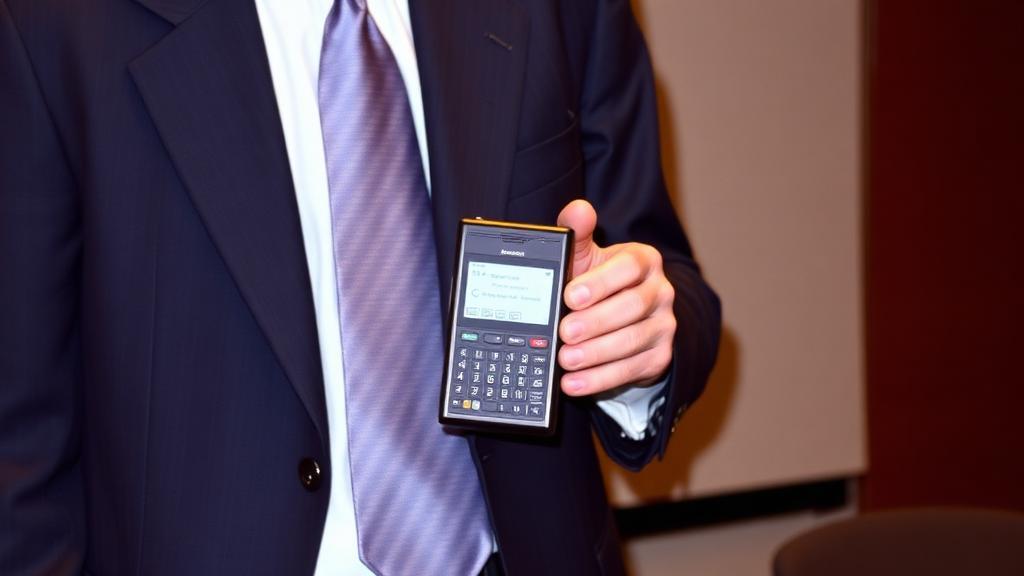
BlackBerry 850: the device that made email check you
On January 19, 1999, in Munich, a small Canadian company called Research In Motion unveiled a device that looked vaguely like a pager and weighed about as much as a deck of cards. It had a miniature QWERTY keyboard whose tiny round keys — the marketing firm Lexicon Branding had tested roughly forty candidate names before settling on this one — resembled the drupelets of a blackberry. The name stuck. So did the device.
The BlackBerry 850 was not a telephone. It was a two-way pager running a 32-bit Intel 386 processor on a single AA battery, and its trick was that it delivered email the moment the email arrived. Not when you asked. Not after you dialed in. The message appeared on the belt-clip device of a Wall Street attorney or a government aide before the sender had moved on to the next thing they were already drafting.
Research In Motion had been founded in 1984 in Waterloo, Ontario, by Mike Lazaridis and Doug Fregin, two University of Waterloo students who won a General Motors contract and never returned to finish their degrees. By the late 1990s, Lazaridis had become fixed on a single problem: corporate email systems held all the information that ran the world, but getting to that information from the road required a laptop, a hotel modem, and a great deal of patience. He believed the answer was to rebuild email around the device rather than the desk — to make the push, not the pull, the default.
The mechanism was the BlackBerry Enterprise Server, a piece of software installed inside a company’s IT infrastructure. The BES monitored an employee’s corporate mailbox on Microsoft Exchange, Lotus Domino, or Novell GroupWise; the moment a new message arrived, it pulled a copy, compressed and encrypted it with Triple DES, and delivered it to the device over the pager network. The whole journey took seconds. From the user’s perspective, the email simply appeared.
RIM’s revenue jumped 80 percent to $85 million in the year after the 850 launched, driven almost entirely by executive word-of-mouth: a senior manager got one, gave one to his deputy, who gave one to his assistant, and so on down the corporate chain until the BlackBerry had quietly colonized the pockets of professional America. By the mid-2000s the device had earned a nickname — “CrackBerry” — that Webster’s New World College Dictionary named its 2006 word of the year. The joke was that you couldn’t put it down. The punchline was that this wasn’t quite a joke.
What the BlackBerry proved was more consequential than any single executive’s inbox. It demonstrated that email could be ambient — always present, never tethered to a desk. Every notification that has buzzed a pocket since descends from those first BlackBerry 850s. The concept of checking your email quietly became obsolete. Since then, the email checks you.
Sources
- First BlackBerry device hits the market — HISTORY — Launch date January 19, 1999; device specs; revenue figures; CrackBerry cultural impact.
- BlackBerry — Wikipedia — Push email mechanism, BES architecture, naming origin via Lexicon Branding, enterprise adoption, Webster’s word of the year.
- How a BlackBerry Works — HowStuffWorks — Technical details of the BES push email pipeline, Triple DES encryption, and wireless delivery.