Tea at the bottom of Boston Harbour
Sometime before midnight on December 16, 1773, approximately 116 colonists dressed in Mohawk war paint boarded three ships moored at Griffin’s Wharf in Boston and heaved 342 chests of East India Company tea into the harbour. It took three hours. The tea was worth roughly £10,000 — a single consignment under the Tea Act, which had handed the East India Company a monopoly on colonial tea sales while maintaining the hated Townshend duty. The colonists were not, primarily, making a statement about beverages. They were making a statement about Parliament. Coffee turned out to be the beneficiary.
Before that night, the American colonies drank tea the way they drank air — reflexively, in vast quantities. By the early 1770s, colonists consumed an estimated 1.2 million pounds of tea annually. Coffeehouses existed — Dorothy Jones had held the first licensed coffee-trading permit in Boston as early as 1670, and the Green Dragon Tavern on Union Street had been hosting political meetings since 1701 — but tea was the everyday drink of the household, the hearth, the afternoon.
The boycott changed the arithmetic. Committees of correspondence circulated pledges; communities passed resolutions; households put their teapots away. The Green Dragon, already the meeting place where Paul Revere and the Sons of Liberty organised, became a hub for both the rebellion and the new default drink. The rooms were dense with tobacco smoke, radical pamphlets, and, increasingly, coffee.
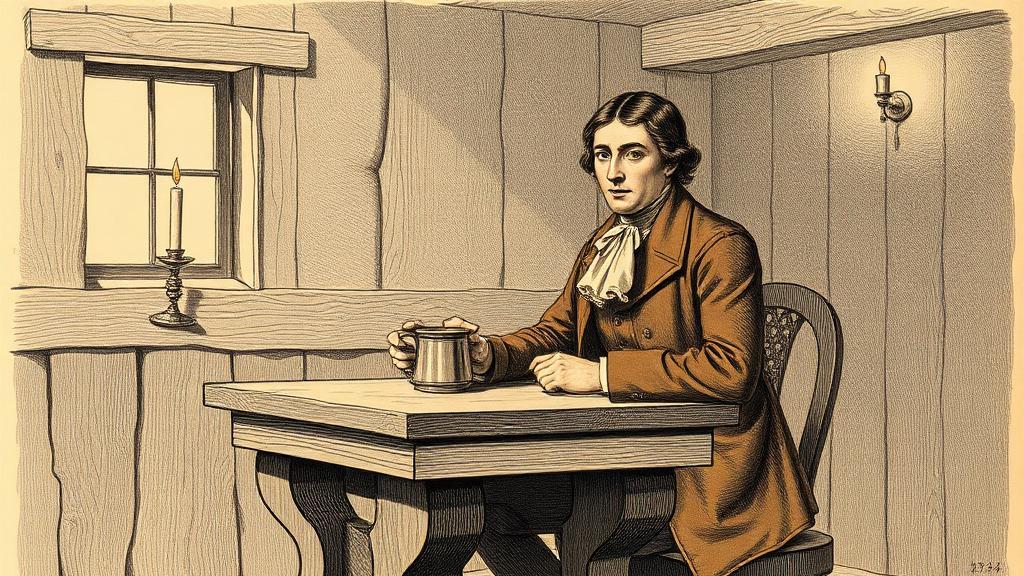
The clearest window into what the boycott felt like on the ground comes from a letter John Adams wrote to his wife Abigail on July 6, 1774 — six months after the harbour protest, after a 35-mile ride into Falmouth, Maine. He arrived at Mrs. Huston’s lodgings and asked, wearily, whether he might have tea — “provided it has been honestly smuggled, or paid no Duties.” Mrs. Huston was not amused. “No sir,” she told him, “we have renounced all Tea in this Place.” She brought coffee instead. Adams drank it without complaint and wrote to Abigail that he had borne it “very well.” “Tea must be universally renounced,” he concluded. “I must be weaned, and the sooner, the better.”
It sounds like a small domestic scene. It describes an entire nation making the same negotiation. The weaning worked. By the time independence was won, coffee had displaced tea in American homes so thoroughly that the cultural association — British equals tea, American equals coffee — had set permanently. Large numbers of Americans had switched for political reasons and simply never went back.
The downstream effects took decades to fully appear. A country of roughly four million coffee drinkers by the 1780s represented a demand signal that would help drive the Brazilian plantation expansion into the world’s dominant coffee economy. The harbour at Griffin’s Wharf held exactly 342 chests of tea. It had no idea what it was making room for.
Sources
- American Battlefield Trust — “Sip Sip Hurrah! How Coffee Shaped Revolutionary America” — Dorothy Jones licensing, the Green Dragon Tavern, coffeehouse culture during the Revolution.
- Massachusetts Historical Society — John Adams to Abigail Adams, 6 July 1774 — Primary source: the exchange with Mrs. Huston and Adams’ “universally renounced” declaration.
- Greenwell Farms — “How the Boston Tea Party Turned Americans into Coffee Drinkers” — Tea consumption figures, the 342 chests, the political context of the boycott.
- Wikipedia — History of Coffee — Post-Tea Party shift in American drinking habits and coffee’s spread through the Americas.