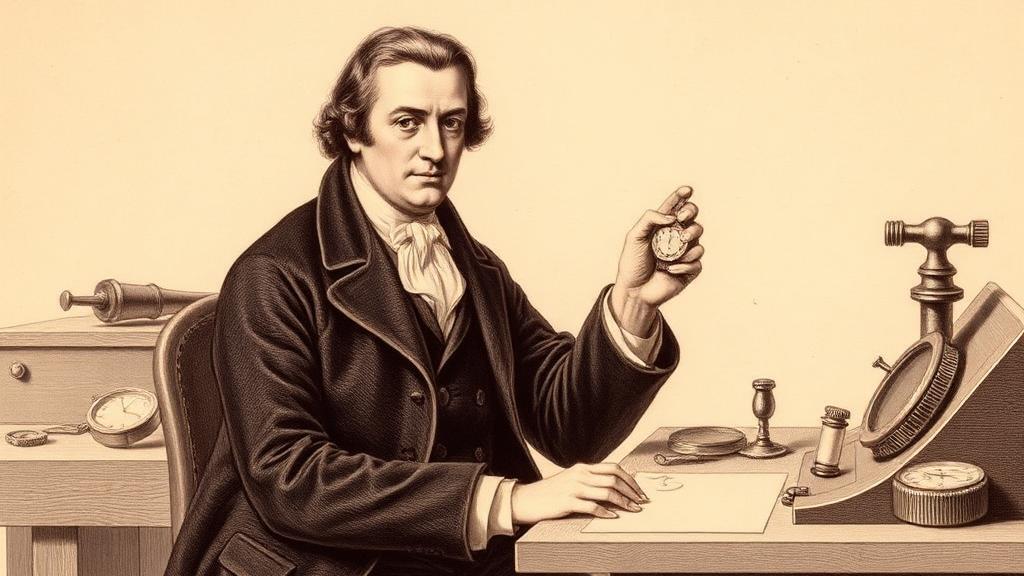
Breguet's wristwatch, or the timepiece that arrived fifty years too soon
On the morning of June 8, 1810, Abraham-Louis Breguet’s workshop on the Quai de l’Horloge in Paris received an order that stopped his clerks. The customer was Caroline Murat, Queen of Naples. She wanted, along with a grand carriage clock at one hundred louis, a watch designed to be worn on the wrist — a repeater, she said, for a bracelet, at five thousand francs. No such object had ever been made.
Breguet was sixty-three years old and the most celebrated horologist in Europe. Born in Neuchâtel in 1747, he had survived the Revolution, returned to Paris, and given the trade the tourbillon, the self-winding “perpétuelle” movement, and the overcoil spring that still bears his name (Wikipedia). Caroline, thirty-three and newly seated on the Neapolitan throne her brother had handed her, had been buying from Breguet since 1808 — thirty-four clocks and watches in six years, an acquisitiveness that ran in the family. The bracelet watch was her strangest request, and the reason was practical: the fashions of the Empire dressed women in high-waisted gowns with no functional pockets, while a gentleman’s waistcoat came standard with a chain. To tell the time, she needed Breguet to invent something new.
The result, registered in Breguet’s archives as Watch N° 2639, was an exceptionally thin oval repeater (Breguet Archives). Its guilloché silver dial carried Arabic numerals and a small thermometer at the edge of the face. A wristlet of human hair plaited with gold thread would secure it to the arm. Building it required seventeen craftspeople performing thirty-four distinct operations — a level of labor proportionate to the challenge of fitting a chiming repeater mechanism inside an object no thicker than a few stacked coins.
The watch was apparently ready by December 1811, and an invoice for 4,800 francs — Breguet having shaved two hundred off the original quote — was drawn up on the fifth of that month. Then he set it aside. He was unhappy with the motion-work and with the gold dial he had fitted. He replaced both, substituting silver for the dial, and did not record the delivery until December 21, 1812 — two and a half years after Caroline’s commission (Worldtempus). The watch then entered private life. The next time it surfaces in any record is 1849, when Caroline’s daughter — the Countess Rasponi, residing at 63, Rue d’Anjou in Paris — brought it in for a service. Breguet’s workshop polished the pivots, reset the thermometer, and restored the repeater to working order: eighty francs. It came in again in 1855. After that, nothing. Its current whereabouts are unknown.
Breguet’s contemporaries were unmoved. The pocket watch held its position as the default timepiece for men for another century, until the trenches of 1914 made clear that synchronizing an artillery barrage was difficult with one hand occupied by a fob chain. The wristwatch displaced the pocket watch within a single generation.
Caroline Murat lost her throne in 1815 and died in 1839, long before her commission made sense to anyone but herself. The wrist she had Breguet dress arrived at the future about fifty years before the future was ready.
Sources
- Abraham-Louis Breguet — Wikipedia — Breguet’s biography, major inventions, survival of the Revolution.
- Order for the first wristwatch — Breguet Archives — The original commission date, specifications of Watch N° 2639, delivery date, 1849 repair record.
- The first wristwatch — Worldtempus — Technical specifications, production timeline, Caroline Murat’s context.