The straight last: when shoes finally learned left from right
In September 1800, the commanding officer of the King’s Shropshire Light Infantry issued a regimental order that would strike any modern reader as bizarre: soldiers were to alternate which boot they wore on which foot on successive days. The goal was even wear. Nobody thought this unreasonable, because for two centuries it had been perfectly standard — your left boot and your right boot were the same boot.
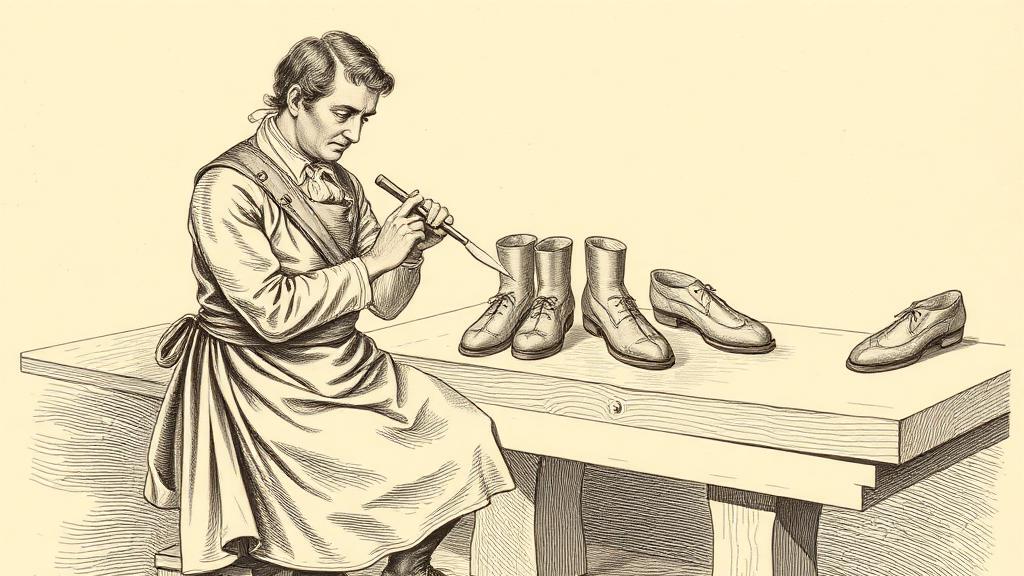
They had a name for this in the trade: the “straight last.” A last is the wooden form over which a shoe is built, and from roughly 1620 onward, most European cobblers used a single symmetrical shape for both feet of a pair. When heels became fashionable in the late 16th century, making a mirror-image pair of lasts to accommodate the angle grew fiddly and expensive, and the mass market wasn’t willing to pay. So the straight last it was, and wearers shaped their shoes to their feet through use — as, it seemed, they always had.
Playwright John Day had already made a joke of it in 1608, writing of shoes that gentlemen wore “now of one foot, now of another.” SATRA Two centuries later, the British army was still rotating boots by regimental order. The shoe had simply accepted the arrangement.
William Young, a Philadelphia bootmaker, apparently found this unacceptable. Sometime around 1817 or 1818, he began producing shoes on paired lasts — a left-specific form and a right-specific mirror image — and selling them to his customers. Xero Shoes The enabling technology had been lurking in the armories: the gun-stock lathe, already used to mill mirror-image rifle stocks, could produce matched last pairs with the same logic. Historians aren’t certain this was the first such attempt in the modern era, but Young’s Philadelphia workshop was enough to start a trend. In a new republic full of gunsmiths and woodworkers, the leap was not a large one.
It had almost happened earlier, in England. In 1812, the engineer Marc Brunel — who had already mechanized pulley-block production for the Royal Navy at Portsmouth — formed a partnership with James and William Farthing to supply the British army with machine-made boots. Wikipedia The machinery worked. The war ended first. When the government cancelled the contract after Waterloo, Brunel was left with idle machines and, eventually, a stretch in debtor’s prison. History is full of inventors who got the timing wrong by three years.
Even after Young’s workshop proved the concept, adoption was slow. From the 1820s through the American Civil War, Union soldiers were still commonly issued brogans made on straight lasts — no left, no right, shape them with your feet. Civil War Virtual Museum It was the Civil War’s industrial appetite — millions of boots, needed fast — that finally tipped mass production toward differentiated pairs. By the time the war ended in 1865, the question of which boot went on which foot was becoming one with an answer printed on the inside.
What Young’s innovation unlocked was not just comfort. It was the premise that a shoe could be designed around the actual shape of a human foot — asymmetric, specific, irreducible to a convenient average. That logic, once accepted, would eventually produce the sports shoe, the orthotic, and the motion-controlled running trainer. The foot, it turned out, had been waiting two centuries for the industry to notice it had a left and a right.
Sources
- SATRA: “When left and right were identical” — Straight lasts from c. 1620, John Day’s 1608 comedy, the 1800 King’s Shropshire Light Infantry regimental order, gun-stock lathe technology enabling mirror pairs.
- Evolution of Shoes — Xero Shoes — William Young of Philadelphia c. 1817–1818 and left/right shoe differentiation.
- Marc Isambard Brunel — Wikipedia — Brunel’s 1812 boot factory with the Farthings, contract cancellation after Waterloo, subsequent imprisonment for debt.
- Army Shoes — Civil War Virtual Museum — Union brogans issued on both straight and differentiated lasts; Civil War as the tipping point for mass adoption.