Calcio storico: the first printed rulebook for a team ball game
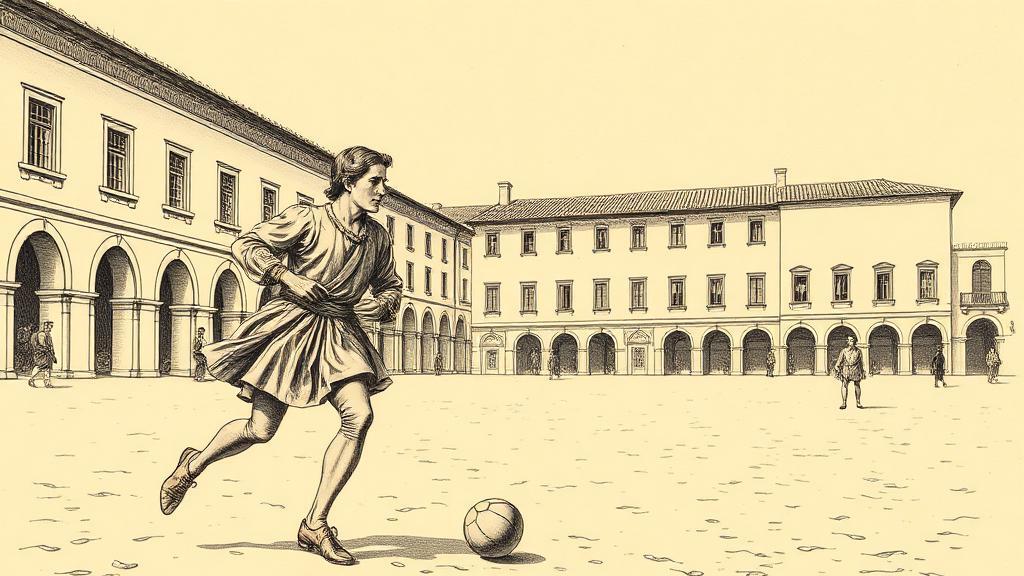
On the morning of February 17, 1530, the city of Florence was four months into a siege. Imperial troops under Charles V had ringed the walls; starvation was on its way. Someone decided to play football. Not in secret, not apologetically — publicly, in the Piazza Santa Croce, sand spread on the cobblestones, brass band playing, a crowd watching from windows and rooftops within sight of the enemy lines.
That game was calcio fiorentino, and fifty years later it got a rulebook.
In 1580, Giovanni de’ Bardi, Count of Vernio — soldier, courtier, and a man with an implausible number of projects — published Discorso sopra 'l giuoco del calcio Fiorentino in Florence, from the press of the Giunti firm. The treatise ran to 36 pages and included an engraved folding plate showing a match in progress before the church of Santa Croce. It was dedicated to Grand Duke Francesco of Tuscany — a Medici, as these things tended to be — and laid out 33 articles governing the game from start to finish. It is the earliest surviving printed rulebook for a team ball game.
The sport Bardi described was not gentle. Twenty-seven players a side took to a sand-covered rectangular field; four goalkeepers minded the ends, while fifteen forwards whose primary instrument was the fist drove into the opposition. Headbutting, elbowing, and choking were permitted. Goals — cacce — went to whichever team could throw or kick the ball over a low barrier at the far end. The match ran fifty minutes without pause, and a player ejected or injured left his team permanently short.
Six years before Bardi published his treatise, Henry III of France attended a match in Florence and reportedly judged it “too small to be a real war and too cruel to be a game.” Bardi’s achievement was to write down, precisely, what that particular cruelty should look like. The same man was also, during these years, hosting the Florentine Camerata in his palace — the circle that included Vincenzo Galilei and that produced, within a generation, the first operas. The Count of Vernio who calculated the correct ratio of halfbacks to fullbacks was simultaneously midwifing Western music’s dominant theatrical form.
What the Discorso demonstrated was deceptively simple: that a game could have a canonical text. Before 1580, calcio lived in custom and memory — played every Carnival on whichever square the local nobility had commandeered. After 1580, there was a printed version you could consult, dispute, and eventually revise. Every rulebook that follows this story — Broughton’s boxing code, the Knickerbocker Rules, the Football Association’s 1863 Laws — inherits that premise. You write the game down, and it becomes reproducible.
Calcio storico still runs in Florence every June, sand spread on the Piazza Santa Croce, four neighborhood teams in Renaissance livery. The rules have barely changed since Bardi printed them in 1580. The game survived the Medici, Napoleon, and two world wars. Written down correctly the first time, it turned out not to need revision.
Sources
- Calcio storico fiorentino — Wikipedia — History of the game, the 1530 siege match in Piazza Santa Croce, Giovanni de’ Bardi’s 1580 codification, and game structure.
- Giovanni de’ Bardi — Wikipedia — Author biography: dates (1534–1612), role in the Medici court, the Florentine Camerata and its connection to the origins of opera.
- Discorso sopra il giuoco del calcio fiorentino, 1580 — Hünersdorff Rare Books, AbeBooks — Publication details: 36-page treatise with engraved folding plate, Giunti press Florence, first edition bibliographic description.