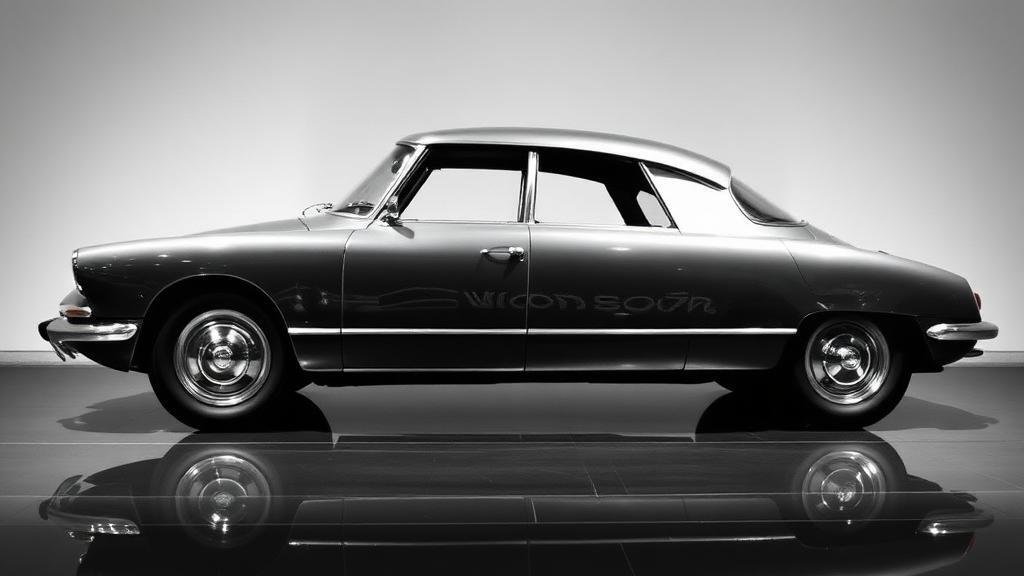
Citroën DS: the goddess at the 1955 Paris Motor Show
On the morning of 6 October 1955, the gates of the Paris Salon de l’Automobile had barely opened when visitors crowded around a low, alien-looking object on the Citroën stand. In the first fifteen minutes of the show, the company took 743 orders. By closing time, the number was 12,000. By the end of the ten-day exhibition, 80,000 Parisians had left deposits on a car that none of them had driven, most of them had barely seen, and that the French had already begun calling the Déesse — the Goddess.
The car was the DS 19, and its name was a small joke for anyone who spoke French. DS, said aloud, sounds exactly like déesse, goddess. Citroën didn’t invent the nickname; the crowd did, within hours. The philosopher Roland Barthes, writing two years later in Mythologies, decided this was entirely appropriate: the DS, he wrote, was “the supreme creation of an era, conceived with passion by unknown artists.” He compared it to a Gothic cathedral — something that appeared to have fallen from the sky rather than been assembled on a production floor.
The artists were less unknown than Barthes suggested. The body was shaped by Flaminio Bertoni, an Italian sculptor who had trained in Milan and joined Citroën in 1932. He worked in plaster, by hand, sculpting a car that looked more like an aircraft fuselage than any automobile of its time. The engineering belonged to André Lefèbvre, a French aeronautical engineer who had spent the 1920s designing aircraft and brought an airman’s contempt for drag and unnecessary weight. Together they produced a car with front-wheel drive and an aerodynamic profile that left contemporary competitors looking like furniture.
The suspension was the work of a third figure: Paul Magès, who joined Citroën in 1936 and spent nearly twenty years developing the hydropneumatic system that set the DS apart from everything else on the road. The car had no conventional steel springs. Each wheel connected to a pressurized nitrogen sphere and a central hydraulic pump that also drove the brakes and the power steering. The result maintained a constant ride height regardless of load, absorbed bumps that would shake a conventional chassis apart, and knelt at kerbs to allow easy entry. At rest, the car sagged toward the ground. Start the engine, and it rose.
That capacity to absorb punishment was tested in earnest on the evening of 22 August 1962, near the Paris suburb of Petit-Clamart. Charles de Gaulle was riding in an unarmored DS when twelve OAS gunmen opened fire. The car absorbed 140 bullets. Its rear tyres were punctured. The DS skidded — then kept going. De Gaulle’s chauffeur floored the accelerator and drove clear on the rims. The president climbed out unhurt, lit a cigarette, and subsequently refused to travel in any other make of car.
The DS ran in production until 1975, with 1,455,746 built in six countries. Its hydropneumatic suspension influenced Rolls-Royce, Mercedes-Benz, and every pneumatic air-ride system since. The aerodynamic discipline Bertoni had worked into the clay became the standard that manufacturers would chase for the next half-century.
Seventy years later, a parked DS sits lower than you expect. Start the engine, and it gathers itself and rises. Every car that adjusts its own suspension today is still working through the same idea.
Sources
- Citroën DS — Wikipedia — launch date and orders at the 1955 Paris Motor Show, Bertoni and Lefèbvre backgrounds, Paul Magès and the hydropneumatic suspension, production figures, de Gaulle incident.
- Citroen helps de Gaulle survive assassination attempt — History.com — details of the OAS attack at Petit-Clamart on 22 August 1962 and the DS’s role in the escape.
- The Citroën DS, mythologized by Roland Barthes — Open Culture — Barthes’ “The New Citroën” from Mythologies (1957), “supreme creation of an era,” cathedral comparison.