Essen's Flying Bedstead and the death of the astronomical second
On 3 June 1955, the BBC pips — those six short tones that have marked Greenwich Mean Time for the British public since 1924 — carried a new kind of authority. For the first time, they were governed not by the rotation of a planet but by the vibration of an atom.
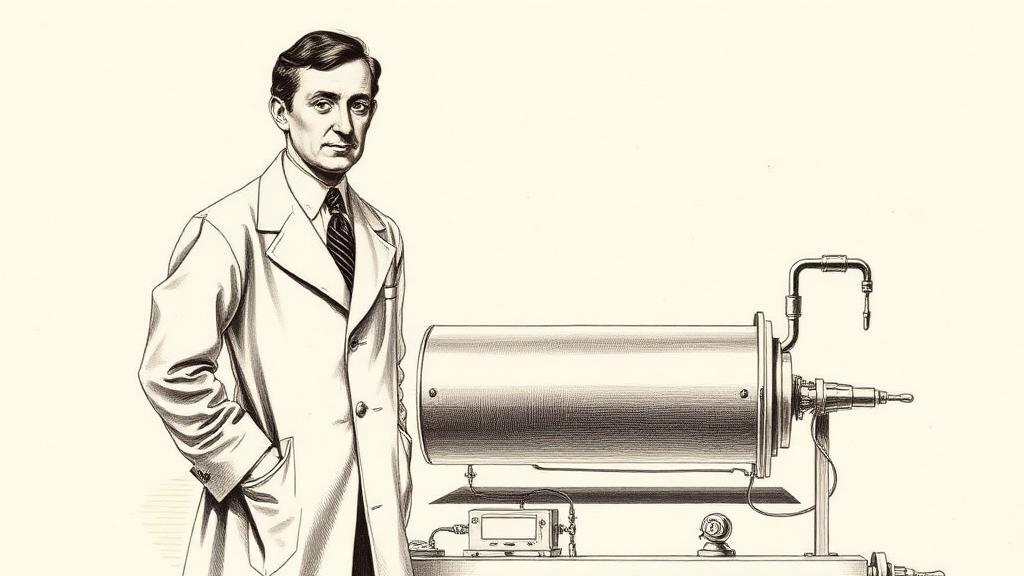
The clock behind them sat at the National Physical Laboratory in Teddington, southwest of London, and it was not, by any measure, beautiful. Over a metre in length, trailed by external electronics and tethered to a vacuum pump, it had been immediately nicknamed the “Flying Bedstead” by BBC engineers who saw it. Its builders were Louis Essen, a meticulous physicist who had spent the war working on microwave cavity resonators for radar, and his colleague Jack Parry. They had drawn on a 1949 Harvard design by Norman Ramsey and turned it, over five years of patient measurement, into something that could actually serve as a standard.
The operating principle was unlike anything in five thousand years of horology. A beam of caesium-133 atoms, heated until they streamed freely, passed through two successive microwave cavities separated by roughly fifty centimetres. When the microwaves were tuned to exactly the frequency at which caesium electrons flipped between energy states, the atoms resonated. That resonant frequency — the same in every sample of caesium anywhere in the universe — became the clock’s tick. NIST
The result was a machine accurate to one second in three hundred years: thirty times better than the quartz crystal clocks that had themselves seemed remarkable in the 1930s, and three hundred times better than the finest pendulum clocks.
But Essen was not finished. After accumulating enough data to trust his clock against the sky, he turned to a question that had been nagging at metrologists for decades: was the astronomical second actually any good? Working with William Markowitz at the U.S. Naval Observatory, Essen measured how many caesium oscillations filled one conventionally defined second — the one anchored to the Earth’s rotation. The answer was 9,192,631,770, published in 1957. It was reproducible to an absurd number of decimal places. Essen reportedly invited the director of the NPL to the laboratory to witness, in his words, “the death of the astronomical second and the birth of atomic time.” Whether the director grasped the full weight of what he was looking at, history does not record.
In 1967, the General Conference on Weights and Measures made the number official. The second was redefined as exactly 9,192,631,770 periods of the caesium-133 hyperfine transition — severing, after several millennia of service, the link between time and the turning of the Earth.
Every GPS satellite, every mobile network time signal, every financial exchange running on coordinated universal time now ticks at a rate first measured in Teddington in 1955. Time had always been borrowed from astronomy. Essen returned the loan.
Sources
- A Brief History of Atomic Time — NIST — Essen’s method, Norman Ramsey’s 1949 precursor design, Markowitz collaboration, 9,192,631,770 Hz measurement.
- Caesium Atomic Clock, 1955 — Science Museum Group Collection — accuracy comparison with quartz and pendulum clocks, physical description.
- Celebrating Louis Essen and the birth of atomic time — Physics World — BBC pips on 3 June 1955, “Flying Bedstead” nickname, 1967 SI second redefinition, Essen’s quote.