The Converse All-Star, or what forty years on the road built
In 1921, a 20-year-old semi-professional basketball player named Charles Taylor walked into the Converse Rubber Shoe Company’s Chicago office and complained that his feet hurt. He was wearing the company’s own canvas basketball shoe — the All-Star, released in Malden, Massachusetts in 1917, already two years into its second name. Taylor had a list of improvements. Converse hired him on the spot.
That may be the most consequential personnel decision in the history of footwear.
Converse had launched the shoe four years earlier when Marquis Mills Converse, who had been making rubber-soled footwear in Malden since 1908, spotted an obvious gap. Basketball, invented at Springfield, Massachusetts in 1891, was spreading rapidly through schools and YMCAs — but players were improvising with whatever rubber-soled shoe they owned. Converse’s answer was a canvas upper over a vulcanized rubber sole stamped with a diamond-tread pattern (hence the original name, “Non-Skids”) and a high-top silhouette with a reinforced ankle patch designed to support the lateral cutting the game demanded. It was purpose-built for a sport that still didn’t have its own shoe.
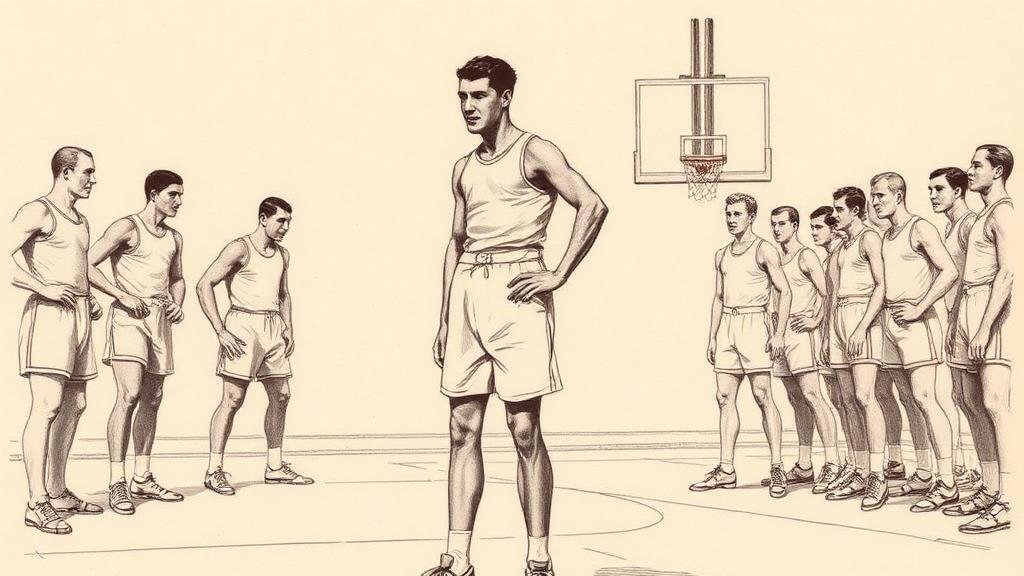
Taylor’s changes were practical: a widened toe box, a revised insole, improved ankle flex. Within a year, Converse had folded them into the design. What Taylor contributed next, though, was not engineering. For the following four decades he lived out of hotel rooms, driving from high school gyms to YMCAs to college campuses, running free basketball clinics. He taught coaches the game. He fitted players with shoes. He kept no fixed address. By the time Converse formally stamped his signature on the ankle patch in 1932, coaches and athletic directors across the country had been ordering “Chuck’s shoe” by name for years — making the All-Star the first celebrity-endorsed athletic shoe in history. He collected no royalties. Just a salary, expenses, and a commission.
Taylor personally helped design the white model with red-and-blue trim worn by the U.S. basketball team at the 1936 Berlin Olympics — the sport’s Olympic debut. Converse held the official Olympic basketball shoe contract from 1936 through 1968. By the 1960s, the company had captured 70–80% of the basketball shoe market, with roughly 90% of professional and college players wearing the All-Star on the court. The 1939 NCAA championship, the NBA’s founding in 1949, the first Olympics to include the sport: every milestone in basketball’s rise came with Converse on the hardwood.
What the All-Star established was the template. Before 1917, athletic footwear was a generic category — rubber-soled shoes pressed into service for whatever sport needed grip. After it, a shoe could be engineered for one specific sport, refined by an athlete who played that sport, endorsed by a person the community already trusted, and sold through the relationships that person had spent years building. Taylor’s clinic circuit was the first grassroots sports marketing campaign in American history, and it worked across three decades before mass advertising had words for what he was doing.
By the 1979–80 NBA season, center Tree Rollins was the last player in canvas Converse All-Stars, and he already looked like a holdout. Leather uppers, cushioned midsoles, and a basketball player from North Carolina named Michael Jordan would change the game’s footwear entirely. Nike acquired Converse in 2003 for $305 million.
The ankle patch still carries Chuck Taylor’s signature. Over 750 million pairs have been sold in 144 countries. Every sneaker company that came after made its first serious move by finding its own Chuck Taylor.
Sources
- Chuck Taylor All-Stars — Wikipedia — shoe history from the 1917 Non-Skids through the Olympic years, market share statistics, Tree Rollins as last NBA canvas wearer, Nike acquisition.
- Chuck Taylor biography — WBUR “Only a Game” — Taylor’s four decades in hotel rooms, the clinic circuit, the 1932 ankle-patch signature, the royalties he never received.
- Converse All-Star History — ChucksConnection — technical design details, market-share figures, the 1936 Olympics model, timeline of commercial milestones.