coffee · 3 min read
Cup of Excellence and the auction that taught coffee its price
In July 1999, fifty bags of coffee from a Brazilian farm called Alterosa sold at auction for $2.60 a pound — more than double the commodity price. The buyers were in Japan. The bidding happened on the internet. Nobody in the history of the coffee trade had done any of this before.
The commodity market had always priced coffee roughly the same, regardless of how carefully it was grown. A farmer who tended his trees through the rains, hand-sorted his cherries, and dried them on raised beds received nearly the same price as one who didn’t bother. The International Coffee Organisation, the Common Fund for Commodities, and the International Trade Centre had spent five years, through a programme they called the Gourmet Coffee Project, trying to prove that a premium market for high-quality coffee was viable (Cup of Excellence). Everyone in specialty coffee suspected it was. The mechanism was the problem.
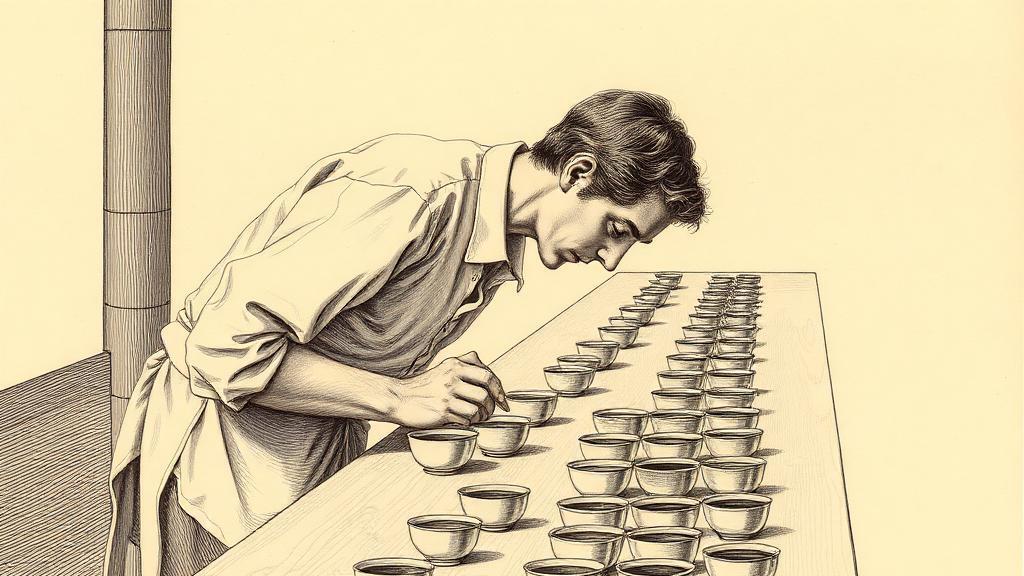
George Howell was a coffee entrepreneur from Massachusetts who had spent years arguing that exceptional coffee was a fundamentally different product from ordinary coffee — and that the market had simply never been given the tools to recognise this (Wikipedia). Working with Susie Spindler and a team from the Brazil Specialty Coffee Association, Howell organised a competition called “Best of Brazil.” An international jury of fourteen judges tasted coffees blind on a 100-point scale. Any coffee above 80 passed. Ten did.
Then came the part nobody had tried. Rather than sell those ten lots through the usual broker chain — which would have threaded several middlemen between farmer and buyer — the team built an online auction platform, enlisting Hewlett-Packard auction economists to design the bidding protocols (Alliance for Coffee Excellence). The top lot from Alterosa cleared $2.60 per pound and landed with a buyer in Japan who had never met the farmer who grew it.
Fifty bags is not a lot of coffee. The first Best of Brazil was, by any commercial measure, a demonstration project. What it demonstrated was the existence of a price: that buyers would pay significantly more for a verifiably exceptional coffee, and that you could locate them, anonymously, over the internet. The mechanism was replicable. Within two years, Guatemala had its own competition. By 2009, a producer in Honduras named Marysabel Caballero received $18.75 per pound for her winning lot — roughly fifteen times the commodity price that year — and netted more than $35,000 from twenty-five bags (Transcend Coffee). By 2018, winning lots were selling for $80 per pound.
The name “Cup of Excellence” arrived when the Alliance for Coffee Excellence incorporated as a nonprofit in 2002. The name the program carried in Brazil in 1999 — Best of Brazil — was blunter and, in retrospect, more accurate. The question the auction actually answered wasn’t which coffee was best. It was whether anyone would pay to find out.
The lot from Alterosa cleared in three days. The bidding has not stopped since.
Sources
- Cup of Excellence history — Cup of Excellence official site — founding team, 1999 “Best of Brazil” competition, role of the Gourmet Coffee Project.
- Cup of Excellence — Wikipedia — founding, judging process, expansion to multiple countries, George Howell’s role.
- 10 Things You Should Know About Cup of Excellence — Alliance for Coffee Excellence — Hewlett-Packard auction protocol design, competition open to all farmers, ACE’s structure.
- What is the Cup of Excellence? — Transcend Coffee — first “Best of Brazil” ten-lot auction, Honduras 2009 producer earning $18.75/pound, $80/pound by 2018.