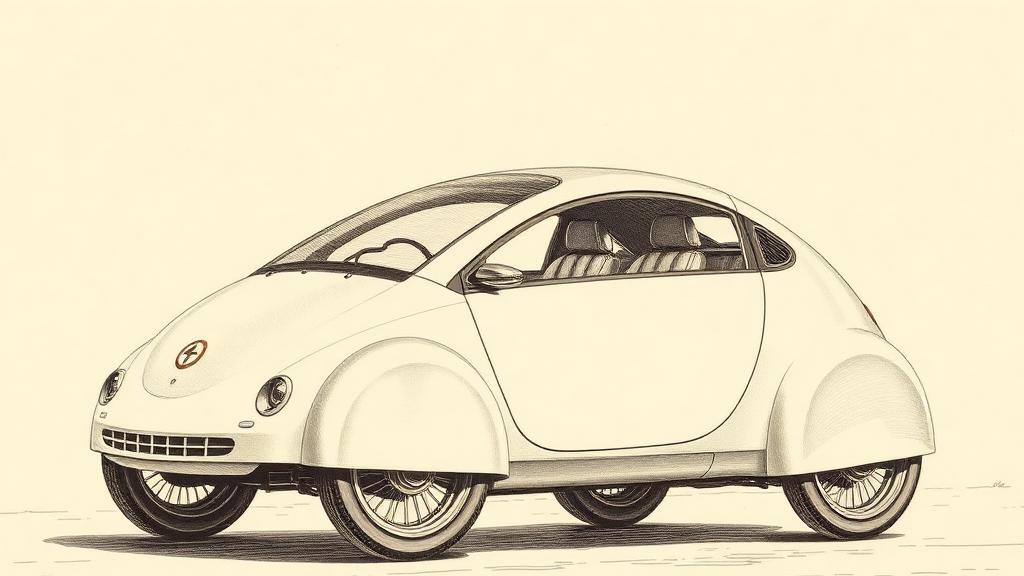
Honda Insight: America's first production hybrid
The most efficient gasoline-powered car ever sold in America weighed 820 kilograms — less than a large horse — and looked somewhat like a teardrop with mirrors. It arrived at Honda dealerships in December 1999, seven months before anyone in the United States could buy a Toyota Prius, and it immediately set an EPA fuel-economy record that would stand untouched for sixteen years.
The Insight was built on a logic simple to state and hard to execute. Honda’s engineers skinned the car in aluminum, faired over the rear wheels with smooth aluminum skirts to cut turbulence, and gave the body a drag coefficient of 0.25 — the second-lowest ever recorded on a production car at that point, surpassed only by the lease-only GM EV1. The whole car tipped the scales at 820 kilograms, roughly half what a steel-bodied Civic hatchback weighed. Less weight meant less engine, less engine meant less fuel, and less fuel meant the numbers that would show up on the EPA’s sticker: 61 miles per gallon in the city, 70 on the highway.
The Integrated Motor Assist system — IMA — was what made the math work. Honda’s engineers mounted a 10-kilowatt electric motor directly on the crankshaft of a 1.0-liter three-cylinder engine, thin enough to fit between engine block and gearbox without lengthening the car at all. During acceleration, the motor assisted the gasoline engine. During braking, it ran in reverse, recapturing kinetic energy and feeding it back into a 144-volt nickel-metal hydride battery pack tucked behind the two seats. The engine itself shut off at red lights and restarted when the driver pressed the clutch — a feature called idle stop that seemed eccentric in 1999 and is now standard behavior in every hybrid on the market.
Honda’s own projections called for 6,500 American sales per year. Over the car’s entire seven-year production run, North America took delivery of 14,288 Insights in total — a little over 2,000 a year. The Insight was, commercially speaking, a polite disaster. Buyers wanting a hybrid with a back seat could get a Prius when it arrived in the United States in 2000; buyers wanting just a small, cheap car found the two-seat interior odd and the rear fender skirts odder still. Honda kept the car in production anyway, apparently on the theory that holding the world fuel-economy record was worth more in brand equity than the losses.
What the Insight proved was simpler than its engineering: a hybrid drivetrain could be built reliably enough to sell in the open market, survive an American winter, pass federal safety inspections, and not strand its owner on the highway. That demonstration mattered because no one had yet made it in America. The Prius had done it in Japan; the Insight did it here, seven months first, on aluminum wheels barely wider than bicycle tires.
The 70-miles-per-gallon highway rating the EPA assigned the Insight in 1999 stood as the record for a gasoline-powered production car in the United States until 2015. By then, hybrid powertrains occupied everything from city sedans to pickup trucks, and the argument the Insight had first made on an American dealer’s showroom floor — that a motor on a crankshaft could save fuel rather than replace the engine — had long since been won.
Sources
- Honda Insight — Wikipedia — technical specifications, IMA system, aerodynamics (Cd 0.25, second only to GM EV1), production history, North American sales figures (14,288 units), and Honda’s 6,500-unit annual projection.
- Honda Global Newsroom: Insight introduction, September 1999 — weight of 820 kg, fuel consumption figures, idle-stop system details, and environmental certification data.
- Honda Marks 25 Years of Hybrid-Electric Sales — December 1999 US market launch, 70 mpg highway designation, and confirmation as the most fuel-efficient gasoline production car ever sold in America.