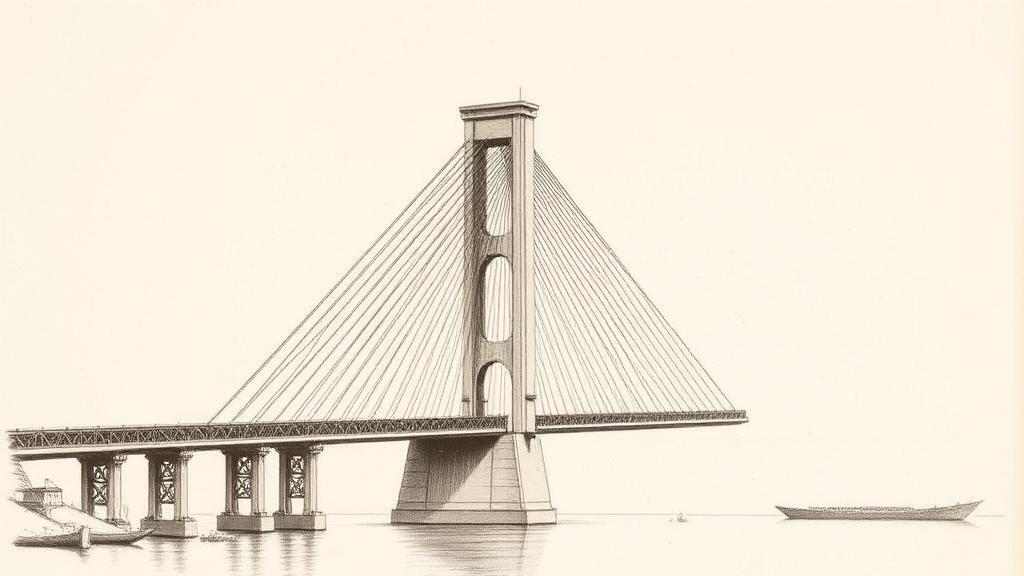
Danjiang Bridge: the longest single-mast span
A single concrete mast, 200 metres tall and leaning back at an angle that suggests a dancer arrested mid-leap, rises from the north bank of the Tamsui River in northern Taiwan. From it, steel cables fan asymmetrically across 450 metres of open water to a deck hovering twenty metres above the estuary. Nothing touches the river. The Danjiang Bridge opened on May 12, 2026, as the longest single-tower asymmetric cable-stayed bridge ever built. Its architect had been dead for ten years.
Zaha Hadid Architects won the international design competition in 2015. Hadid — the first woman to win the Pritzker Architecture Prize, in 2004 — drew the mast’s curve in reference to the Cloud Gate Dance Theatre, a celebrated Taiwanese company whose dancers’ movements the tower’s lean evokes. She died in Miami on March 31, 2016, from cardiac arrest, before the project reached the construction stage.
The bridge had been on the drawing board since 1998. The Tamsui River mouth is a bottleneck: the Guandu Bridge, five kilometres upstream, carried the full weight of the northwestern crossings and was permanently congested. A new bridge here was obvious. Getting it built was not. Environmental reviews, design revisions, and a string of failed construction tenders kept the project stalled for two decades. Ground broke in February 2019, and the final steel deck segment went in during October 2025. When the bridge opened on May 12, 2026, the Tamsui-to-Bali journey shortened by fifteen kilometres and travel time fell by approximately twenty-five minutes; projections showed a thirty-percent drop in traffic at the Guandu crossing.
The engineering problem is not simple. A conventional twin-tower cable-stayed bridge would plant a foundation in the riverbed, disrupting the estuary and blocking navigation channels. The single pylon stands entirely on the bank. But an asymmetric cable arrangement exerts unequal forces — the mast is, in effect, pulled sideways by its own cables. Leonhardt, Andrä and Partner and Sinotech Engineering Consultants worked out the cable geometry through years of 3D modelling. The deck — 71 metres wide, designed to carry cars, motorcycles, buses, bicycles, pedestrians, and an eventual light-rail line — was stress-tested for Taiwan’s typhoon loads and seismic events. During construction, workers encountered underwater leaks in the foundation works and persistent difficulties with the estuary’s wind.
Zaha Hadid Architects, now under the leadership of Patrik Schumacher, shepherded the design through a decade of engineering review after Hadid’s death — keeping the mast’s lean, the asymmetric silhouette, and the restraint of a structure that leaves the river visually open. The result surpasses the previous record, held since 2000 by the Yugra Bridge in Surgut, Russia, by roughly thirty metres of main span.
Single-tower asymmetric cable-stayed bridges have been built before, mostly in Japan and at smaller spans. What Danjiang demonstrated is that the form scales to half a kilometre without a foundation in the water — through the typhoon belt, across an active seismic zone, over two decades of administrative delays. Whoever builds the next long-span estuary crossing will start from here.
Sources
- Danjiang Bridge — Wikipedia — engineering specifications, construction timeline, 2015 competition, multi-modal capacity, record status, opening date.
- Taiwan inaugurates Danjiang Bridge — Focus Taiwan — inauguration ceremony, Cloud Gate Dance Theatre inspiration, presidential remarks, traffic impact projections, engineering challenges including underwater leaks and wind.