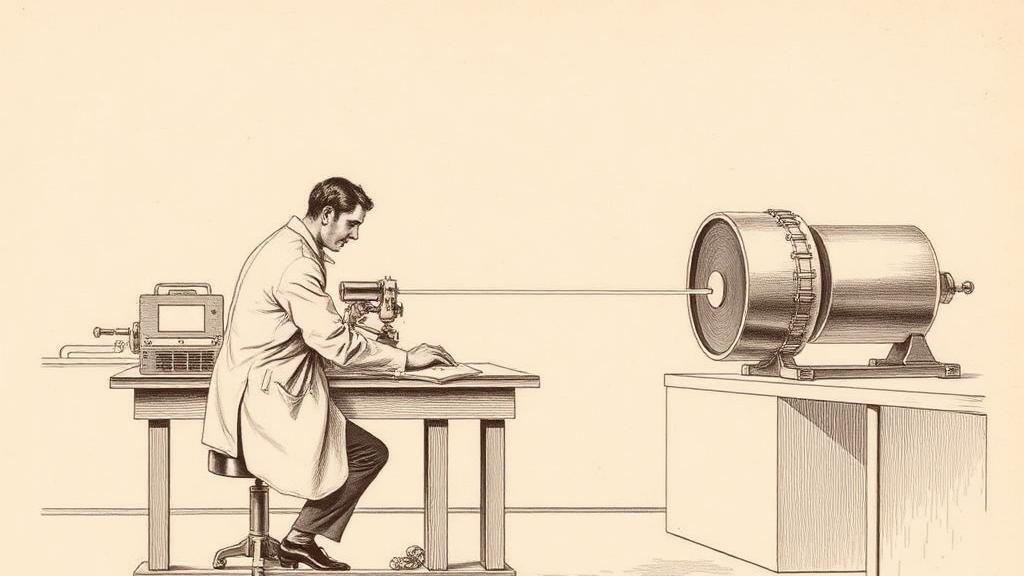
The flywheel that runs on light
In a JILA laboratory in Boulder in the summer of 2026, a ten-centimetre block of silicon was cooled to 17 Kelvin — colder than liquid nitrogen, colder than most of interstellar space — while laser light bounced back and forth between its mirror-polished ends. Two of these devices, together with a clock locked to a molecular iodine transition, then ran uninterrupted for over twenty days. The team compared all three against each other. Their disagreement over the entire period: less than a hundred picoseconds.
A hundred picoseconds is the time light takes to travel about three centimetres. After twenty days of independent running, that is how much three optical time scales in Boulder disagreed.
This was not a demonstration of how precisely you could measure a second. It was a demonstration of how precisely you could count them.
The distinction matters more than it sounds. Since Louis Essen built the first practical cesium clock at the National Physical Laboratory in 1955, atomic frequency standards have measured the length of one second with ever-increasing precision. But the time scales that actually count elapsed seconds — the systems that generate UTC, synchronise satellites, and keep the world’s financial and communications infrastructure ticking — have run on hydrogen masers. Masers are excellent microwave oscillators. They are also the weakest link.
The problem is the gap between measurement and maintenance. An optical frequency standard can characterise a single second at nineteen-decimal-place accuracy, then switch off. The maser runs continuously in between, doing its best to hold time steady. Some of the hard-won precision of the optical measurement vanishes into maser noise. The result is a time scale slightly inferior to the best atomic clock in the world, because running continuously and measuring exquisitely are, for now, different jobs.
Dahyeon Lee, Jun Ye, and twelve colleagues at JILA — the partnership of NIST and the University of Colorado Boulder — reported in August 2026 that the maser could be replaced as the flywheel. Their three optical oscillators accumulated drift nearly an order of magnitude smaller than the best hydrogen masers over equivalent periods. All three agreed with each other to below one part in ten quadrillion after a few days of averaging.
The silicon cavities are the stranger component. Cooled to 17 Kelvin, thermal vibration in the crystal lattice all but ceases, and the laser resonating inside achieves short-term frequency stability that hydrogen masers cannot approach. They are not clocks in the usual sense — they do not measure absolute time. Paired with a strontium optical frequency standard that gives them their absolute reference, they become time scales that run on light rather than on microwave oscillation.
Hydrogen masers have underpinned UTC since the 1970s. They are not going anywhere immediately. But the twenty-day result from Boulder showed that the maser’s role as the timekeeping backbone is no longer physically necessary — only institutional. The SI second has been defined by cesium since 1967. That definition is up for review around 2030, and it appears to have an appointment to keep.
Sources
- Phase-continuous comparison of three all-optical time scales over 20 days — arXiv 2608.00910 — primary source; JILA team at NIST/CU Boulder, architecture (two cryogenic silicon cavities, one iodine clock, strontium frequency standard), 20-day trial, performance figures.
- Optical Clocks: The Future of Time — NIST — NIST overview of optical clocks vs. cesium fountains and the path toward redefining the SI second.
- Louis Essen — Wikipedia — context on the 1955 NPL cesium clock that established the modern atomic timekeeping era.