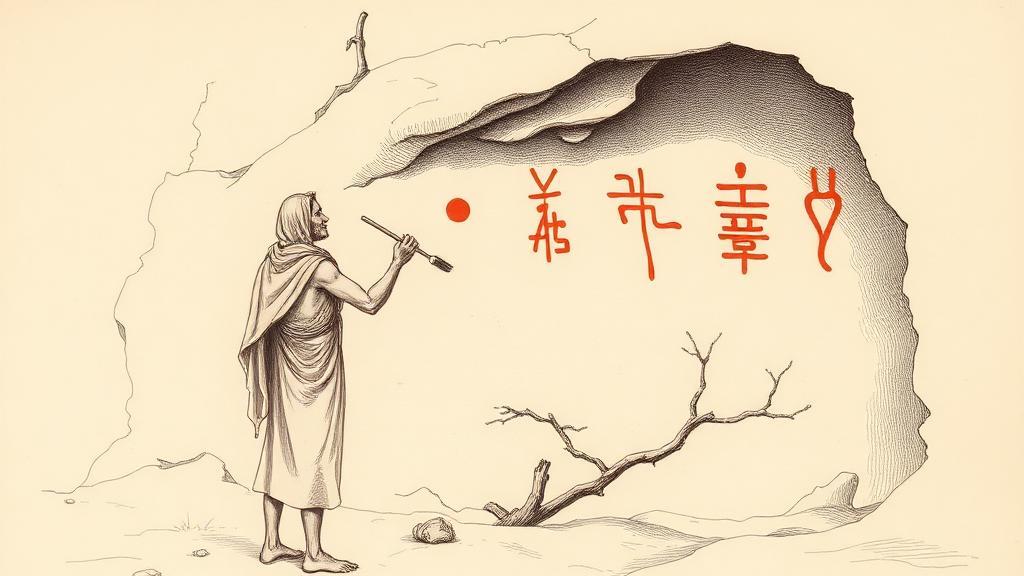
Dhofari: the script that rewrote Arabian history
By Ḥwdb, son of Kws³r — five tokens painted in red ochre on a cave wall in Oman’s Dhofar region, sometime around 400 BCE — waited 2,400 years to be read. Western travelers noticed the inscriptions in the late nineteenth century. For the century and a quarter that followed, the script was perfectly preserved and perfectly silent.
The writing, which scholars call the Dhofari script, runs across a strip of southern and southeastern Arabia — from Dhofar through Yemen’s Al-Mahrah region and as far out as the island of Socotra. Painted in caves and rock shelters, occasionally carved into wadi beds and movable stones, it comes in two distinct varieties. The first serious academic survey, conducted by linguist Ali Mahaash al-Shahri and archaeologist Geraldine King between 1991 and 1992, catalogued the corpus and sorted it into Script 1 and Script 2 — each with roughly 26 glyphs — without achieving decipherment (Wikipedia). The theories that filled the vacuum were creative: some declared the inscriptions to be writings of the people of ʿĀd, a legendary tribe mentioned in the Quran. Ahmad Al-Jallad at Ohio State University calls these claims “fanciful.”
In 2025, Al-Jallad, who holds the Chair in Arabic Studies at OSU, published a decipherment of Script 1a in the journal Jaarbericht Ex Oriente Lux (OSU NESA). His key was three inscriptions inside the corpus that had been overlooked: each contained exactly 26 non-repeating symbols. Twenty-six symbols in sequence, no repeats — that is not a sentence. That is an alphabet listing, what linguists call an abecedary. By comparing the Dhofari abecedaries to the halḥam sequence — the alphabet order used in ancient North Arabia and Yemen, named for its first four letters — Al-Jallad could assign a sound to each glyph. The script became audible.
The texts spoke modestly at first. Personal names, blessings, laments. One greeting runs By Ḥwdb, son of Kws³r. But decoding them required a small grammatical revelation. Read as Arabic, a common two-letter sequence looked like bn — Arabic for “son of.” The grammar didn’t cohere. Tried as br — the equivalent word in Modern South Arabian languages like Mehri, still spoken today in pockets of Oman and Yemen — the texts aligned (Language Hat). The script wasn’t recording Arabic. It was recording an extinct close relative of those indigenous pre-Islamic languages, whose descendants survive in the same landscape where their ancestor was painted on cave walls.
Giuliano Castagna of Beijing Normal University called Al-Jallad’s study “the first ever reliable study on this matter.”
The deeper implication concerns the shape of the South Semitic family tree. Based on glyph forms, Dhofari did not descend from ancient South Arabian script, as everyone had assumed. It descended from Ancient North Arabian — a branch of writing that originated far to the north. The letters had traveled southward through Arabia. Writing, in other words, doesn’t only record a language; it tracks the roads the people who carried it once walked.
The inscriptions waited in their caves for two and a half millennia. It turned out what they needed was not another expedition, but someone who thought to count to twenty-six.
Sources
- Dhofari script — Wikipedia — geographic distribution, script types, 1991–1992 survey, and decipherment overview.
- Ahmad Al-Jallad’s Research Featured in Science Article — OSU NESA — publication details, Castagna’s expert reaction, and Al-Jallad’s dismissal of prior theories.
- Dhofari Deciphered — Language Hat — methodology, abecedary analysis, the br vs. bn linguistic insight.