ENIAC: the thirty-ton computer and the six who weren't invited
On the evening of February 15, 1946, the U.S. Army threw a dinner to celebrate the ENIAC — the machine the press was already calling a “giant brain.” Generals attended. Reporters attended. J. Presper Eckert and John Mauchly, who had designed it, were there. The six mathematicians who had spent the better part of a year learning to program it, and who had built the trajectory demonstration that wowed the crowd that afternoon, were not invited.
The machine had been born from a wartime bottleneck. The Army’s Ballistic Research Laboratory in Maryland was drowning in artillery tables — the charts that told gunners how to aim for a given shell weight, charge, wind, and elevation. Human “computers,” mostly women with mathematics degrees, produced one table per week by hand. In 1942, physicist John Mauchly proposed a fix: an all-electronic machine that could do it in seconds. He found a partner in J. Presper Eckert, a 24-year-old electrical engineer at the University of Pennsylvania, and the Army signed a contract in June 1943. Work began in secret, under the code name Project PX.
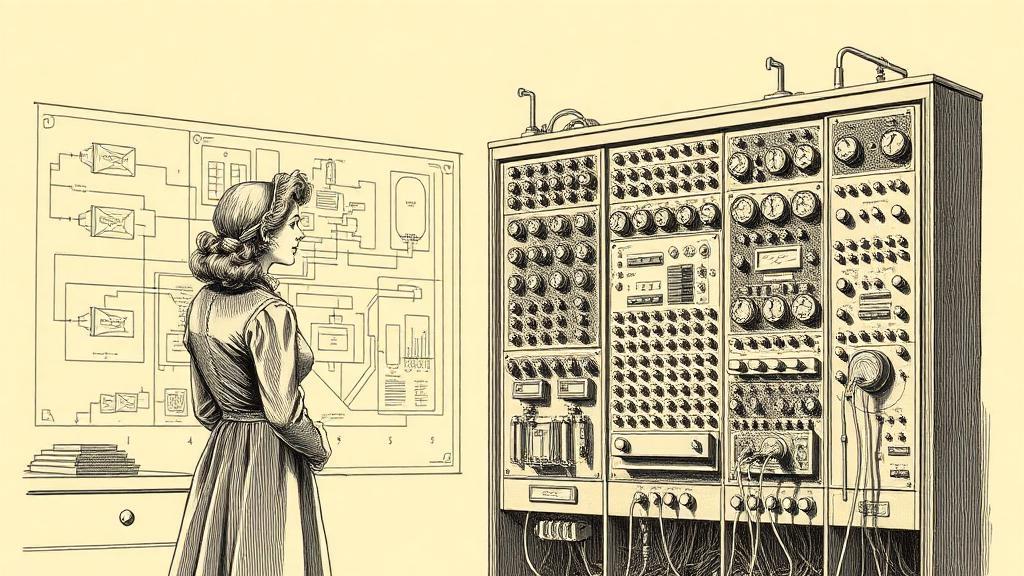
What emerged in the basement of Penn’s Moore School of Electrical Engineering was not subtle. The ENIAC — Electronic Numerical Integrator and Computer — stood ten feet tall and ran 100 feet along the wall. It weighed over 30 tons, contained 18,000 vacuum tubes, 70,000 resistors, and nearly five million hand-soldered joints. It consumed 150 kilowatts of electricity and could perform 5,000 additions per second — roughly 1,000 times faster than the electromechanical relay machines it replaced. Cost: $487,000, or about $7 million today.
Reprogramming it was a physical act. For each new problem, operators reconfigured hundreds of cables and flipped thousands of switches — a process that could take days. The six women assigned to make it work — Kay McNulty, Jean Bartik, Betty Holberton, Marlyn Wescoff, Fran Bilas, and Ruth Lichterman — came from the Army’s human-computer corps and received their assignment in 1945: make the ENIAC trace ballistics trajectories. Their resources were a set of wiring schematics; they had no access to the machine while it was still being built. As Bartik later recalled, working from the diagrams was how they “began to understand what it could and what it could not do.” They created debugging technique and programming logic from scratch.
Their February 15 demonstration ran flawlessly. The ENIAC fired a virtual shell across the room in seconds. The press declared a new age. At the formal dinner that followed, the generals and engineers raised their glasses. None of the six programmers were present — not invited, per every account of the event. They were not recognized publicly until 1997, when Kathy Kleiman’s research led to their induction into the Women in Technology International Hall of Fame.
What ENIAC set loose went well beyond ballistics. During its decade of operation — it ran until 1955, when a lightning strike finally stopped it — the machine may have performed more calculations than all of humanity had done before it. The conversations at Moore School had also drawn in mathematician John von Neumann, whose 1945 draft report on the EDVAC laid out the stored-program concept — instructions and data held in the same addressable memory — that became the template for nearly every computer since. The answer the six women had worked out by hand and by wire — how to give a machine instructions — turned out to be the only question in computing that really mattered.
Sources
- ENIAC — Wikipedia — Technical specifications, completion and dedication dates, the six programmers, and the exclusion from the February 1946 dinner.
- The world’s first general-purpose computer turns 75 — Penn Today — The six programmers by name, Bartik’s quote on learning from diagrams, and the 1997 Hall of Fame induction.
- ENIAC — Computer History Museum — ENIAC’s decade of operation, volume of calculations performed, and context on the machine’s service life.