The report that named an architecture and killed a patent
On June 25, 1945, twenty-four engineers and administrators at the University of Pennsylvania’s Moore School of Electrical Engineering each received a mimeographed copy of a 101-page document. The title page read “First Draft of a Report on the EDVAC.” The author listed was John von Neumann. The names of J. Presper Eckert and John Mauchly — who had built ENIAC and were now designing EDVAC as its successor — were nowhere on it.
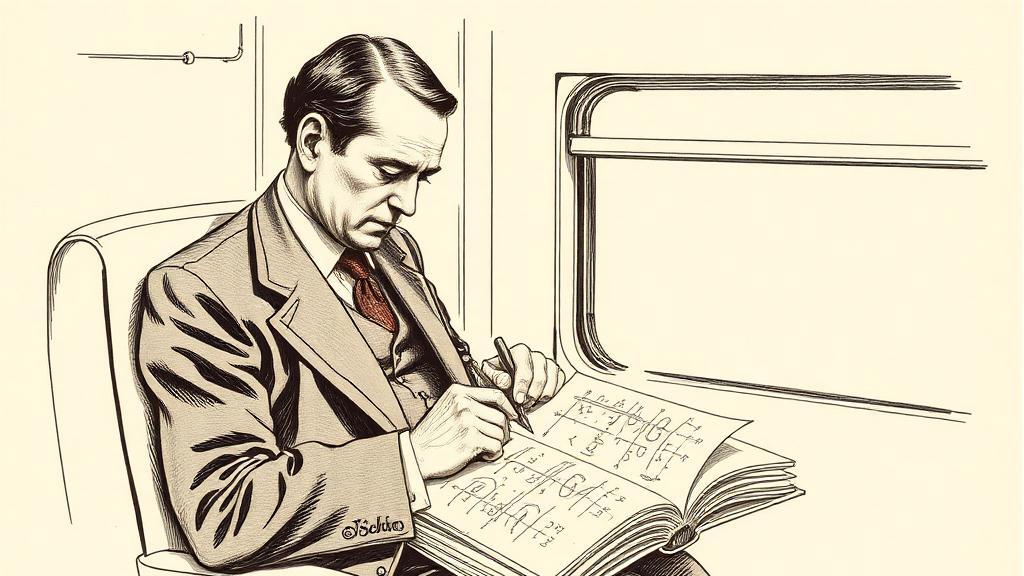
Von Neumann had written the draft by hand while commuting between Philadelphia and Los Alamos, where he was consulting on the Manhattan Project. He mailed his handwritten notes east; Herman Goldstine, the Army officer serving as liaison to the Moore School project, had them typed, duplicated, and sent out — under von Neumann’s name alone (Wikipedia). The document was incomplete, visibly a work in progress. It was also, without planning to be, one of the most influential technical papers in computing history.
What the draft described was the stored-program computer. ENIAC, just completed, required its operators to rewire it — plugboards, patch cables, manual switch settings — each time they wanted to run a different calculation. Von Neumann’s report sketched a different machine: one that held its program in the same memory as its data, represented in the same notation, operated on by the same circuits. Five components: a central arithmetic unit, a control unit, a unified memory holding both instructions and data, input mechanisms, and output mechanisms (Wikipedia). The implication was enormous: to change what the machine did, you changed what was in memory. No rewiring. No new machine.
The credit question did not stay academic. Eckert and Mauchly had been developing the stored-program concept before von Neumann joined the project; several team members argued that his contribution was primarily to translate their engineering conversations into the formal mathematical notation he knew cold. When Eckert and Mauchly later filed a patent for the EDVAC’s design, a court ruled that Goldstine’s distribution of the draft counted as a public disclosure — one that had occurred more than a year before the patent application — and the patent was rendered unenforceable (Wikipedia). The report that made von Neumann’s name synonymous with computing architecture also, quietly, destroyed the principal inventors’ intellectual property.
The mimeographed copies traveled. Maurice Wilkes at Cambridge read one in 1946, flew to Philadelphia to attend the Moore School’s lectures on the EDVAC design, and returned to England to build the EDSAC — Electronic Delay Storage Automatic Calculator, completed in 1949, among the first machines to fully implement the architecture the draft had outlined. From EDSAC the design propagated into every commercial, academic, and eventually personal computer that followed (Computer History Museum). The architecture had named itself, however imperfectly, and the name stuck.
Every computer science textbook still opens with the von Neumann architecture. Whether the naming is fair is a question historians have been arguing for eighty years. The architecture itself has not been seriously revised.
Sources
- First Draft of a Report on the EDVAC — Wikipedia — date of distribution, von Neumann writing on the train, Goldstine’s circulation, patent ruled unenforceable.
- Von Neumann architecture — Wikipedia — five components of the architecture, stored-program concept, attribution controversy with Eckert and Mauchly.
- 1945 — Computer History Museum — von Neumann’s EDVAC report, Maurice Wilkes reading the draft and building EDSAC, legacy of the stored-program design.