The Federal Reserve, or the duck hunt that never happened
In the autumn of 1907, a 70-year-old banker named J.P. Morgan locked the door of his Madison Avenue library and told a room full of New York’s most powerful financiers they were not leaving until they pledged enough money to keep the American banking system upright. They stayed until 4:30 in the morning. The system survived. But everyone in that room understood that the United States had just survived a national emergency on the private credit of one man — and that man was nearly seventy-one.
The panic had started on October 16, when a bid to corner the United Copper Company stock collapsed and triggered a chain of bank runs. By October 22, the Knickerbocker Trust Company — second-largest trust in New York — had failed outright. Real GDP shrank more than ten percent over the following year, roughly double the contraction in 2008. Morgan’s midnight intervention worked, but the lesson was obvious: you cannot run the world’s largest economy on the availability of one private banker at one in the morning.
Congress responded by creating the National Monetary Commission in 1908, chaired by Rhode Island Senator Nelson Aldrich. Aldrich spent two years studying European central banks and returned convinced that America needed a lender of last resort — something capable of expanding the money supply in a crisis and contracting it afterward. The question was whether such a thing could be built without simply handing the money supply to the New York banks that already controlled most of everything else.
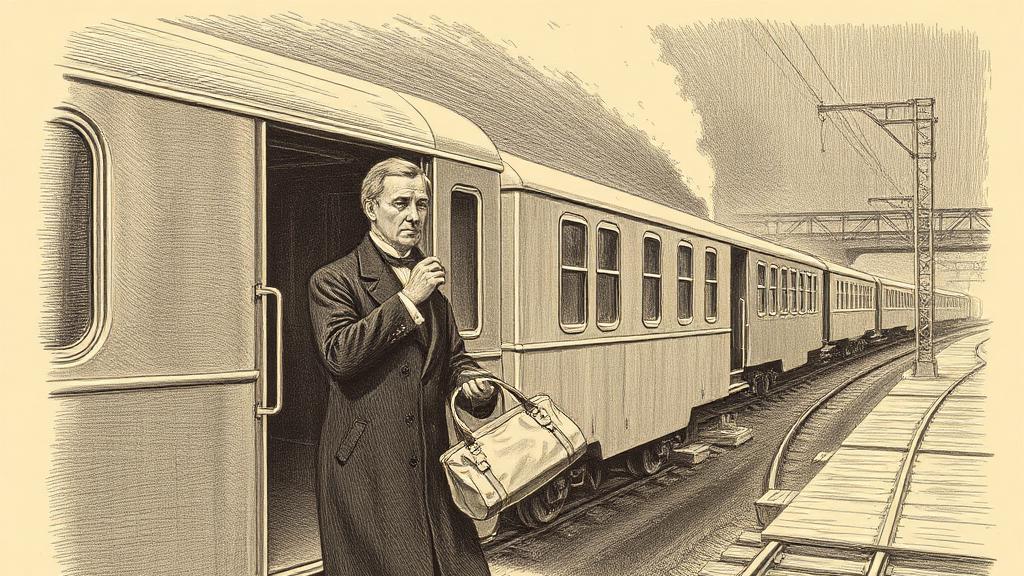
Aldrich’s answer arrived in secret. On November 22, 1910, six men boarded a private railcar in Hoboken, New Jersey, and traveled south to the Jekyll Island Club on the Georgia coast, telling anyone who asked that they were going duck hunting. Aldrich had instructed each to travel separately and use first names only — or to adopt false ones entirely — so that railroad staff couldn’t identify the party (Market Histories). The six were Aldrich; Henry Davison of J.P. Morgan & Co.; Frank Vanderlip of National City Bank; Paul Warburg of Kuhn, Loeb & Co.; Harvard economist and Treasury official A. Piatt Andrew; and Aldrich’s secretary Arthur Shelton. Over nine days, they drafted the “Aldrich Plan” — a National Reserve Association with fifteen branches, issuing an elastic currency against commercial paper. None of them admitted the meeting had taken place until Vanderlip published a memoir in 1935.
The plan never passed as written. Democrats called it a gift to the “money trust.” Woodrow Wilson won the 1912 election running against that trust, and the design shifted accordingly. Congressman Carter Glass of Virginia and Senator Robert Owen of Oklahoma rewrote the Aldrich blueprint with a crucial change: oversight would sit with a Federal Reserve Board whose members the president appointed and the Senate confirmed — public governance, not banker governance. The Senate passed the result 43 to 25 on December 22, 1913, with every present Democrat in favor and nearly every Republican against. Wilson signed it the following evening at six o’clock, initialing with several pens — then a new custom — while Democratic whip J. Hamilton Lewis offered a deadpan explanation: “The bill itself was made in installments, Mr. President.”
Twelve regional Federal Reserve Banks opened in 1914. The era in which the American financial system rested on J.P. Morgan’s willingness to stay up past midnight was over. Whether what replaced it was more reliable — that question, the country has been answering ever since.
Sources
- The Final Crisis Chronicle: The Panic of 1907 — Liberty Street Economics, Federal Reserve Bank of New York — Panic timeline, Knickerbocker Trust failure, J.P. Morgan’s role, GDP contraction figures.
- Senate Passes the Federal Reserve Act — U.S. Senate History — Vote count, Wilson signing at 6 p.m. December 23, J. Hamilton Lewis quote.
- The Federal Reserve Founding — Market Histories — Jekyll Island attendees, secrecy measures, Aldrich Plan structure, Vanderlip’s 1935 memoir.