Federal Aid Road Act: the law that fixed the mud
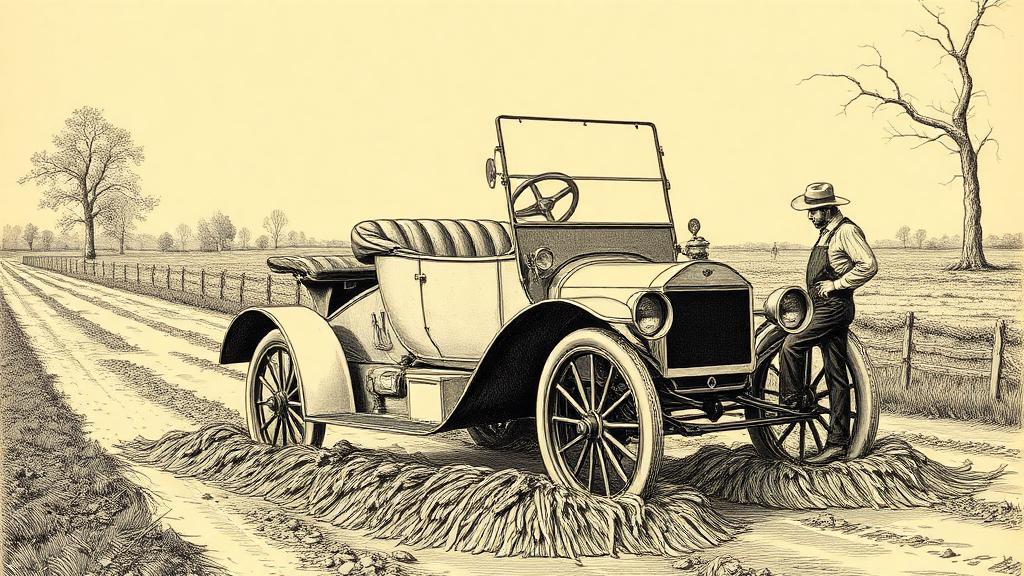
The road from Springfield, Missouri, on a dry morning in 1916, was something a Ford Model T could manage. After the rains — any rains — the same stretch dissolved into mud deep enough to swallow an axle and hold it there. The United States that year had more automobiles than any other country on earth and, by most assessments, far fewer reliable roads to match: most of what connected one town to the next was dirt, maintained by nobody in particular and passable only at nature’s discretion.
On July 11, 1916, President Woodrow Wilson signed a bill officially titled “An Act to provide that the United States shall aid the States in the construction of rural post roads.” The law took its common name — the Bankhead–Shackleford Act — from its two sponsors: Representative Dorsey W. Shackleford of Missouri and Senator John H. Bankhead of Alabama (Wikipedia). Both men represented states where impassable spring roads meant crops spoiled before reaching a buyer. They had argued for years that a nation couldn’t move its mail, feed its cities, or transport its Army on seasonal mud.
The act was deliberately modest. It set aside $75 million, spread over five years, allocated among states by a formula that weighted geographic area, population, and existing road mileage. The federal government would pay half the cost of approved projects; states matched it dollar for dollar and submitted plans to the Secretary of Agriculture for review. One condition applied before any money changed hands: a state had to first establish a functioning highway department. By 1917, every state in the union had one (Wikipedia).
The Good Roads movement that produced the political will for the 1916 act did not begin with automobiles. In May 1880, cycling enthusiasts met in Newport, Rhode Island, to form the League of American Wheelmen — riders who found American roads unusable and said so, at sustained volume, for decades (Wikipedia). The League’s Good Roads magazine reached a million copies in circulation within three years of its 1892 launch. By the time Ford’s Model T made car ownership plausible for a working family, cyclists had already built the political architecture: lobbying networks, public sympathy, and the settled argument that road quality was a legitimate government concern. The automobile industry stepped into a coalition it had not assembled; the AAA inherited the League’s cause, already refined by two decades of grievance.
World War I consumed most of the act’s early momentum before it could be tested. Engineers shipped out and materials were diverted; the $10,000-per-mile federal cap proved too low for practical construction in any case (FHWA). The Federal Aid Highway Act of 1921 addressed those gaps, and the system that followed — numbered interstate routes, federal engineering standards, and the forty-seven-thousand-mile network dedicated in 1956 — traces its legal ancestry directly to Wilson’s pen on that July morning.
The cyclists who started the argument never got to drive on what they built.
Sources
- Federal Aid Road Act of 1916 — Wikipedia — sponsors Shackleford and Bankhead, $75 million funding, 50/50 matching, state highway department requirement, all states compliant by 1917.
- Good Roads Movement — Wikipedia — origin in the League of American Wheelmen (Newport, May 1880), Good Roads magazine circulation of one million, transition from cyclists to automobile advocates.
- Creation of a Landmark: The Federal Aid Road Act of 1916 — FHWA — Federal Highway Administration’s legislative history; $10,000-per-mile cap and WWI implementation delays.