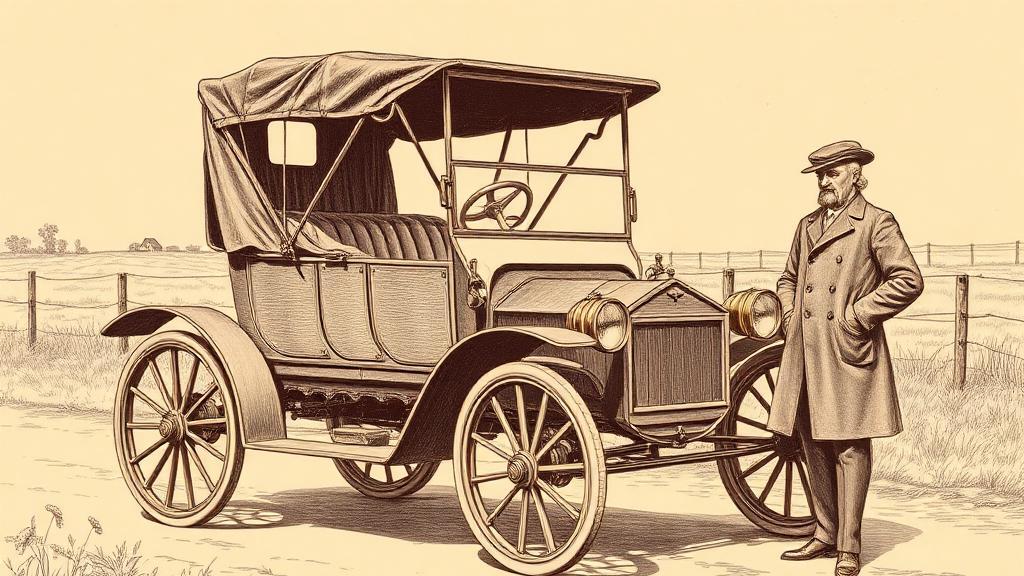
Ford Model T: the car for the great multitude
In January 1907, Henry Ford summoned a patternmaker named Charles Sorenson to the mostly empty third floor of the Piquette Avenue plant in Detroit and told him to build a room with a locked door. What went on inside was nobody else’s business.
That locked room — maybe twenty feet across, furnished with a rocking chair where Ford liked to sit and think — is where the Model T was designed. Two years of quiet engineering, and on October 1, 1908, Ford Motor Company publicly unveiled its new car. Within two days, dealers had placed fifteen thousand orders without having laid eyes on the actual vehicle.
The T was not the most powerful car on the road, nor the most elegant. It cost $850 at launch — in a market where decent automobiles ran $1,500 and up — and it looked like exactly what it was: a pragmatic piece of machinery designed for a country whose roads were, in most places, still mud. The frame flexed deliberately, letting all four wheels track independently over ruts. The planetary transmission replaced a hand-shifted gearbox with foot pedals, which meant a farmer who had never driven anything mechanical could learn in an afternoon.
Two engineering choices set the T apart from everything else. At a road race in 1905, Ford picked up a piece of a wrecked French car and had the steel analysed. It was a vanadium alloy — lighter and stronger than the carbon steel American manufacturers used — and he built the T’s frame and axles from it. The ignition used a magneto embedded in the flywheel, generating its own low-voltage current: no separate battery, no external power source. You cranked it, and it ran on itself.
Ford made his pricing intent plain. He wanted a car for what he called the great multitude — for farmers and mechanics, for people who would maintain it themselves with a wrench and a lantern. So he kept cutting the price as production scaled: the Touring model fell from $850 in 1909 to $360 by 1916, and to $265 by 1924. By 1922, Ford held fifty percent of the American automobile market.
There is a small story about colour that gets misremembered. The original Model T was available in red, green, gray, and blue — not black. It was only after 1913, when Ford moved production to Highland Park, that the palette narrowed to a single shade. Japan black enamel dried faster than any other paint, and in a factory where one chassis arrived every ninety-three seconds, drying time was a production variable. “Any customer can have a car painted any colour that he wants so long as it is black” describes the assembly line era, not the launch. The car had turned so popular that Ford could afford to be monotone.
By May 1927, when the last one rolled out the door, fifteen million Model Ts had been built across nineteen countries on six continents — the first automobile that could genuinely be called a world car. It had created roads by sheer demand, spawned the used-car market, trained a generation of shade-tree mechanics, and made the filling station as common as the general store.
Making a car cheap enough for a farmer is one kind of problem. Making enough of them for fifteen million farmers is a different one entirely — and what Ford built to solve it would change every factory that came after.
Sources
- Ford Model T — Wikipedia — engineering specifications, vanadium steel origin, planetary transmission, production history, colour policy timeline.
- Ford’s Model T: A Car for the Great Multitude — The Henry Ford — price history, dealer order figures, fifty-percent market share data, world-car claim.
- Ford Piquette Avenue Plant — fordpiquetteplant.org — the locked development room, Charles Sorenson’s role, early production details at Piquette.