The brass pot and the blotting paper: Melitta Bentz's 1908 coffee filter
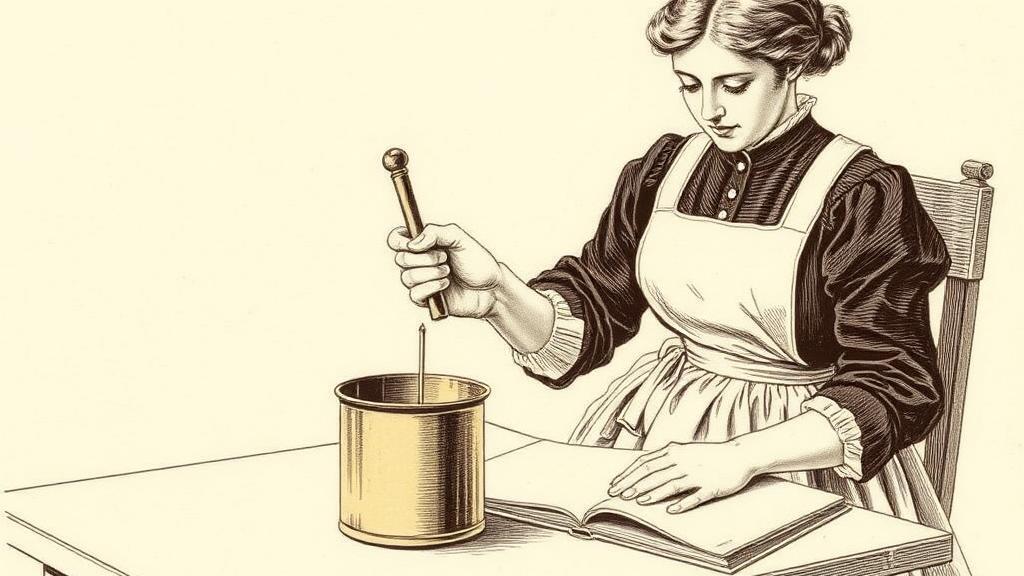
The nail went through brass. That was the easy part. Melitta Bentz had already decided that the lidded pot she was modifying would serve as the brew chamber — she just needed drainage. She tore a page of blotting paper from her son Willi’s school exercise book and lined the bottom. Ground coffee went on top. Boiling water went in. The cup that came out was clear.
Amalie Auguste Melitta Bentz was thirty-five years old and had lived with bad coffee long enough. Born Melitta Liebscher on 31 January 1873 in Dresden, she was a housewife with a precise palate and a low tolerance for the gritty dregs that every brewing method of the era delivered. Percolators overextracted and scorched. The metal and linen filters then in use trapped grounds imperfectly and were a nuisance to clean. The problem was not the coffee. The problem was the container.
She filed a utility model registration with the Imperial Patent Office on 20 June 1908. The office granted it on 8 July, recording the device as a “coffee filter with a domed underside, recessed bottom and inclined flow holes.” The language is technical and dry — the German patent office does not deal in poetry — but the underlying idea was elegant: water falls through the grounds under gravity, the paper catches what metal and cloth cannot, and the cup requires no apology to the drinker.
She registered the company that December. Starting capital: 72 Reichspfennig — less than a single cup of coffee at any decent café in the city. Her husband Hugo managed production while Melitta called on shops herself, demonstrating the device at counters across Dresden. Their sons Horst and Willi made the early deliveries by handcart.
The Leipzig trade fair in 1909 was the public test. She set up a stand, brewed coffee in front of visitors, and sold 1,250 filters before the fair closed. “People had to see it to be convinced of it,” Hugo said afterward. They had seen it.
The detail that lodges in memory is the notebook. Willi was still a schoolboy when his mother tore the blotting page from his exercise book; years later, he became a co-owner of the company bearing her name. His brother Horst recalled that their mother “was often irritated by the coffee grounds in her cup.” The filter she improvised from classroom supplies went on to solve that irritation for the better part of the next century.
What the paper filter unlocked was the separation of the brew cycle from the brewer’s vigilance. You no longer had to time a percolator or wring out a cloth filter or pick grounds from your teeth. The drip method Bentz had established was passive, repeatable, and clean — and automatic drip machines, from the Braun to Mr. Coffee, are all her direct heirs.
The company she started with 72 pfennigs now produces 50 million filters a day. Willi’s exercise book was, as it turned out, well spent.
Sources
- Melitta Bentz — DPMA (German Patent and Trade Mark Office) — utility model registration date (20 June 1908), industrial property right granted (8 July 1908), Leipzig 1909 fair.
- 110 years of the coffee filter — DPMA — company registration (15 December 1908), 72 Reichspfennig starting capital, patent device description, 50 million filters daily figure.
- Melitta Bentz — Wikipedia — full name (Amalie Auguste Melitta Liebscher), birth date, sons Horst and Willi, husband Hugo, blotting paper from Willi’s exercise book, subsequent company growth.
- Overlooked No More: Melitta Bentz — WRAL — 1,250 filters sold at Leipzig; Hugo’s quote; Horst’s recollection; handcart deliveries.