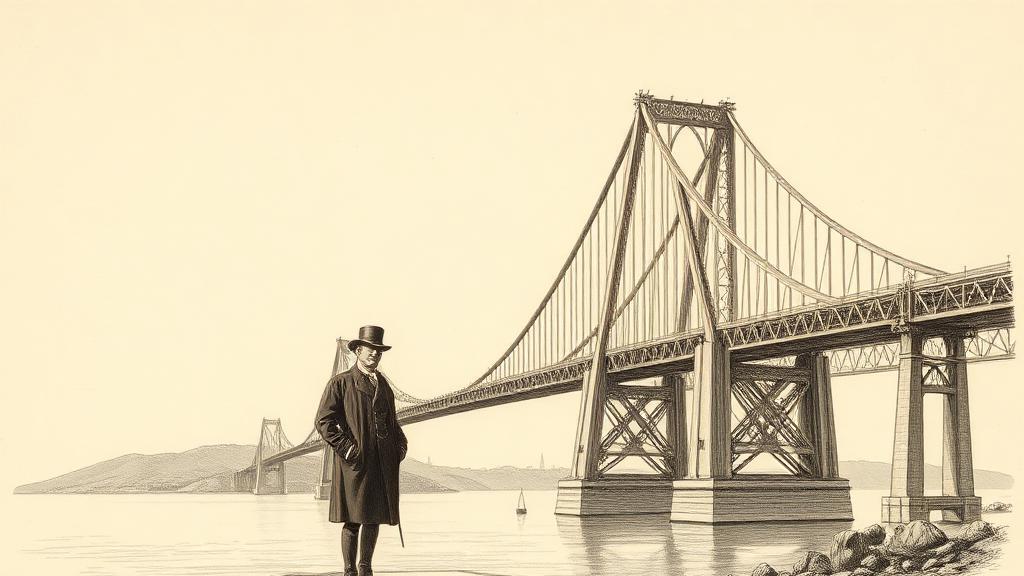
The Forth Bridge: steel, cantilevers, and a lesson from the Tay
The night train from Edinburgh to Dundee was halfway across the Tay Bridge when the wind took it. It was 28 December 1879, a Sunday evening, and the gale had been building all day. Thomas Bouch’s bridge — opened only eighteen months earlier to popular acclaim — had been designed to withstand roughly 10 lbs per square foot of lateral wind pressure. The actual loading that evening was closer to 50. Eleven central spans collapsed. The locomotive and its six carriages went into the Tay. Seventy-five people died.
Fifteen miles to the south, the Firth of Forth was already under consideration for a railway crossing. Bouch had a design for that too: a grand suspension bridge. The inquiry returned its verdict — the structure had been “badly designed, badly constructed and badly maintained” — Bouch died within the year, and his Forth Bridge drawings died with him. Parliament authorized a fresh start. The new engineers were John Fowler and Benjamin Baker, and they had absorbed the lesson.
Their answer was a cantilever: three diamond-frame towers, each rising 330 feet above the waterline at Queensferry, supporting two main spans of 1,710 feet each. The Board of Trade, suitably chastened, mandated lateral wind loading of 56 lbs per square foot — more than five times Bouch’s figure. The structure was built entirely from mild steel, the first bridge of its scale to abandon wrought iron. At peak, 4,600 workers were on site; by opening day, the bridge had consumed 55,000 tonnes of steel, 6.5 million rivets, and the lives of 73 men.
In 1887, midway through construction, Baker needed to explain the cantilever principle to a skeptical public. He staged a demonstration. Baker and Fowler sat in chairs on either side of Kaichi Watanabe, a Japanese engineer who had come to Scotland to study the project. Each man gripped one of Watanabe’s outstretched hands, representing the cantilever arms in tension; wooden sticks on their outer shoulders carried the compression. The Forth Bridges The photograph survives: three men sitting in a field, holding still, being a bridge.
The structure opened on 4 March 1890, when the Prince of Wales drove a golden rivet at the south tower. Fowler was made a baronet; Baker and William Arrol, the Glasgow contractor who had started in a cotton mill at age nine, were knighted the same day.
The bridge held the world record for single cantilever span until 1919, when Canada’s Quebec Bridge edged past it. That it fell to a longer bridge rather than to another disaster was precisely the point Baker had been arguing in every lecture, every demonstration, with a willing Japanese engineer and two wooden sticks. He built not to break a record but to not come down — and every bridge specification written since has carried, somewhere in its wind-load tables, the ghost of a Sunday night in December 1879.
Sources
- Forth Bridge — Wikipedia — construction timeline, statistics (steel, rivets, deaths), Tay Bridge context, wind loading mandate, opening ceremony.
- The Forth Bridge Builders — theforthbridges.org — biographical details on Fowler, Baker, and Arrol; the Baker-Watanabe cantilever demonstration.