Bertha Benz and the first road trip
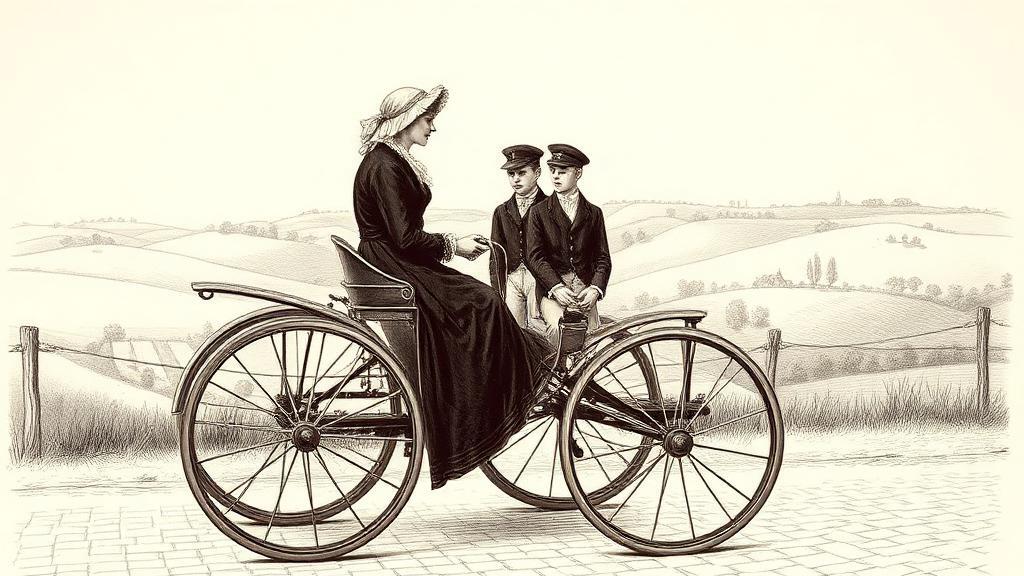
Before dawn on 5 August 1888, Bertha Benz left a note for her husband, roused her two sons, and drove the Benz Patent-Motorwagen out of Mannheim without asking permission. She did not tell Karl where she was going. He found out when she telegraphed from Pforzheim, 106 kilometres away.
The vehicle was the same three-wheeled gasoline automobile that Karl had patented under Imperial Patent No. 37435 in January 1886 — now inscribed in the UNESCO Memory of the World Register. By the summer of 1888 it had been demonstrated publicly in Mannheim, but it had never been tested over a real distance. Karl, constitutionally cautious, had confined it to short loops near the workshop. Bertha had been watching this hesitation for two years and had apparently reached a conclusion about whose nerve was the limiting factor.
Her sons Richard and Eugen were fifteen and thirteen. Their stated destination was Bertha’s mother’s house in Pforzheim. Their actual mission — whether she named it that or not — was to prove the car could travel.
The route ran south from Mannheim through Heidelberg and on toward the foothills above the Rhine plain. The engine ran on ligroin, a petroleum distillate sold as a cleaning solvent, and the tank was small enough to require refilling along the way. No filling station existed because no long-distance automobile journey had been attempted before. In Wiesloch, Bertha walked into the town pharmacy and bought the entire available supply of ligroin. The Stadtapotheke in Wiesloch is now recognised as the world’s first petrol station.
The repairs accumulated as the day went on: a blocked fuel line, cleared with her hat pin; a fraying ignition wire, wrapped in her garter. When the wooden brake blocks wore down on the descents, she stopped at a cobbler’s shop and had him nail leather strips onto them — the first brake linings in automotive history. On the steeper gradients, Richard drove and Bertha and Eugen pushed. They reached Pforzheim that afternoon, sent Karl a telegram, and waited.
He had reportedly spent the day looking for his car.
The return trip came two days later over a different road. The engineering notes Bertha brought home were direct: the car needed a lower gear for hill climbing. Karl implemented it in the next model. That third gear became standard equipment on every automobile that came after. The commercial sales that had stalled at public exhibitions began arriving once newspapers reported the journey.
Karl Benz later remarked: “She was more daring than I.”
Bertha had co-financed the company with her dowry and kept it solvent through years of near-bankruptcy. She had now field-tested the product, repaired it on the road, identified its weaknesses, and driven it into the historical record. What the patent had established on paper in 1886, the road confirmed in August 1888: the automobile could carry people somewhere. Every road trip since has followed the route she mapped without a map.
Sources
- Bertha Benz — Wikipedia — date, sons’ names and ages, fuel stop at Wiesloch, mechanical repairs, commercial sales aftermath.
- Bertha Benz — National Motor Museum, Beaulieu — Wiesloch pharmacy stop, brake lining at cobbler’s shop, Karl’s quote, route details.
- Bertha Benz — DPMA (German Patent and Trade Mark Office) — Patent DE 37435, UNESCO Memory of the World inscription, third-gear recommendation and implementation.