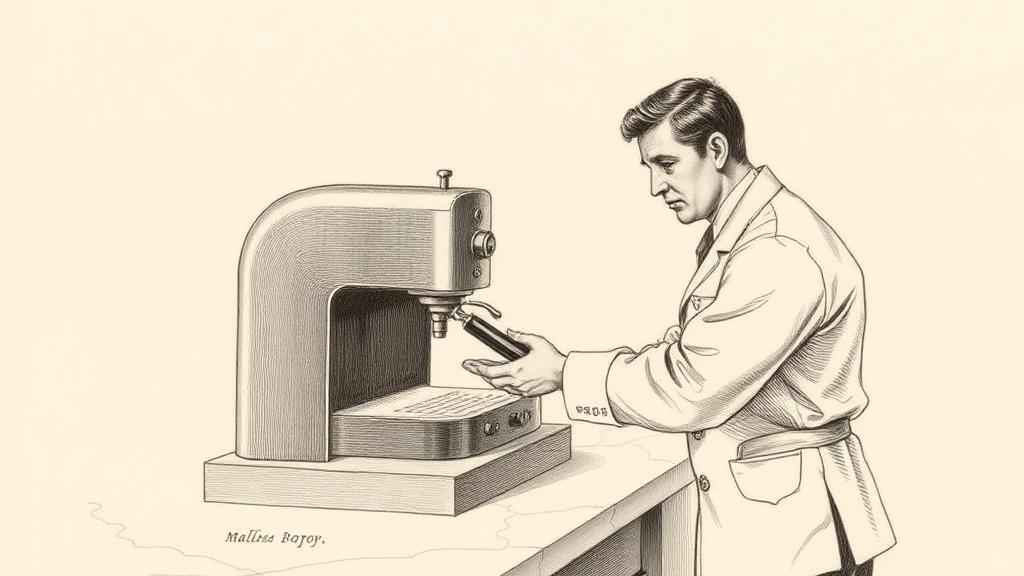
Achille Gaggia and the cream nobody ordered
On August 8, 1947, Achille Gaggia filed a patent in Milan for a coffee machine nobody had seen before. The mechanism was simple: a barista pulled a chrome lever down, compressing a steel spring; when released, the spring drove a piston through a cylinder of hot water, pressing it through twenty grams of ground coffee at roughly eight bar of pressure. That is five times what the best pre-war espresso machines could manage. The device produced a shot in twenty-five seconds. It also, as a side effect nobody had anticipated, produced cream.
Gaggia had spent a decade arriving at this moment. He ran Caffè Achille on Viale Premuda in Milan and had served coffee the same way every other Milanese barman did — from a column-style steam machine that forced overheated steam through the grounds. Steam is water above 100°C, and 100°C scorches coffee, producing the thin, bitter cup that prewar Italy had accepted as espresso. Gaggia did not accept it. In September 1938 he filed his first patent, number 365726, for what he called the “Sistema Lampo” — a steamless machine that would press hot water, not steam, through the coffee under pressure. The idea was right. The execution still needed something.
The lever gave him the something. By compressing a spring mechanically rather than building pressure in a boiler, Gaggia’s 1947 design pushed water through the grounds at 8 to 10 bar — and did it with water at brewing temperature, not superheated steam. The result was a cleaner extraction: the oils in the coffee dissolved properly, the bitterness from scorched grounds disappeared, and a reddish-brown foam appeared on the surface of the cup. This was crema, though nobody had a name for it yet.
The foam puzzled customers. Gaggia’s answer was to name it before anyone else could define it poorly. He installed his machines at Motta & Biffi in Milan’s Galleria Vittorio Emanuele II and hung signs in the windows reading Crema caffè di caffè naturale — natural coffee cream. The implication was clear: the foam was not a defect, it was the point. The Galleria was one of the most elegant arcades in Europe, and if Motta & Biffi served it, Milan decided it must be worth drinking.
The lever design settled another question without meaning to. The cylinder on a lever group held only enough water for about thirty milliliters — one ounce, roughly. That physical limit became the volume of a single espresso shot, set not by any committee or trade standard but because the hardware made anything larger impossible. “Pulling a shot” is still the term baristas use, decades after anyone pulled an actual lever.
In 1961, Faema — which had helped manufacture Gaggia’s first machines under the name Officine Faema Brevetti Gaggia — launched the E-61 pump machine. An electric pump replaced the human arm, achieving the same 9 bar automatically. Faema borrowed the pressure target that Gaggia had arrived at by experiment and made it a design specification. Every espresso machine built since has been, in some sense, trying to match the output of a spring-loaded piston in a Milanese café.
Sources
- Gaggia — Wikipedia — biography of Achille Gaggia (1895–1961), Motta & Biffi installation, company founding 1947–48.
- The Long History of the Espresso Machine — Smithsonian Magazine — pressure increase from 1.5–2 bar to 8–10 bar, lever mechanism, standardization of espresso shot volume.
- 85 Years of Heritage 1938–1947 — Gaggia — patent dates, Sistema Lampo, Viale Premuda café background, crema naturale origin.