Garay: the alphabet born in sand
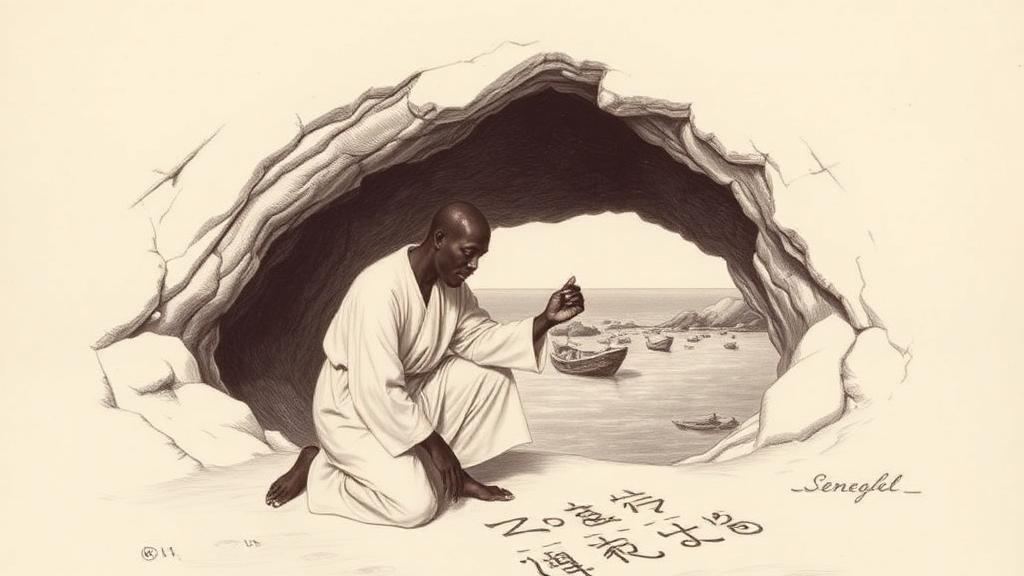
Assane Faye knelt in the sand near a Senegalese cave and started writing — then called to a friend to bring him something to write on. The cave near his coastal village of Yen was called Garay, for the whiteness of its walls, the colour of the cotton flower. It was 1961, the year after Léopold Sédar Senghor made his independence radio address asking Senegalese people to come and build this new country. Faye had been thinking about what that building looked like from where he stood. At Garay, an answer arrived.
What came out of that visit was an alphabet. Garay, named for the cave, was designed specifically for Wolof, the language spoken by roughly half the population of Senegal. Wolof had long been written — in Latin letters carried by French colonial education, or in the Arabic-influenced Wolofal script of the mosques — but neither system had been made for Wolof. Both were inheritances from elsewhere, and Faye, by all accounts, felt the difference.
The finished script has 25 consonants and 14 vowels, runs right to left like Arabic, but keeps its letters separate and unjoined. Scholars have noted one feature reportedly unparalleled in the documented history of writing: in Garay, every word self-underlines, the lower strokes of adjacent letters forming a continuous baseline that marks word boundaries without added punctuation. Capitals — distinguished by decorative swashes — denote sentence beginnings and proper names. It is a complete working system, not a sketch.
For thirty years Garay spread only through Faye’s own effort: face-to-face teaching, handwritten notebooks, word of mouth. He translated the Quran into the script and filled notebooks with textbooks, folktales, maps, and lessons in mathematics. A women’s adult literacy program in Dakar took it up. The script crossed language lines into Mandinka. But without keyboards, print infrastructure, or official recognition, it stayed in the margins. In 2009, Charles Riley, a librarian at Yale, visited Faye and helped digitize five surviving texts — the first systematic archiving of what had accumulated across fifty years of notebooks. Then came a digital font, a Facebook page, YouTube tutorials run by Faye’s son Souleiman. In 2019, the script appeared on the bridge monitors of the USS Discovery in Star Trek: Discovery — a form of cultural recognition not normally available to endangered alphabets.
Faye died in October 2021, three years before the recognition that might have mattered most. On 10 September 2024, the Unicode Consortium released version 16.0, assigning Garay the range U+10D40 to U+10D8F — 69 code points for a script that had waited 63 years for a digital address. It joined six other newcomers in that release: the medieval Albanian Todhri, the South Indian Tulu-Tigalari, and four scripts from Nepal and northeastern India.
Unicode encoding doesn’t make Wolof speakers reach for a Garay keyboard. The Latin letters will stay where they are. But a code point is a different kind of claim: it says the thing existed, that it merited coordinates in the permanent record. Faye made that claim in sand in 1961. The Consortium filed the paperwork in 2024.
Sources
- Garay alphabet — Wikipedia — origin (1961), script structure, right-to-left directionality, Unicode block U+10D40–U+10D8F.
- Garay — Endangered Alphabets Project — Senghor radio address, cave near Yen, sand vision, Quran translation, Yale librarian visit 2009, Faye’s death October 2021, self-underlining feature.
- The Garay Alphabet — JangaWolof — design philosophy, Wolof adoption challenges, women’s literacy program in Dakar, Mandinka usage, Unicode encoding significance.
- Unicode 16.0 — Unicode Consortium Blog — release date 10 September 2024, seven new scripts, total 154,998 characters.