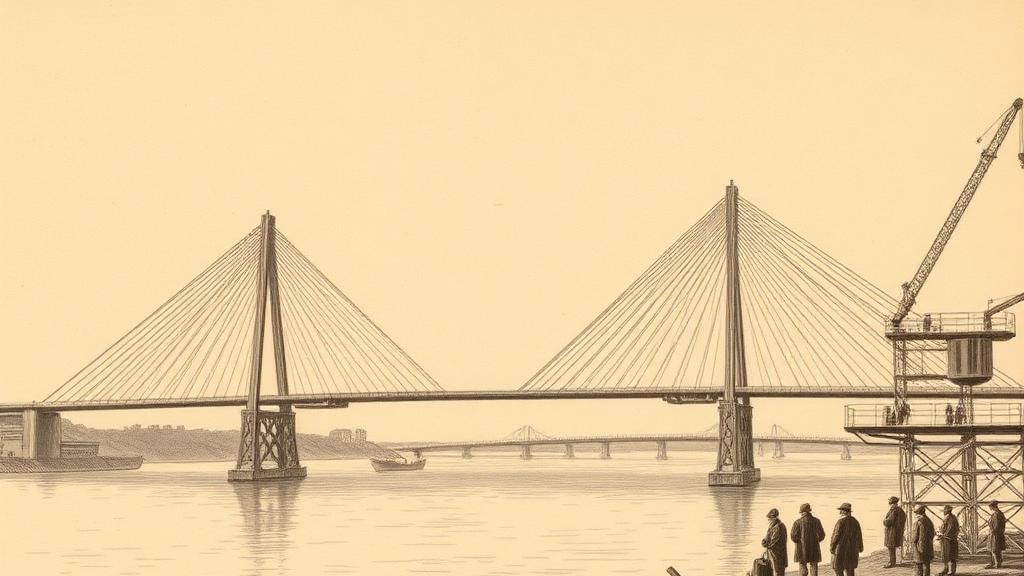
The Gordie Howe International Bridge
Down the centerline of the Detroit River, at first light on June 14, 2024, two cranes held the two halves of a cable-stayed bridge centimetres apart above the water. Construction workers maneuvered the sections together, the steel met, and a Canadian worker and an American worker shook hands above the river. The Gordie Howe International Bridge was, at that moment, one piece. It had taken twenty-three years.
The Windsor-Detroit corridor is the busiest international land border crossing in North America, processing hundreds of millions of dollars in goods every day. Auto parts shuttle back and forth across the river on a just-in-time schedule that treats the international border as an inconvenience rather than a line. The two existing crossings — the Ambassador Bridge (opened 1929) and the Detroit-Windsor Tunnel (1930) — were built for the traffic volumes of a pre-war world. By the early 2000s, planners on both sides had been arguing about a third crossing for years.
The bridge that emerged is a cable-stayed span with a main span of 853 metres, the longest of its kind in North America. Its two towers rise 220 metres and were shaped to suggest hockey sticks at the apex of a slapshot — the city’s homage to its namesake, rendered in concrete and steel. Total length: 2.5 kilometres, carrying six lanes of traffic and a separated bicycle-and-pedestrian path. The “Bridging North America” consortium — AECOM, Dragados Canada, Fluor, and Aecon — deployed 2,300 workers at peak. Canada funded the project entirely, at a total of CA$6.4 billion, with costs to be recovered through tolls.
The human obstacle was a billionaire named Manuel Moroun. His family owned the Ambassador Bridge, and the prospect of a publicly funded competitor threatened the private toll revenue it generated. When Canadian and Michigan officials agreed to the project in June 2012, Moroun spent more than US$30 million bankrolling a Michigan ballot measure that would have required legislative approval for any new international crossing — a veto by proxy. Michigan voters rejected it 60 to 40. The project survived. It nearly stopped again in February 2026, when Trump threatened to block the opening after the Moroun family donated US$1 million to a Trump political fund. A compromise — Canada agreed to direct half of net toll profits to a U.S. economic development fund for fifteen years — resolved it, and on July 27, 2026, the first vehicles crossed.
What the corridor gained was not only a third crossing but a direct freeway connection. The Ambassador Bridge deposits traffic into city streets on the Canadian side; the Gordie Howe links Ontario Highway 401 to Interstate 75 without a traffic light in between. The difference matters because when the Ambassador Bridge was blockaded by protesters in February 2022, auto plants on both sides of the border began idling within forty-eight hours. The corridor’s dependence on a single, privately owned chokepoint had been obvious for decades; the new bridge distributes the risk.
Gordie Howe was born in Floral, Saskatchewan, in 1928, played twenty-five seasons for the Detroit Red Wings, and died in Sylvania, Ohio, on June 10, 2016 — two years before the first steel was placed. The bridge named for him runs above the river that separates the country of his birth from the city where he made his name. He never crossed it.
Sources
- Gordie Howe International Bridge — Wikipedia — engineering specifications, construction timeline, Moroun ballot campaign, Trump threat, cost breakdown, naming history.
- The Gordie Howe International Bridge will open on July 27th — Canada.ca — official government announcement, trade significance at Detroit-Windsor corridor, toll agreements.