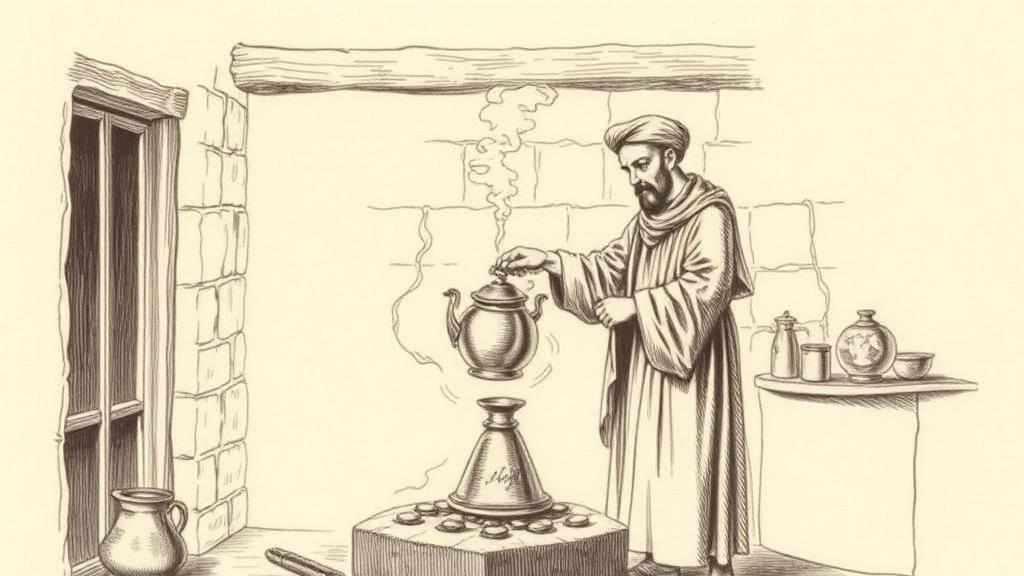
A large shop in Tahtakale: Istanbul's first coffeehouse
In the autumn of 1554, two Syrian merchants set up a shop in Tahtakale, the commercial district of Istanbul, and served coffee from cushioned benches. One man was Hakem, a trader from Aleppo. The other was Shems, from Damascus. Neither one knew he had just invented a room that the world would spend the next five centuries trying to replicate.
The Ottoman chronicler İbrahim Peçevi, writing some years later, described the founding in his chronicle: “a fellow called Hakam from Aleppo and a wag called Shems from Damascus” opened “a large shop” in Tahtakale and filled it with “pleasure seekers and idlers, and also of the wits from among the men of letters.” The drink was qahwa, already well established in Mecca and Cairo by this point, but new to Istanbul. It had traveled north with returning pilgrims and Ottoman officials who had encountered it in Yemen and Egypt, and Hakem and Shems bet that a city of half a million people might want somewhere to sit and drink it in company (History of coffee — Wikipedia).
Within a year, more shops had appeared on the same streets. By 1560, Istanbul had roughly fifty coffeehouses. One lane in Tahtakale acquired a name — Tahmis Sokak, meaning Roasted and Ground Coffee Street — that it has not surrendered since. Inside these rooms, the mix of customers was the remarkable thing: Peçevi records merchants, poets, legal scholars, and janissaries sharing benches, playing chess, listening to professional storytellers, and arguing about literature and current affairs (Ottoman Coffeehouse — Wikipedia). No institution in the Ottoman city had offered quite this combination before. The mosque required prayer. The bazaar required commerce. The coffeehouse required only a coin and a willingness to sit.
Not everyone considered this a virtue. Ebussuud Efendi, the şeyhülislam — the empire’s chief legal jurist — under Sultan Suleiman, issued a fatwa against coffeehouses. His legal argument rested on the beans: roasted black, they fell into the same category as charcoal, which was prohibited by religious law. Coffee was therefore charcoal-water, and coffeehouses were shops selling charcoal-water. Istanbul responded by quietly ignoring him. By the end of the century the city had around 600 of these establishments, and the lane named for roasted coffee was doing brisk trade (earthstoriez.com).
The idea traveled fast. European merchants and diplomats encountered coffeehouses in Ottoman ports and carried the blueprint home. By 1652 it had reached London. By 1700, London alone had more than 2,000 such establishments — working offices, news exchanges, proto-clubs where deals were struck and institutions were born. One of them, Edward Lloyd’s coffeehouse on Tower Street, eventually became Lloyd’s of London. None of it would have happened without two merchants from Syria deciding that a room in Tahtakale was worth renting.
What they sold for the price of a cup was not quite coffee. It was the room itself — neutral ground, cushioned benches, and an argument nobody had to finish.
Sources
- History of coffee — Wikipedia — İbrahim Peçevi’s account of Hakem of Aleppo and Shems of Damascus founding the first coffeehouse in Tahtakale, c. 1554; the spread of qahwa from Yemen and Egypt to Istanbul.
- Ottoman coffeehouse — Wikipedia — Social character of the Ottoman coffeehouse; Peçevi’s characterization of the clientele; growth from roughly 50 establishments by 1560 to 600 by end of the 16th century and 2,500 by the 19th century.
- History and Evolution of the Ottoman Coffeehouses of Istanbul — EarthStoriez — Tahtakale as the founding district; Tahmis Sokak (Roasted and Ground Coffee Street); Ebussuud Efendi’s charcoal fatwa; social mixing across class and profession.