The last joust: how a broken lance ended a king and a sport
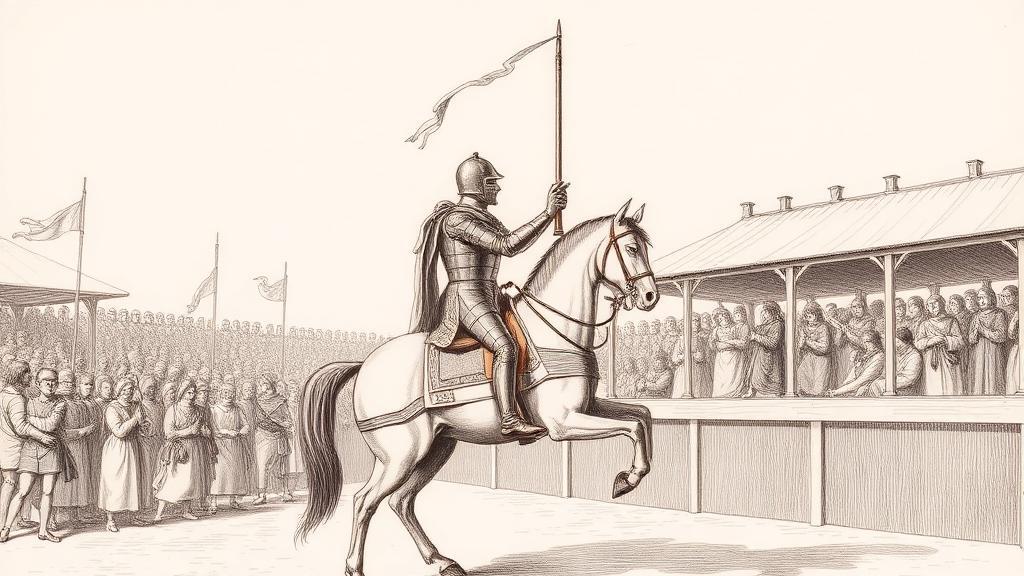
The tournament on the Rue Saint-Antoine had been going well. It was June 30, 1559, the last day of a three-day celebration marking the Peace of Cateau-Cambrésis — which had ended France’s long war with Spain — and the marriage of Henry II’s daughter Elisabeth to Philip II. The king had already ridden twice that afternoon, wearing black and white, the colors of his mistress Diane de Poitiers rather than those of his wife Catherine de Medici. He had ridden well. He had no reason to ride again.
He insisted on riding again.
His opponent was Gabriel de Montgomery, Count of Montgomery, captain of the Scottish Guard. Montgomery knew enough to be worried; he reportedly refused twice before the king overruled him. Catherine de Medici had already sent word begging her husband to stop. Henry ignored her, couched his lance, and spurred his horse down the lists.
Montgomery’s lance struck the king’s golden helmet and shattered. One long splinter slipped through the visor’s narrow opening into Henry’s right eye socket, driving into his brain. Henry was forty years old and had just become the most famous casualty in the history of his sport.
Ambroise Paré, France’s foremost surgeon, and Andreas Vesalius, the anatomist who had rewritten the field two decades earlier, were both summoned to the Hôtel des Tournelles. Modern medical analysis concludes that the foreign material triggered periorbital cellulitis and an interhemispheric empyema — in plain terms, bacteria from the splinter colonized a sealed cavity next to the brain, and infection did what lances could not. Henry II died on July 10, eleven days after the joust.
Before he died, the king absolved Montgomery of blame. The absolution did not last long in Catherine de Medici’s memory. Montgomery fled to Normandy, converted to Protestantism, and threw himself into the French Wars of Religion that followed — as if Henry’s death had not merely killed a man but cracked open the country. Catherine never forgave him. In 1574, fifteen years after the joust and now ruling France as regent, she had Montgomery captured and beheaded in Paris. The man who had broken his lance on a king’s helmet paid for it with his head, in a city governed by the dead king’s widow.
Jousting itself did not die on the Rue Saint-Antoine that afternoon — the sport persisted in European courts into the early seventeenth century, as the New World Encyclopedia’s jousting history notes. But Henry’s death stripped it of its central fiction: that knights in armour could collide at speed and walk away ennobled. The fiction had been wearing thin for a century already. Gunpowder had made plate armour ceremonial and the mounted lance a period piece. What Henry’s accident did was provide the necessary embarrassment — a king dead from a splinter, two of the greatest physicians in Europe helpless beside the bed.
Europe’s tilting yards went quiet within a generation. The tournament had started as a rehearsal for war; by 1559, it had become its parody. The cannon did not need to rehearse.
Sources
- Missed History — A Jousting Splinter Killed the King of France — tournament context, Peace of Cateau-Cambrésis, Rue Saint-Antoine location, narrative of the accident
- Tudor Society — June 30, 1559 — Montgomery’s reluctance, Catherine de Medici’s warning, Diane de Poitiers’s colors, the Hôtel des Tournelles
- Wikipedia — Gabriel de Lorges, Count of Montgomery — Henry’s absolution, Montgomery’s flight, conversion, Huguenot service, and 1574 execution
- PubMed — The last ride of Henry II of France — medical analysis: periorbital cellulitis and interhemispheric empyema
- New World Encyclopedia — Jousting — persistence of jousting into the early seventeenth century and overall historical context