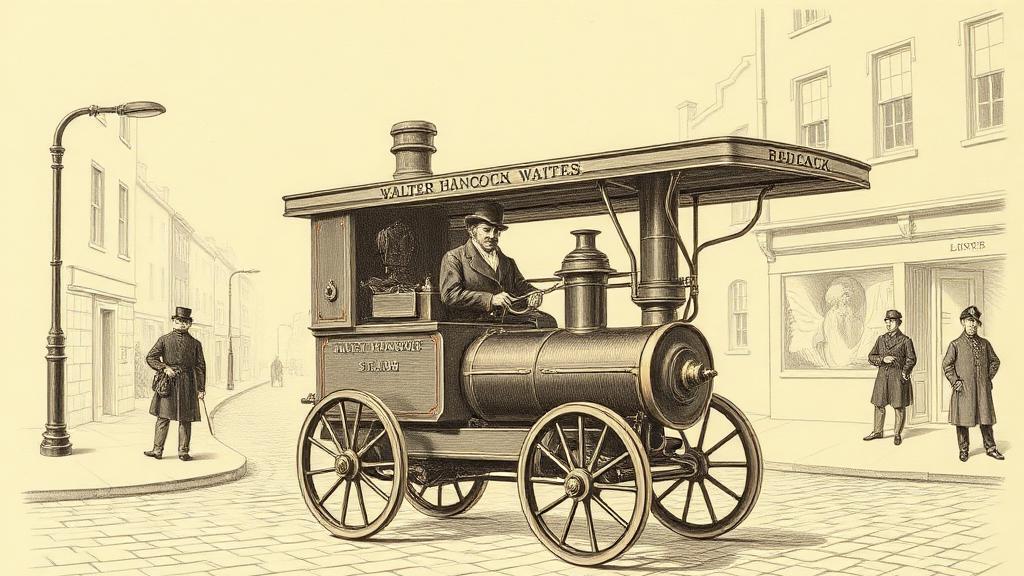
Hancock's Enterprise: London's first scheduled motor bus
On the morning of 22 April 1833, a fourteen-seat vehicle rolled out of London Wall, turned west, and set off for Paddington with a full complement of passengers. There was no horse. The motive power was a pressurized boiler firing on coke, driving a chain to the rear axle. The driver steered with a horizontal wheel. The timetable was printed and sold. Walter Hancock’s Enterprise had just inaugurated what the London and Paddington Steam Carriage Company advertised as a regular public service.
Hancock was born in 1799 in Marlborough, Wiltshire, the son of a cabinet-maker, and trained as a watchmaker and jeweller in London. The precision trades gave him habits that separated him from most steam engineers of the day: he thought small, light, and tight-fitting, at a time when steam meant massive iron castings and engineering by brute force. He began experimenting with steam vehicles in Stratford, Essex in 1824, and by 1831 his first machine, the Infant, was running a paid service between Stratford and the City — the first time a self-propelled vehicle had plied for hire on a common road, by Hancock’s own account.
The Enterprise was the commercial refinement. It ran between London Wall and Paddington via Islington, nine miles through the middle of one of the densest cities on earth. Hancock’s boiler was a safety design — thin-walled chambers engineered to vent rather than explode, running at roughly 150 psi, fueled by coke to avoid smoke complaints. The drivetrain used chain drive to a live rear axle, leaf springs front and rear, and a forced-air blower to improve combustion — every one a genuine novelty on a road vehicle. By 1836 his largest vehicle, the Automaton, had completed more than 700 journeys, and the fleet had collectively carried over 12,000 passengers across 4,200 miles of London streets without a fatal accident.
The technology worked. On a frozen day in the course of normal service, Hancock’s carriages climbed an icy gradient on which horses were slipping and failing; the machine simply drove up. The obstacle was financial. A horse-drawn coach on most turnpike roads paid four shillings in tolls. Hancock’s steam carriage was charged forty-eight — twelve times as much, for the same road. The turnpike trusts were run in large part by coaching interests and landowners who had obvious reasons to keep steam road travel commercially unviable. The Enterprise did not fail because it stopped working. It failed because the road was legally priced against it.
By 1840 every steam road carriage service in Britain had folded. Hancock was declared bankrupt in 1844. The Locomotives Acts of 1861 and 1865 finished the job legally, reducing any road vehicle to four miles per hour and requiring a man with a red flag to walk ahead — measures apparently designed to make the technology impossible rather than merely expensive. British road vehicle development then stagnated for thirty years, while engineering talent poured onto railways.
The next scheduled motor bus service in London would begin in 1902, sixty-nine years after the Enterprise, using a petrol engine with a chain drive to a rear axle and leaf-spring suspension. Hancock had solved most of that problem in 1833.
Sources
- Walter Hancock — Wikipedia — vehicle chronology, fleet summary, toll disparity, passenger totals.
- Walter Hancock — Dictionary of National Biography (1885–1900), Wikisource — primary-source biographical detail, service records, first-for-hire claim, bankruptcy.
- The Enterprise Steam Omnibus — London Museum collection record — confirmed start date 22 April 1833 and route detail.