The Menai Suspension Bridge, or how Telford hung a road from iron chains
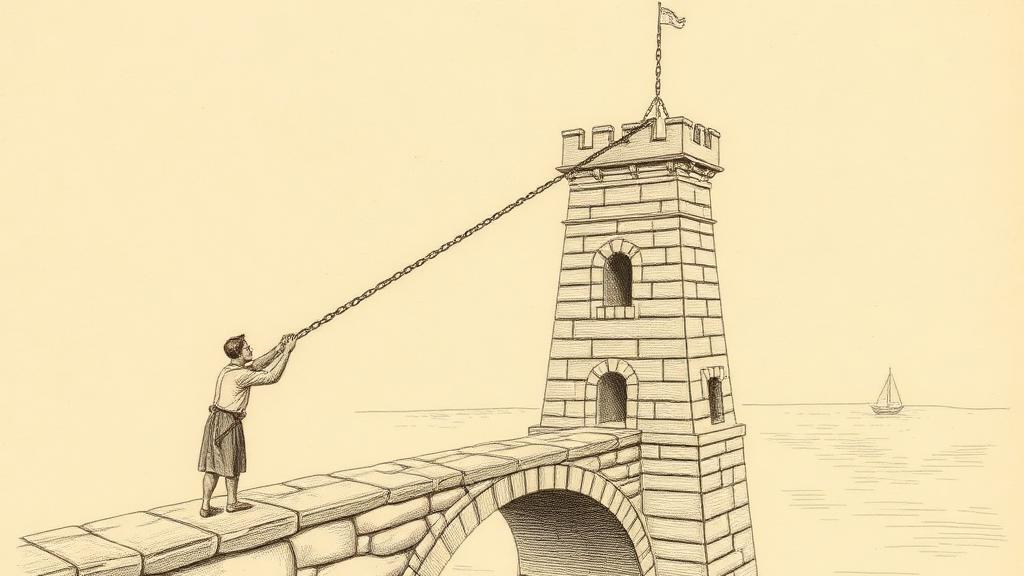
In 1825, a raft carrying 23.5 tons of wrought-iron chain was floated across the Menai Strait between Anglesey and the Welsh mainland. When it reached the midpoint, 150 men took hold of blocks and tackles and began to haul. A fife-and-drum band played to keep the rhythm, because the pull needed to stay synchronised or the chain would slip. The chain rose. The central span of Thomas Telford’s Menai Suspension Bridge became a physical fact rather than a drawing on paper.
The bridge had been nine years in the making. In 1815, Parliament passed the Holyhead Roads Act to improve communications with Dublin after the 1800 Act of Union — the most direct route ran through Holyhead, at the far end of Anglesey, which meant crossing the Menai Strait. The strait’s tidal currents were fast and treacherous. Ferries had served the crossing for centuries, but capsizes and groundings were common; the waters claimed lives with casual indifference. Telford surveyed the route and concluded a bridge was the only reliable answer.
He proposed a suspension bridge — a form used at the time for light footbridges and one modest vehicular crossing on the River Tweed. The Menai Strait demanded a main span of 579 feet, the longest iron-chain span ever attempted. The deck also had to clear the water by 100 feet so the Royal Navy’s sailing vessels could continue using the seaway. Parliament authorised construction in 1819.
The chains were manufactured by William Hazledine at his forge near Shrewsbury, each link tested individually before being carted overland to Wales. Sixteen chains of wrought iron, each composed of five parallel bars linked end to end, made up roughly 2,000 tons of metal in total. The final central sections were floated out on rafts and hauled into position by the 150 men on the bank.
The bridge opened on 30 January 1826. The journey from London to Holyhead, previously 36 hours by coach, dropped to 27. The improvement was not only in time — the old ferries had made the crossing genuinely dangerous in bad weather. The bridge made it merely cold.
The deck’s weakness announced itself within a decade. Twenty-four feet wide with no stiffening trusses, it acted in a strong gale approximately like a sail. In January 1836, a storm drove oscillations of 16 feet peak to trough across the main span. Modifications followed — the deck was stiffened in 1840 and replaced with steel in 1893. The iron chains were swapped for steel ones in 1938, without closing the bridge for a single day. The engineering lesson — that a long, flexible deck in a windy location needs resistance to torsional forces — would take another century to become standard practice. Its most dramatic demonstration came at a narrow gorge in Washington State in November 1940.
What Telford proved at the Menai Strait was the central thesis of the suspension bridge: iron hung in catenary arcs between stone towers could carry a road across a span no arch could reach.
The towers are still Telford’s. Every suspension bridge since — the Brooklyn Bridge, the Golden Gate, the Humber, the Akashi Kaikyō — is working with the same geometry, scaled up and eventually strung from steel wire rather than iron bars.
Sources
- Menai Suspension Bridge — Wikipedia — construction dates, 579-foot main span, opening January 1826, deck modifications and chain replacement.
- Menai Suspension Bridge — ASCE Historic Landmarks — William Hazledine’s fabrication, engineering significance, influence on later suspension bridge design.
- Menai Suspension Bridge — Menai Heritage — ferry crossings and their dangers, the chain-raising episode with 150 men and a fife-and-drum band, 1836 gale oscillations.