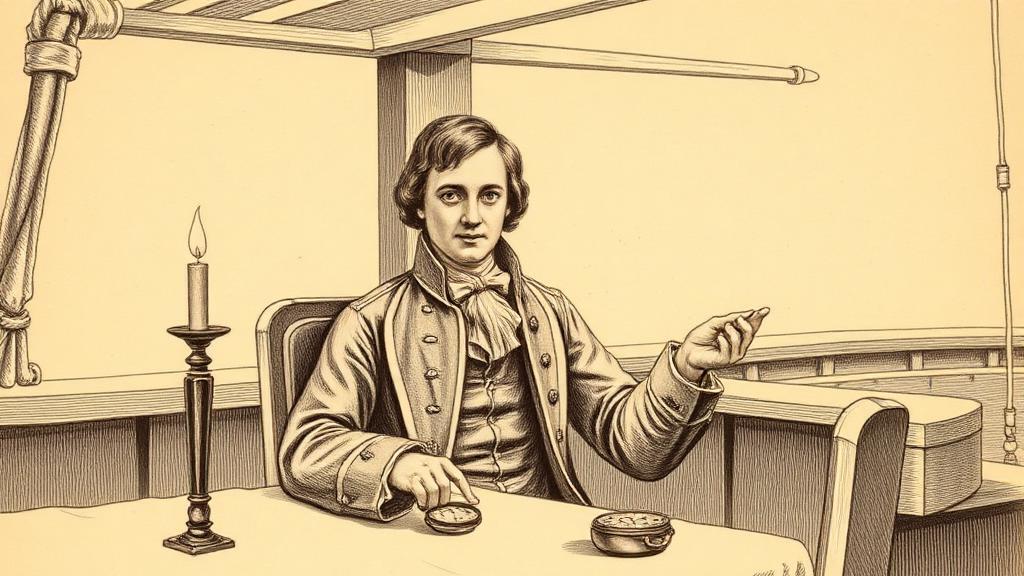
John Harrison's H4 and the Longitude Prize
On the night of 22 October 1707, four British warships ran onto the rocks of the Isles of Scilly off Cornwall’s southwest coast. Admiral Sir Cloudesley Shovell’s squadron had miscalculated its position by nearly 60 miles. Around 1,400 sailors drowned. The ships knew their latitude — that much was easy, just measure the sun’s angle at noon — but longitude required knowing the exact time at a fixed reference meridian, and at sea in 1707, nobody had a clock that could keep it.
Seven years later, Parliament passed the Longitude Act of 1714, offering prize money on a sliding scale: £10,000 for any method accurate to within one degree, and £20,000 — roughly £3.2 million in today’s money — for accuracy within half a degree, or about 30 nautical miles (Wikipedia). The Board of Longitude was established to judge entries. Astronomers, mathematicians, and clockmakers from across Europe began circling the problem.
Among them was John Harrison, a self-taught carpenter from Barrow, Lincolnshire, born in 1693 (Wikipedia). He had no formal education. He had built his first pendulum clock at twenty using lignum vitae — a wood so naturally oily it barely needs lubrication — and by the 1720s he was producing movements accurate to within a second a month. He believed the same precision could be coaxed into a portable machine that could survive Atlantic storms.
He was right, but it took him 34 years and four attempts to prove it. H1 (1735), H2, and H3 each advanced the art; none won the prize. In 1759 Harrison completed H4, and it looked nothing like its predecessors. Where H1 weighed 34 kilograms and stood like a piece of furniture, H4 fit in a coat pocket: a large silver watch, 13 centimetres across, with diamond pallets in its escapement and a balance wheel ticking five beats per second (Royal Museums Greenwich). It was an entirely different class of object.
The trial voyage fell to Harrison’s son William. On 18 November 1761, he boarded HMS Deptford at Portsmouth with the watch secured in a padded box. After 81 days at sea — rolling swells, salt air, temperature swings — the ship arrived in Kingston, Jamaica on 19 January 1762. H4 was 5.1 seconds slow. That corresponds to 1.25 minutes of longitude, well inside the half-degree required for the full £20,000 (Wikipedia). Partway through the crossing, William predicted the ship would sight Madeira earlier than the navigator expected. He was right. The captain was impressed.
The Board of Longitude was not. Nevil Maskelyne, appointed Astronomer Royal in 1765, had his own competing method — lunar distance tables, which let navigators calculate Greenwich time by measuring the moon’s position against known stars. He declared the Jamaica result a fluke and demanded further trials. He was not a disinterested judge. He conducted a 10-month test of H4 at the Royal Observatory in Greenwich; the results disappointed, and Harrison challenged them publicly. Parliament eventually stepped in. Between incremental payments and a direct act in 1773, Harrison received a total of £23,065. He was 80 years old.
The argument about whether he was adequately compensated never quite settled. The argument about whether his method worked was over. Within decades, every British naval vessel carried a marine chronometer. The age of sailors dead-reckoning their longitude — and dying for the guess — had ended.
The problem that wrecked Sir Cloudesley Shovell’s ships was not ignorance but the absence of a reliable clock. Harrison built the clock. Time, as it turned out, was the missing half of the map.
Sources
- Longitude found — the story of Harrison’s timekeepers, Royal Museums Greenwich — H4 physical description, Harrison’s background, trial voyage details.
- Longitude prize — Wikipedia — prize amounts and accuracy tiers, the 1707 Scilly disaster as motivation, establishment of the Board of Longitude.
- John Harrison — Wikipedia — Harrison’s biography, H4 technical specifications, Jamaica trial results, prize money timeline.