The Cassini survey: four generations to map a kingdom
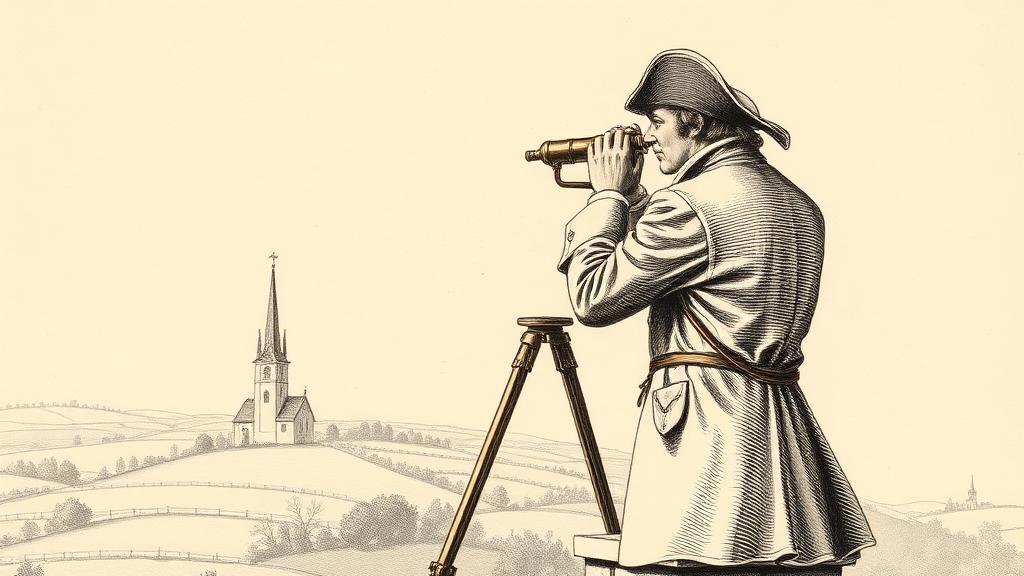
On a clear morning sometime around 1750, a surveyor climbed to the top of a church belfry somewhere in the Île-de-France, trained a theodolite on a distant steeple, and wrote an angle in a field notebook. He then descended, rode a few leagues to the next station, and did it again. Across every province of France, teams were doing this — measuring triangles between church towers, windmills, and hilltops, knitting the kingdom together one angle at a time.
The man responsible was César-François Cassini de Thury — Cassini III — the third in a dynasty of French astronomers that had begun when his Italian grandfather Giovanni Domenico arrived in Paris in 1669 to found the Observatory. In 1747, Louis XV commissioned Cassini III to do what no country had yet done: map France in its entirety by triangulation, not by pasting together regional sketches or estimating distances from travel time, but by measuring the whole kingdom from a single verified baseline and calculating everything else from angles (Wikipedia).
The method traced back to Gemma Frisius in the 1530s — measure one baseline precisely, then let trigonometry do the rest — but applying it at national scale was a logistical project of a different order. Cassini’s teams established 800 principal triangulation stations, each one a church steeple, a fortress tower, or a farmhouse rooftop, and built a network of interlocking triangles across every province. At 1:86,400 scale, the finished map would require 182 engraved sheets, assembled into a wall map roughly twelve metres square. The first sheet came off the press in 1756 (MacTutor).
Money nearly killed it. Louis XV’s treasury backed the first phase, but by the late 1750s the coffers dried up. Cassini III responded with a solution that feels more Enlightenment venture capital than ancien régime: he incorporated a shareholder company. Fifty-two private investors subscribed to the Société de la Carte de France, each buying a stake in the completed map. Provincial authorities funded their own sheets. The final bill exceeded 800,000 livres (New York Public Library).
The Revolution resolved the question of ownership permanently, if brutally. In 1793, the Committee of Public Safety requisitioned the project — copper plates, paper stocks, field notebooks, everything — and moved it to the War Depot. The map was national property now. Cassini IV, who had inherited the directorship, was imprisoned during the Terror. Freed eventually, he spent his later years comparing himself to a painter stripped of his canvas. He was not wrong, but the map was finished: 182 plates, engraved and published.
The precision still astonishes. When modern satellite imagery is overlaid on the Cassini plates, roads, forest edges, and field boundaries align with unsettling accuracy — the product of theodolites and field notebooks before the United States existed as a country. The survey had taken four generations of one family, cost 800,000 livres, survived a royal funding crisis, and been seized by a revolution. None of this made the triangulation wrong.
The British Ordnance Survey, founded in 1791, took the Cassini model — triangulation, institutional structure, national scope — and applied it to Britain. The United States Coast Survey followed in 1807. What had started as a French royal commission became the template for how modern states understand their own borders and roads and rivers.
They had measured a country. Every country that came after measured itself the same way.
Sources
- Cassini map — Wikipedia — timeline, 182-sheet structure, scale, triangulation network.
- Revolutionary Cartography and the Cassini Map of France — New York Public Library — Société shareholders, Revolutionary requisition, Cassini IV’s imprisonment.
- César-François Cassini de Thury — MacTutor History of Mathematics — Cassini III biography, triangulation methods, 1747 commission.