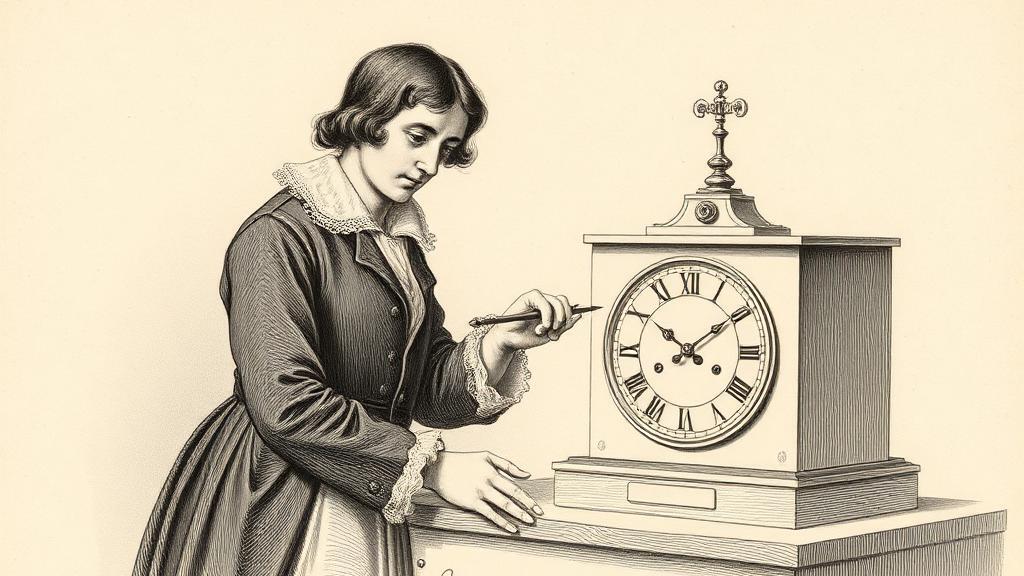
Huygens's pendulum clock: fifteen minutes become fifteen seconds
On Christmas Day 1656, in The Hague, Christiaan Huygens set the first pendulum clock ticking. He hadn’t built it himself — he was twenty-seven, a mathematician by training, with no craftsman’s hands — but the mechanism was entirely his. The best clockmakers in Europe were producing instruments that lost roughly fifteen minutes a day; Huygens’s lost fifteen seconds (Wikipedia).
The insight he was working with was already half a century old. Galileo, watching a suspended bronze lamp swing from the ceiling of the Pisa Cathedral around 1602, had noticed that a pendulum’s period stays roughly constant regardless of the arc width — a property called isochronism (History of Information). Galileo had sketched a pendulum clock near the end of his life but never built a working one. Huygens rederived the mathematics independently, completed the design, and handed the drawings to a Dutch clockmaker named Salomon Coster. He patented the device on June 16, 1657, and described it the following year in a short book called Horologium.
What made it so much better than any clock that came before was physics, not craftsmanship. The verge-and-foliot escapements that had governed mechanical clocks since the thirteenth century were erratic things: the foliot swung freely, at the mercy of mainspring tension and bearing friction. A pendulum swings at a rate determined by its length and gravity, and it doesn’t much care how hard the mechanism pushes it. Huygens went further still: he proved that a pendulum constrained to a cycloidal arc is perfectly isochronous, its period fixed regardless of amplitude, and he shaped curved metal cheeks at the pivot to enforce exactly this path (Wikipedia).
Always thinking of the longitude problem, Huygens arranged for sea trials in 1664. The expedition commander was Major Robert Holmes — a man Samuel Pepys privately described as “an idle, proud, conceited, though stout fellow” — and in January 1665 Holmes filed a triumphant report: the clocks had guided his ship to within thirty leagues of the island of Fuego. Huygens, reading the account, grew suspicious. He wrote to his Royal Society contact Sir Robert Moray: “I am amazed that the clocks were sufficiently accurate to allow him to find such a tiny island.” He was right to be. When investigators compared the logs of Holmes’s other captains, his reported positions were off by eighty to a hundred and twenty leagues; the island he had “found” was St. Vincent, thirty leagues from Fuego; and dead reckoning had been just as accurate as the clocks (OpenLearn). Holmes had concealed, in Robert Hooke’s verdict, “all their failures and miscarriages.” Huygens published the triumphant account in his 1673 treatise Horologium Oscillatorium anyway.
The sea defeated him. On a pitching hull, a pendulum becomes unreliable in exactly the way that makes it reliable on land — its regularity depends on stillness. What pendulum clocks could do on solid ground, they did with authority: observatories used them to time stellar transits to within seconds, correcting the navigational tables that ships relied on. Royal Observatory Greenwich, founded in 1675, ran its timekeeping on pendulums, as did every major national time-signal service for the next two and a half centuries.
It would take another century and a different kind of mechanism to beat the sea. But the number that solution had to surpass was the number Huygens had put on the table in 1657: fifteen seconds a day.
Sources
- Pendulum clock — Wikipedia — Huygens’s 1656–57 invention, Salomon Coster’s construction, accuracy improvement from 15 minutes to 15 seconds per day, the cycloidal isochronism proof and cheek design.
- Never trust a pirate: Christiaan Huygens’s Longitude Clocks — OpenLearn / Open University — the 1664–65 sea trials with Major Robert Holmes, Samuel Pepys’s description, the log discrepancies, Hooke’s verdict on the cover-up.
- Huygens Invents the Pendulum Clock — History of Information — Galileo’s 1602 isochronism observation, patent date June 16 1657, Horologium 1658.