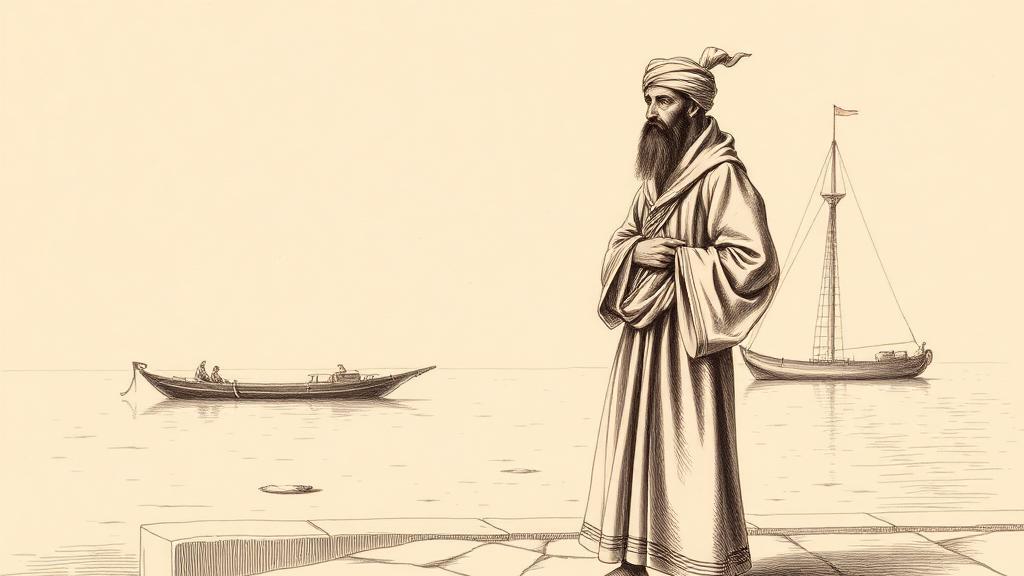
Seven beans and a long walk from Mocha
The port of Mocha, on the western tip of Yemen, was in 1670 the only gate through which coffee left Arabia — and the Yemenis were deliberate about what could pass through it. Raw green beans were not among the permitted exports. Coffee left Mocha roasted or scalded to a state that prevented germination; the mechanics of the monopoly were botanical as much as political. Any merchant caught trying to move viable seed faced execution. The trade had held on those terms for nearly two centuries. Then a Sufi pilgrim named Baba Budan tucked seven green beans against his body and walked onto a ship.
The exact method of concealment varies by who is telling the story. His beard, say some accounts. His hollowed walking stick, say others. The most consistent version binds the beans in cloth at his waist. Whatever the hiding place, the number was deliberate: seven is the sacred number in Islam, and Baba Budan was a saint from the hill country of Karnataka, not a professional smuggler. He had first encountered coffee during the Hajj — in the coffeehouses of Aden and along the Arabian coast — and decided that his home region, in what was then the Kingdom of Mysore, should grow it. He took seven. Seven was enough to make the case.
On the slopes of the Chandradrona hills outside Chikkamagalur, he planted all of them. The red laterite soil held moisture from the monsoon. The altitude softened the heat. The plants took. Those hills are now called the Baba Budangiri — the Baba Budan Hills — and they remain the geographic center of India’s oldest coffee district. His tomb sits there as well, a small dargah visited equally by Hindu and Muslim pilgrims. At some point in the centuries since, the Sufi saint became identified with the Hindu sage Dattatreya — a piece of syncretic logic that the shrine’s visitors seem to have resolved by simply continuing to visit. There is a lesson in there somewhere.
Yemen’s monopoly had always rested on a single botanical fact: a scalded bean cannot germinate. For roughly two hundred years no viable coffee plant had left the Arabian Peninsula. Baba Budan’s seven seeds broke the premise. Within a few decades the Dutch East India Company had obtained cuttings from plants already growing in India — there is a traceable chain from the Chandradrona hillside to the VOC plantation on Java in 1696. From Java a tree traveled to the Hortus Botanicus in Amsterdam. From Amsterdam one was sent to the Paris Jardin des Plantes. From Paris, Gabriel de Clieu sailed to Martinique in 1720 with a single seedling, the direct ancestor of nearly every coffee tree in the Western Hemisphere.
The seven beans that left Mocha hidden in a saint’s clothing grew into Brazil.
Sources
- Baba Budan — Wikipedia — identity, estimated timeline c. 1670, planting site in Chikkamagalur, the seven-bean legend and its variants, link to Dutch East India Company propagation.
- Josuma Coffee Company — History of Indian Coffee — Yemen’s export controls (scalded beans), method of concealment, chain of propagation from India to Java, Amsterdam, Paris, and Martinique.