The IBM PC: the standard nobody planned
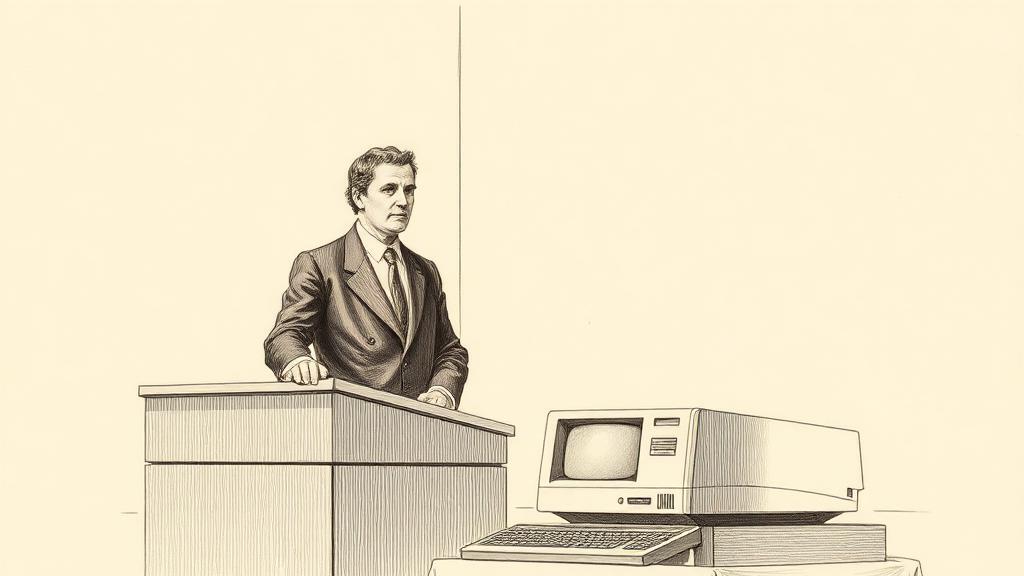
On the morning of August 12, 1981, a group of journalists gathered in the ballroom of the Waldorf Astoria in Midtown Manhattan and watched a man named Don Estridge step to a podium to introduce a beige box. The box had 16 kilobytes of RAM, no hard drive, and a keyboard that reviewers would later describe as the best thing about it. The price was $1,565. Within eighteen months, IBM could not build them fast enough.
The machine — formally the IBM 5150, informally “the IBM PC” — had been assembled in extraordinary secrecy at IBM’s facility in Boca Raton, Florida, by a skunkworks team of roughly 150 engineers working under a codename: Project Chess. The project began in 1980, when William Lowe, director of IBM’s General Systems Division, pitched CEO Frank Cary on building an affordable personal computer. Cary’s response was characteristically blunt: prototype in one month, product on shelves in a year, retail price under $1,500. Lowe missed the prototype deadline, got promoted anyway, and handed the project to Estridge — who somehow met the rest of it.
To hit that timeline, the team had to abandon nearly every rule IBM had. Rather than designing proprietary silicon, they sourced off-the-shelf parts: an Intel 8088 microprocessor running at 4.77 MHz, standard 5.25-inch floppy drives, an ordinary power supply. The motherboard design was finished in forty days. And then the decision that would define the decade: they published the machine’s complete technical specifications and invited third parties to build for it. Software houses, peripheral makers, expansion-card manufacturers — anyone could write for the IBM PC. The machine arrived with an open architecture not because Estridge was a philosopher, but because the schedule demanded it.
The operating system arrived through a deal that has since become computing folklore. IBM needed an OS and approached Microsoft, which was then a small Bellevue, Washington company best known for BASIC interpreters. Microsoft did not, at that moment, own an operating system. Rather than turn IBM away, Gates’s team quietly purchased the rights to a system called 86-DOS — known informally as QDOS, for “Quick and Dirty Operating System” — from programmer Tim Paterson at Seattle Computer Products, for around $75,000. They renamed it PC-DOS for IBM, licensed it for a flat fee, and kept the right to resell the same code to other manufacturers under the name MS-DOS. That retained right would eventually be worth more than anything else Bill Gates ever negotiated.
IBM marketed the 5150 with a campaign featuring Charlie Chaplin’s Little Tramp — an odd mascot for a business machine, chosen to make the PC approachable to buyers who had never touched a computer. The gambit worked. Time magazine named it its “Machine of the Year” for 1982, the first non-human to receive the distinction. By 1983, more than 750,000 units had shipped, well past any internal projection.
What the 5150 actually set loose was not a product but a template. Because IBM had published its specifications and built from commodity parts, rival manufacturers could clone the machine legally — and did, within months. Compaq, Columbia Data Products, Eagle Computer: dozens of companies built IBM-compatible PCs, and the phrase “IBM-compatible” became synonymous with personal computer itself. IBM had intended to sell a machine; it ended up ratifying an architecture that everyone else would manufacture.
The company exited the PC business entirely in 2005, selling its ThinkPad line to Lenovo. The architecture that Estridge’s team sketched out in a Florida office in forty days continues, unbroken, in every x86 machine running today.
Sources
- IBM Personal Computer — Wikipedia — development timeline, Project Chess, hardware specifications, OS licensing history, market figures, and clone ecosystem.
- The IBM PC — IBM History — Don Estridge’s leadership, the Waldorf Astoria announcement, the Charlie Chaplin ad campaign, and Time Machine of the Year.
- Computer History Museum — August 12, IBM Introduces the Personal Computer — launch context, Intel 8088 selection, and market impact.