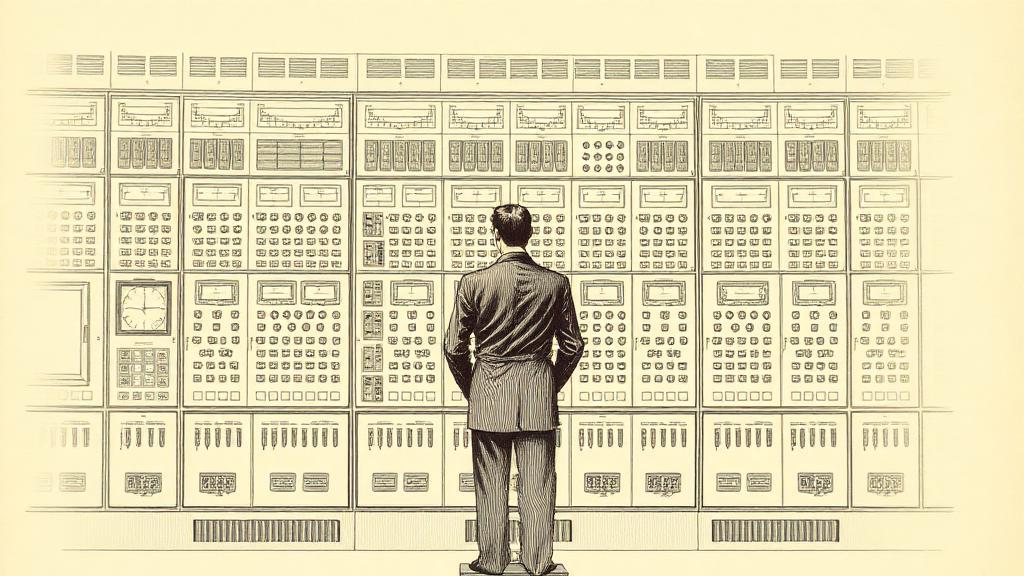
The IBM System/360, or how IBM sold a computer it hadn't finished building
On the morning of April 7, 1964, IBM organized simultaneous announcements in 165 American cities — 100,000 people gathered in hotel ballrooms from Boston to Los Angeles while a special press train carried reporters north to Poughkeepsie, New York, to watch Thomas J. Watson Jr. unveil what he called “the most important product announcement in the company’s history.” Several of the machines on the stage that morning were made of wood.
By 1961, IBM operated seven separate, mutually incompatible product lines. A customer who outgrew an IBM 1401 mainframe faced three equally grim options: rewrite all their software for a larger IBM machine, start over with a competitor’s hardware, or simply buy more 1401s and duplicate every technician to go with them. IBM’s internal solution came from a task force called SPREAD — Systems Programming, Research, Engineering, and Development — which in December 1961 recommended scrapping all seven lines and replacing them with a single compatible family.
The System/360 was the result. Named because it was intended to address 360 degrees of the market — small to enormous — it offered six processor models spanning a fifty-fold performance range, forty-four peripheral devices, and a single software architecture: code written for the smallest 360 ran identically on the largest. A standard hardware interface let third-party manufacturers build compatible disk drives and printers, often undercutting IBM on price. IBM spent $5 billion on development — roughly twice its 1962 annual revenue.
The wooden models on the announcement stage were not the strangest part. The OS/360 operating system, meant to run across all models, was in what engineers delicately called “disarray.” When managers tried to fix the schedule by adding 1,000 programmers, the cost exceeded the entire hardware budget and the software arrived later anyway. Watson would later confess to being “in a nearly continuous panic from 1964 to 1966.” Frederick Brooks, who led the OS effort, turned the experience into a book: The Mythical Man-Month, published in 1975, still assigned in software engineering courses today.
None of it slowed orders. Customers booked more than 100,000 systems in the first month after announcement — at a time when fewer than 20,000 computers of any kind existed worldwide. IBM’s revenue climbed from $3.2 billion in 1964 to $8.2 billion by 1971. And the architecture proved remarkably durable: software written for a System/360 in 1964 runs without modification on IBM’s current Z-series mainframes today.
The 360 established a premise that now feels like furniture: a computer is not a single machine but an architecture — a set of rules any conforming hardware can implement, freeing software from hardware’s upgrade cycle. Every subsequent assumption about enterprise computing — buy small and scale up, write once and port nowhere — traces back to that morning in 165 hotel ballrooms and one very useful prop department.
Sources
- IBM System/360 — Computer History Museum — announcement details, 165 cities, product lineup, architecture, and lasting significance.
- Building the System/360 Mainframe Nearly Destroyed IBM — IEEE Spectrum — development costs, internal conflicts, wooden mockups, OS/360 crisis, Watson’s account, revenue figures.