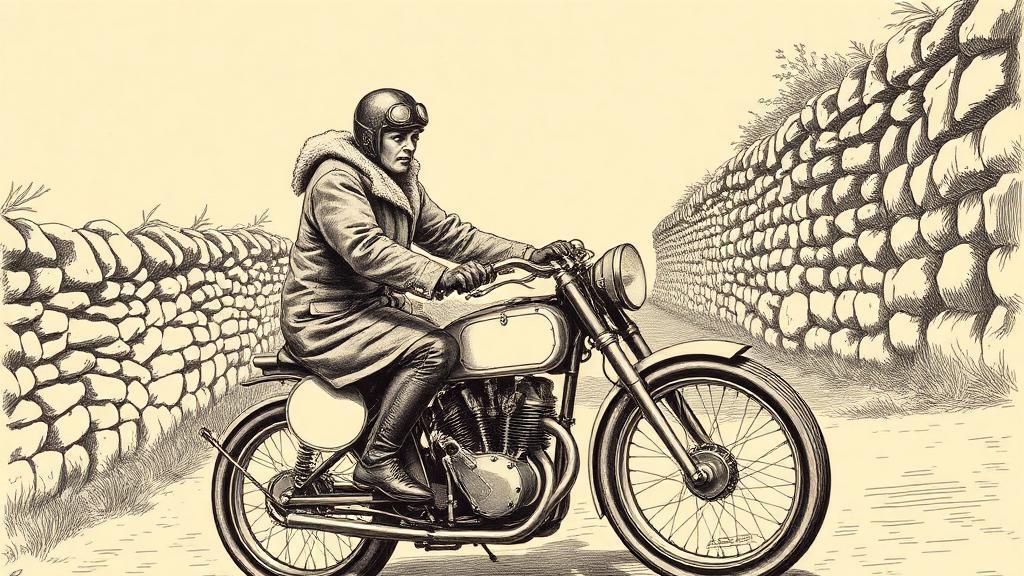
Isle of Man TT 1907: the race that Britain couldn't hold
On 28 May 1907, twenty-five motorcyclists left a start line near St John’s village in pairs, pointed their machines toward Peel, and set off into ten laps of a public road. They were racing. In Britain, that was the problem — back home, racing on public roads had been illegal for decades, and Parliament had no interest in changing it.
The motorcycle community had been watching the automobile clubs’ solution. Shut out of the mainland by the Motor Car Act 1903, which raised the speed limit to 20 mph but left the racing prohibition intact, car organisers had found that the Isle of Man, a Crown dependency with its own legislature, had passed the Highways (Light Locomotive) Act 1904, permitting closed-road racing. Motor-car races had run there since 1905. The motorcyclists took note.
At the Auto-Cycle Club’s annual dinner in London on 17 January 1907, the editor of The Motor Cycle proposed a motorcycle race on the island. A train journey home settled the details: club secretary Freddie Straight, the Collier brothers of Matchless, and the Marquis de Mouzilly St. Mars sketched out the format on the ride back from the dinner. By May they had a course, rules, and a trophy — the Marquis donated it himself: a silver Hermes by Giovanni da Bologna, astride a winged wheel.
The St John’s Short Course measured 15 miles and 1,470 yards per lap, with farm gates at field boundaries that competitors were responsible for opening and closing themselves. Each machine had to carry an exhaust silencer, saddle, pedals, and mudguards, and maintain 90 miles per gallon for single-cylinders or 75 mpg for twins — tourist motorcycles, not racing machines. Ten laps, 158 miles total, one compulsory ten-minute fuel stop. Two classes: single-cylinder and twin-cylinder.
Charlie Collier, riding his family’s own Matchless-JAP, won the single-cylinder class in 4 hours, 8 minutes, and 8 seconds — 38.21 mph average — and collected the Marquis’s trophy, £25, and a special prize for best British-built machine.
Rem Fowler’s race, in the twin-cylinder class, was considerably less smooth. The 25-year-old Birmingham toolmaker was riding a Norton powered by a 5 hp Peugeot engine. Fowler spent ten laps nursing it through failing spark plugs and snapping drive belts. On lap seven, a tyre burst near the Devil’s Elbow at close to 60 mph, and Fowler and the bike went down together. He picked himself up, decided he was finished, and learned from a spectator that he was still thirty minutes ahead of the next man in his class. He got back on. He finished at 36.21 mph. In another corner of the pit area, Oliver Godfrey’s Rex caught fire during the compulsory stop and didn’t.
The race established something every manufacturer immediately understood: win the TT, sell more motorcycles. The format moved to the Snaefell Mountain Course in 1911 and never left — the same roads, the same walls, the same principle.
Rem Fowler came back in 1957 for the TT’s Golden Jubilee and received a gold medal at seventy-five. He died in 1963. The road near the Devil’s Elbow is still there, still public, and still closed every May so riders can take it at speeds he could not have imagined.
Sources
- 1907 Isle of Man TT — Wikipedia — race results, course measurements, class rules, entry requirements, and trophy details.
- Rem Fowler — Wikipedia — Fowler’s background as a Birmingham toolmaker, the tyre burst at the Devil’s Elbow, the 1957 Golden Jubilee gold medal.
- Freeze Frame: The first Isle of Man TT — Hagerty UK — race conditions, the mandatory fuel stop, Godfrey’s fire.
- History — Isle of Man TT official site — fuel economy requirements, farm gates on the course, transition to the Snaefell Mountain Course in 1911.