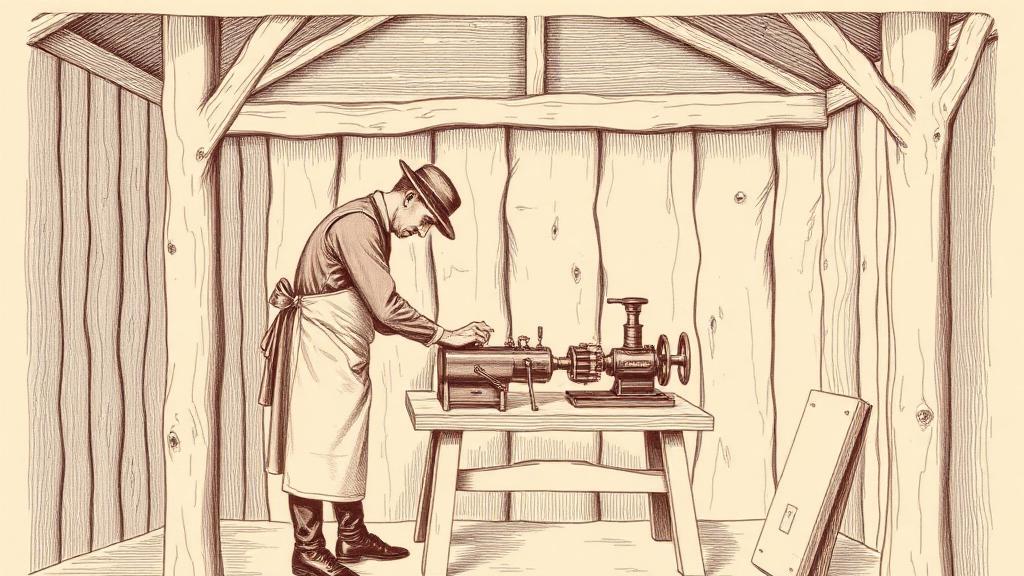
Harley-Davidson and the ten-by-fifteen shed
In the summer of 1901, William Harley and Arthur Davidson pushed a motorized bicycle up a hill in Milwaukee. They had spent two years on the machine — a 116 cc single-cylinder engine slotted into a modified bicycle frame — and on anything resembling a gradient, it made them walk. They called it a valuable learning experience and went home to the ten-by-fifteen-foot shed in the Davidson backyard.
Harley was twenty years old and worked as a draftsman at a Milwaukee bicycle parts supplier. Davidson was his closest friend, a skilled pattern maker. Over the next two years, they rebuilt the engine from the ground up: a larger single-cylinder displacing roughly 24 cubic inches (about 405 cc), with a nine-and-three-quarter-inch flywheel weighing twenty-eight pounds — heavy enough to smooth the power strokes that had made the first attempt so feeble. It sat in a purpose-designed loop frame, lowering the center of gravity and giving the machine real roadholding. The first sale went to Henry Meyer, a friend of the family, who paid $200 (Wikipedia).
Arthur’s brothers joined as the operation grew. Walter Davidson, a railroad machinist, contributed precision metalworking. William A. Davidson, a tool-room foreman, managed the factory floor. The four of them incorporated formally as the Harley-Davidson Motor Company on September 17, 1907, by which point production had reached 150 machines a year and the company had moved into a factory on Chestnut Street — later renamed Juneau Avenue, where the headquarters stands today.
The clearest window into what made the company different is a race result from 1908. Walter Davidson — by then president of his own firm — entered the Federation of American Motorcyclists’ national endurance contest in New York’s Catskill Mountains. The route covered 365 miles of unpaved road. Riders were docked points for mechanical stops, fuel overruns, and outside assistance. Walter finished with a perfect score of 1,000 out of 1,000 points — the only rider to achieve the maximum. On the return leg he set a fuel-economy record: 188.234 miles per gallon. The company president, riding his own product, in public, with no safety net.
The early machines earned a nickname the company quietly cultivated: the Silent Gray Fellow. The gray was the factory paint. The silence came from an unusually effective muffler. The point was image: a Harley-Davidson was a reliable machine for serious riders, not a contraption for daredevils. That positioning widened the customer base and outlasted most of the company’s early competitors, who built noisier, less reliable machines and went broke proving it.
Production numbers tell the rest of the story. Three motorcycles in 1904. Fifty in 1906. One thousand one hundred and forty-nine in 1909. By 1913, Harley-Davidson was the largest motorcycle manufacturer in the world, with dealers across North America, Europe, and Asia. The ten-by-fifteen shed still stands on the Juneau Avenue campus, preserved. In 1903, it was the entire company. By 1913, it was the rounding error.
Sources
- Harley-Davidson — Early History — founding timeline, incorporation date September 17 1907, Chestnut Street factory, production figures.
- Wikipedia — Harley-Davidson — founder backgrounds, first motorcycle specifications, $200 first sale price.
- Harley-Davidson Museum via Google Arts & Culture — The Founders — Walter Davidson’s 1908 endurance contest perfect score and fuel-economy record.